

TreeTake Network
International public funding for climate resilience remains severely inadequate to protect developing nations against accelerating environmental risks as planetary warming heads past 1.5°C. On November 26, 2026, the United Nations Environment Programme released its definitive annual assessment, confirming that the adaptation finance gap has widened sharply despite small localised increases. The comprehensive research reveals that vulnerable communities currently receive a mere fraction of the resources needed to establish functional defences against severe droughts, rising sea levels, and catastrophic storms.
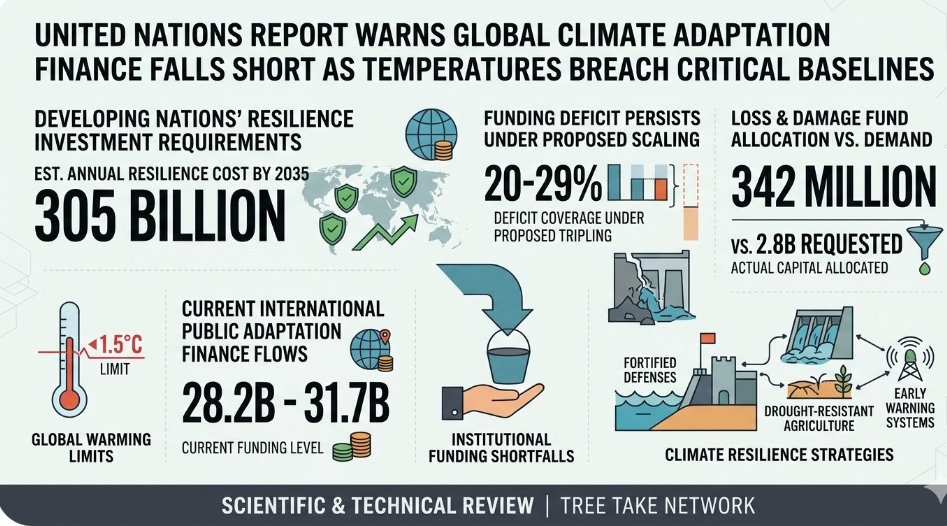
The international public adaptation finance flows from developed countries to developing nations reached 28.2 billion to 31.7 billion US dollars in 2024, marking an increase of only one billion US dollars over the previous tracking period. This current funding level remains entirely detached from actual requirements, as developing territories will demand an estimated 305 billion US dollars annually by 2035 to achieve basic climate resilience. Even if multilateral organisations successfully fulfil the ambitious global aspiration to triple public finance flows by 2035, the resulting capital would cover only 20 to 29 per cent of the global deficit.
The economic and human toll of adaptation delays is already generating historic loss and damage requests that far outstrip current institutional capacities. During its initial operational cycle, the centralised Fund for responding to Loss and Damage received formal financing requests valued at 2.8 billion US dollars. However, the actual capital allocated within the initial funding envelope amounted to just 342 million US dollars, leaving massive infrastructural and ecological rehabilitation programmes completely unfinanced.
"Adaptation is about protecting people from the climate crisis today, but the latest data exposes a staggering, wealth-degrading shortfall where developing nations receive just 10 cents for every dollar needed," stated United Nations Secretary-General António Guterres. Institutional specialists have emphasised that governments must urgently dismantle complex administrative procedures that restrict access to emergency funds. Global environmental directors are advocating the immediate deployment of multilayered disaster-risk insurance instruments and localised early-warning systems to protect vulnerable demographics.
Editor's Note The stark imbalance between adaptation requirements and international capital allocation underscores the immediate failure of passive climate funding structures. To avert catastrophic regional economic collapses, developed nations must move past voluntary pledges and legally institutionalise mandatory wealth-transfer mechanisms while aggressively scaling up private-sector climate resilience investments.



Leave a comment