

Talking Point
TreeTake Network
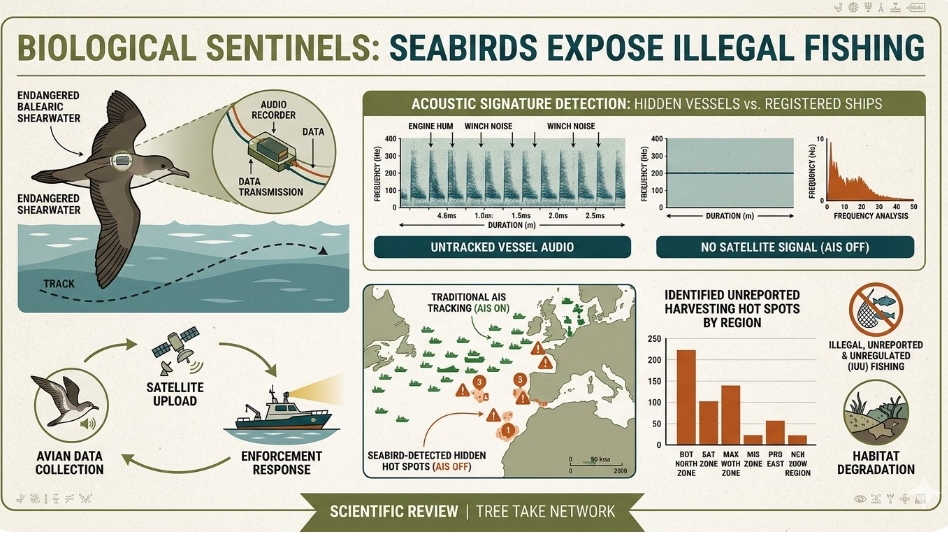
Conservation scientists have pioneered a revolutionary surveillance methodology by equipping pelagic seabirds with miniature acoustic recording devices to detect illicit fishing vessels operating outside international tracking frameworks. On November 26, 2026, a multidisciplinary research team published their definitive findings, demonstrating that wide-ranging marine birds can effectively act as biological sentinels across the open ocean. The investigation reveals that these animals routinely encounter and record the acoustic signatures of vessels that have deliberately deactivated their automatic identification systems to evade maritime authorities.
The field trials utilised advanced, ultra-lightweight bio-logging packages attached to northern gannets, critically endangered Balearic shearwaters, and vulnerable Westland petrels tracking across major oceanic foraging corridors. The specialised audio recorders successfully documented the distinctive, low-frequency thrum of marine diesel engines and operational winches in regions completely devoid of official satellite tracking signals. By cross-referencing the recorded audio timestamps with global maritime registries, researchers confirmed that up to 20 per cent of the vessels encountered by the birds were operating completely under the radar.
Unregulated and unreported fishing continues to cause severe ecological degradation by decimating vulnerable fish stocks, destroying benthic habitats, and causing high levels of accidental seabird bycatch through longline entanglement. Traditional aerial and satellite monitoring frameworks remain severely restricted by immense geographic scales and high operational deployment costs. This innovative avian-assisted monitoring network offers international conservation bodies an automated, highly cost-effective mechanism to map illegal fishing hot spots with unprecedented precision.
"Marine predators are exceptionally proficient at locating fishing vessels because they have evolved to exploit the discards from processing operations, making them the ultimate autonomous trackers for identifying hidden human activities at sea," stated Dr Samantha Patrick, a leading marine biologist who spearheaded the collaborative study. Environmental specialists have emphasised that the collected acoustic data can be seamlessly integrated into existing law enforcement matrices to optimise patrol vessel deployments. Maritime security agencies are currently reviewing the scalability of these bio-logging frameworks to fortify international infrastructure protection frameworks against wildlife trafficking and illegal harvesting.
Editor's Note Utilising foraging seabirds as decentralized acoustic monitoring hubs represents a transformative paradigm shift in global ocean governance and maritime surveillance. To translate these breakthrough scientific insights into practical enforcement, international authorities must rapidly establish unified legal frameworks that accept wildlife-derived acoustic telemetry as admissible evidence in maritime courts.



Leave a comment