

TreeTake Network
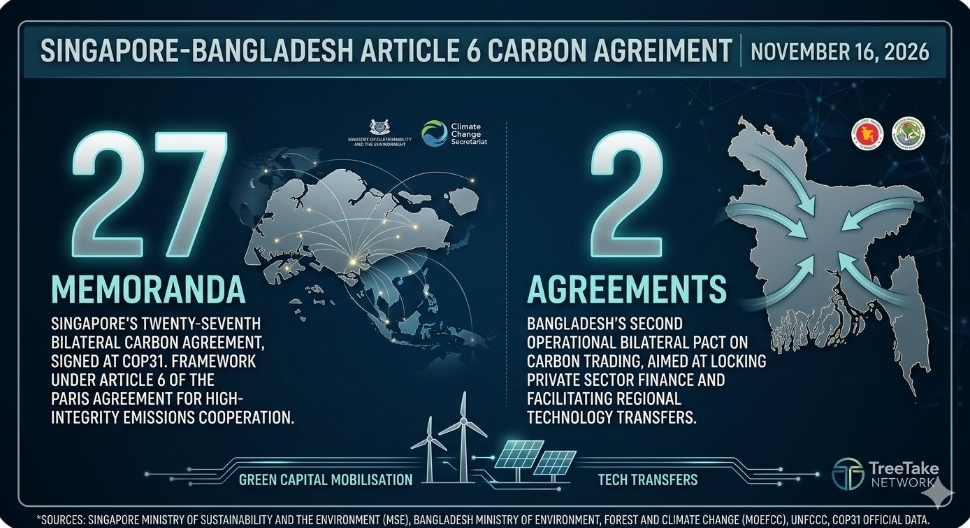
Bilateral climate diplomacy achieved a structural breakthrough at the 31st United Nations Climate Change Conference in Antalya, Türkiye, on November 16, 2026, as Singapore and Bangladesh signed a comprehensive Memorandum of Understanding to establish a cooperative framework under Article 6 of the Paris Agreement. The international pact, executed at the Singapore Pavilion on the sidelines of the intensifying ministerial negotiations, sets up a clear blueprint for the transfer of high-integrity carbon credits between the two Asian nations. This partnership marks a strategic development for both territories, serving as Singapore's 27th environmental agreement under the Article 6 framework and Bangladesh's second bilateral carbon trading pact. The arrangement is designed to unlock new channels of global climate finance while accelerating technical transfers required to execute deep greenhouse gas emission reductions.
Strategic integration of carbon financing and national climate targets
The newly executed document outlines a comprehensive pathway toward a legally binding implementation agreement that will govern the creation and verification of Internationally Transferred Mitigation Outcomes. The operational framework is explicitly designed to support Bangladesh in implementing its ambitious Nationally Determined Contributions under the updated climate plans, which require a significant reduction in industrial and agricultural emissions by the next decade. Under the bilateral system, international project developers will be able to initiate high-integrity mitigation projects within Bangladesh, generating carbon credits that Singapore can utilise to meet its domestic net-zero compliance trajectories.
"This partnership with Singapore represents a vital step forward for Bangladesh as we seek to transform our climate vulnerabilities into sustainable economic opportunities," stated State Minister for Environment, Forest and Climate Change Syeda Rizwana Hasan during the bilateral signing ceremony. "By aligning our national registry with Singapore's robust verification systems, we are establishing a transparent environment that will attract substantial international capital into our renewable energy sector. This is not merely an agreement on carbon accounting; it is a catalyst for technology transfer that will directly benefit our local communities on the front lines of climate change."
Singaporean representatives emphasised that the pact broadens the island nation's regional network of environmental alliances while maintaining the highest possible benchmarks for international carbon accounting.
"We are deeply committed to advancing high-integrity carbon markets that deliver real, measurable, and additional emission reductions," stated Permanent Secretary for Sustainability and the Environment Stanley Loh outside the Antalya Expo Centre. "This Memorandum of Understanding with Bangladesh underscores our shared belief that international cooperation is essential to solving the global climate crisis. By developing a structured framework for corresponding adjustments, we ensure that every credit traded between our nations represents a genuine contribution to global mitigation efforts while supporting sustainable regional development."
Technical alignment and operationalisation of transparent market rules
The technical parameters of the agreement require the establishment of an independent, joint regulatory committee tasked with verifying the additionality of all proposed carbon offset projects. This mechanism ensures that credits are only issued for environmental initiatives that would not have been financially viable without the injection of international carbon finance. Furthermore, the framework introduces a robust accounting ledger designed to prevent double-counting through immediate corresponding adjustments, ensuring that a single emission reduction is never claimed by both jurisdictions simultaneously. The pact also launches immediate knowledge-exchange programmes aimed at building local data registry infrastructures and enhancing the technical capabilities of environmental auditors within South Asia.
Editor's Note
The bilateral agreement between Singapore and Bangladesh exemplifies the growing operational reliance on Article 6 frameworks to link capital-surplus economies with climate-vulnerable nations through performance-based mitigation outcomes. The success of this initiative will hinge entirely on how rapidly both nations can transition from a preliminary understanding to a binding implementation treaty without succumbing to bureaucratic delays. By embedding strict rules against double-counting, the pact sets a commendable benchmark for transparency. Moving forward, the international community must closely monitor these markets to ensure that carbon revenues are directly channelled into genuine green infrastructure projects rather than merely serving as an administrative offsetting tool for industrial polluters.



Leave a comment