

TreeTake Network
A specialised field rescue team from the Save Wildlife and Nature organisation, in immediate coordination with the Bangladesh Forest Department, has successfully rescued two vulnerable fishing cat cubs (Prionailurus viverrinus) from the Kadipur union within the Kulaura upazila of Moulvibazar today, November 15, 2026. The juvenile felids, estimated by wildlife veterinarians to be roughly eight weeks old, were discovered by local agricultural labourers inside a dense sugarcane patch adjacent to a shrinking wetland interface. Fearing immediate retaliatory conflict from local villagers due to recent livestock losses, the field unit executed a rapid containment and extraction protocol to guarantee the safety of the rare mammals.
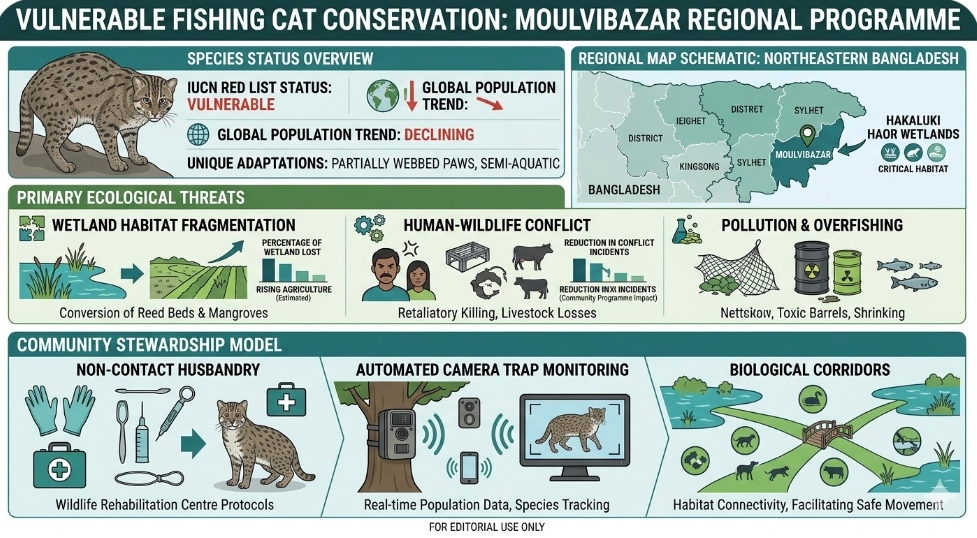
The fishing cat is globally classified as Vulnerable on the International Union for Conservation of Nature Red List and is strictly protected under Schedule 1 of the Bangladesh Wildlife Conservation and Security Act. The species faces critical demographic pressure across the Sylhet division due to the systematic conversion of freshwater marshes, reed beds, and mangrove pockets into commercial aquaculture ponds and residential settlements. The two rescued cubs have been securely transferred to a regional wildlife rescue and rehabilitation facility for comprehensive physiological stabilisation and round-the-clock monitoring.
Field extraction protocols and habitat fragmentation
The rescue operation highlights a growing conservation challenge across northeastern Bangladesh, where territorial fragmentation forces wetland specialists into dangerous proximity with rural farming communities. As seasonal water bodies dry out, maternal fishing cats are frequently forced to utilise crops as temporary nurseries, creating high-risk interfaces where cubs are highly exposed to human disturbance.
"Our rapid response unit acted precisely in time to prevent an escalating human-wildlife conflict scenario," stated Khurshed Alam, an experienced wildlife supervisor with the Divisional Forest Office in Sylhet. "The agricultural workers initially mistook the spotted felids for leopard cubs, which triggered widespread panic across the Kadipur union. By establishing an immediate safety perimeter and engaging directly with the community leaders, we successfully mitigated the threat of retaliatory violence and ensured the juveniles were extracted without suffering physical trauma."
Veterinary rehabilitation and reintroduction pathways
The cubs are currently undergoing specialised neonatal care designed to preserve their natural predatory instincts whilst ensuring full nutritional recovery. Field biologists are actively monitoring the original extraction site using camera traps in an endeavour to locate the mother cat for a potential wilderness reunion.
"Both cubs arrived at our stabilisation unit displaying mild dehydration, but their vital parameters have fully stabilised after targeted fluid therapy," remarked Dr Tabibur Rahman, a principal wildlife veterinarian attached to the regional rescue centre. "We are utilizing completely non-contact husbandry methods to ensure these animals do not become habituated to human presence. Our primary objective is to maintain their natural foraging behaviours over the next few weeks so they can be securely reintroduced into the deep marsh sanctuaries of the Hakaluki Haor ecosystem."
Editor's Note
The successful rescue of the fishing cat cubs in Moulvibazar emphasizes the urgent need to establish community-rooted wildlife monitoring networks across expanding agricultural frontiers. Simply executing reactive animal rescues cannot stop the broader decline of wetland biodiversity if the fundamental aquatic habitats continue to be systematically drained and fragmented. Moving forward, environmental authorities must strictly enforce wetland protection laws, design dedicated multi-use biological corridors, and implement community compensation programmes for livestock losses to foster peaceful coexistence. The long-term survival of the fishing cat relies on recognising that preserving small, isolated marsh ecosystems is just as critical to global biodiversity as protecting massive national forest reserves.



Leave a comment