

TreeTake Network
Negotiations at the 31st United Nations Climate Change Conference, COP31, taking place at the Antalya Expo Centre in Turkiye, have reached an intense impasse as the global summit crosses its critical midpoint. Tensions between developing economies and industrialised nations have escalated over proposals to structurally adapt international treaties to current global trajectories. Concurrently, massive civil demonstrations have mobilised under rainy skies outside the official UN Blue Zone, forcing networks to demand a total cessation of administrative stalls and tactical delays.
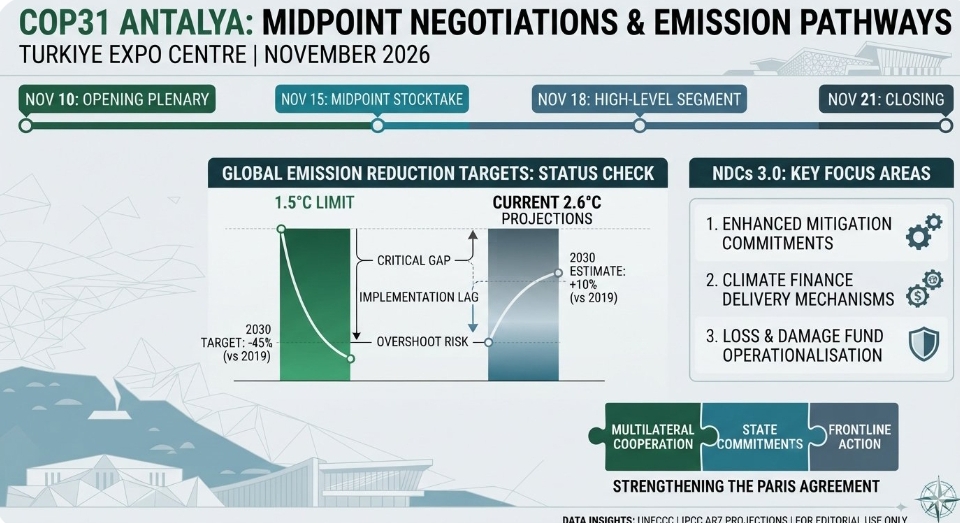
The primary diplomatic gridlock stems from a highly contentious draft text focused on the future of the 1.5 degrees Celsius global warming threshold. Following the recent publication of the United Nations Environment Programme Emissions Gap Report 2026, titled The Point of Return, which verified that full implementation of current national climate plans leaves the world on track for roughly 2.6 degrees of warming by 2100, several major state blocs have clashed openly on how to address this milestone. The collaborative presidency, jointly steered by Turkish Environment Minister Murat Kurum and Australian Climate Change Minister Chris Bowen, is facing severe institutional pressure to deliver a unified text before the final week of discussions.
Geopolitical divisions on the global limits
The operational division between state blocs has widened significantly over updating the next cycle of Nationally Determined Contributions due for formal execution. Negotiators representing major industrialised economies continue to face intense pushback from developing territories, who argue that expanding electrification rates and emission targets without the absolute means to implement them ignores vastly different national realities.
"Our decisions must take shape in a city's infrastructure, on a farmer's land and along a factory's production line," stated Turkish Environment Minister and COP31 President Murat Kurum during a press briefing clarifying the framework. "The issue of transitioning away from fossil fuels has been resolved by previous climate talks, and our position is clear that the focus must be on implementation. Turkiye sees electrification as the main driver of executing these targets, aiming to increase the share of global energy demand met by electricity from 20 per cent to 35 per cent by 2035."
Financial commitments and the implementation gap
A core bottleneck remains the vast disparity between climate finance pledges and actual delivery on the ground, specifically regarding the 300 billion dollar annual commitment agreed upon for developing countries by 2035. Developing nations maintain that the systemic lag in public capital flow completely paralyses local adaptation initiatives, turning international treaties into empty rhetorical exercises.
"We called for grant-based finance including public-private partnerships, alongside significant enhancement of resilience and adaptation funds which amount to survival funds especially for struggling economies," stated Pakistan Prime Minister Shehbaz Sharif whilst delivering an official intervention before world leaders. "Let our success be measured not by promises we make here, but by the families we protect, the resources we deliver, and the meaningful action we sustain."
Tactical delays and the civil response
Outside the secure diplomatic zones, the conference has been marked by escalating public mobilisations as international climate organisations clash discursively with sluggish industrial policies. Thousands of non-governmental observers, youth activists, and frontline community leaders marched under close supervision, holding bird effigies and large banners demanding that leaders prioritise people over corporate monopolies.
Emphasising the urgency of the moment, UN Secretary-General António Guterres urged delegates that overshoot is not surrender, calling for emission cuts of 18 per cent by 2030 and 45 per cent by 2035 compared to 2025 levels to close what he described as a leadership gap.
Editor's Note
The structural fractures unfolding at COP31 expose the widening gap between slow-moving climate diplomacy and the rapid acceleration of global ecological crises. As state delegations utilise administrative bottlenecks to protect immediate macroeconomic interests, frontline ecosystems are left to absorb the devastating shocks of unmitigated emissions. Moving forward, the international community must transcend political gridlock, enforce legally binding corporate accountability, and guarantee that adaptation capital is delivered via non-debt-creating mechanisms. The true metric of success for global climate governance rests not on the construction of ambiguous diplomatic treaties, but on the immediate, rapid execution of clean energy modernisation programmes worldwide.



Leave a comment