

TreeTake Network
The Khyber Pakhtunkhwa Wildlife Department has officially opened the seasonal partridge hunting window across designated game reserves and private lands today, November 15, 2026. The regulatory period runs until the end of January 2027 and permits hunting only on Sundays under closely monitored species conservation quotas. Wildlife protection forces have deployed field monitoring units across the province to enforce strict legal frameworks, ensuring that the tracking of game birds does not disrupt the broader biodiversity baselines or accelerate population declines amongst vulnerable local avifauna.
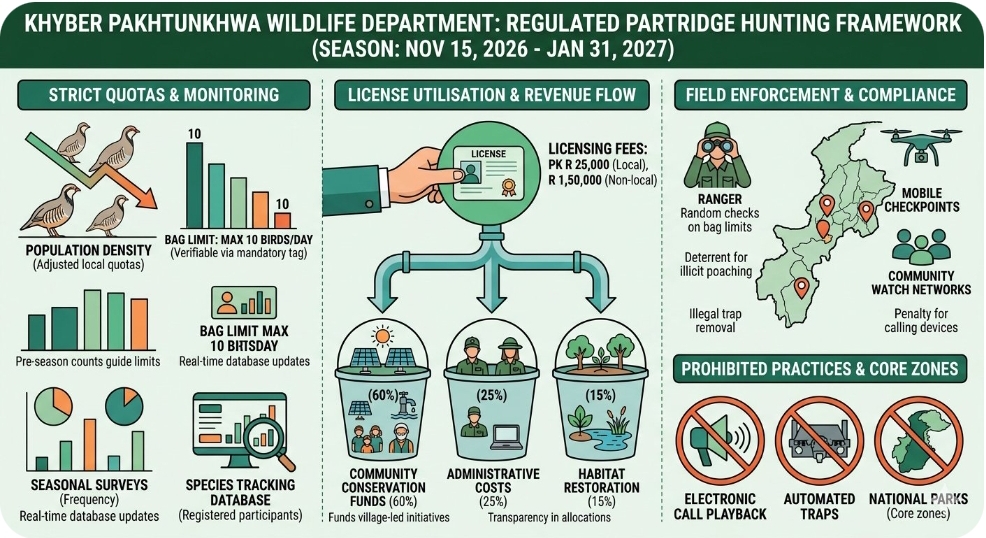
To prevent over-exploitation and combat the illegal trade of wild meat, the provincial administration has instituted a strict licensing fee structure and set maximum daily bag limits for registered hunters. Hunting remains entirely prohibited inside national parks, wildlife sanctuaries, and state-managed core conservation zones. Field teams are utilising digital tracking systems to verify that all participants comply with the authorised parameters and use only approved small-bore firearms during the designated field outings.
Population mechanics and sustainable management parameters
The activation of the regulated hunting calendar relies entirely on extensive pre-season population surveys conducted across regional ecological habitats. By adjusting local quotas based on seasonal breeding success and chick survival metrics, the department endeavours to utilise controlled hunting as a tool to mitigate illegal poaching whilst funding rural community conservation funds.
"Our department executes comprehensive field counts over several months before issuing the formal seasonal hunting notifications," stated Khan Malook, a senior conservator with the Khyber Pakhtunkhwa Wildlife Department. "The daily bag limit has been strictly capped at a maximum of 10 birds per license, and we are tracking populations closely to ensure no local pockets face sudden depletion. By legalising and strictly regulating this seasonal activity, we reduce the incentives for year-round illicit poaching and funnel a significant portion of the licensing revenue directly back into community-led habitat restoration initiatives."
Field enforcement and habitat protection networks
To maintain absolute compliance across extensive rural terrains, divisional wildlife officers have established mobile checkpoints and coordinated community intelligence networks. Specialised task forces are actively patrolling known breeding corridors to deter non-licensed groups and prevent the utilisation of illegal calling devices or unauthorised automated traps.
"We have intensified our field surveillance across the Kohat and Peshawar divisions to check for any structural breaches of the hunting code," remarked Mumtaz Khan, a regional wildlife management specialist. "Any individual found utilising electronic call playback systems or hunting outside the permitted Sunday timeframe faces immediate license cancellation, heavy financial penalties, and the confiscation of equipment. The true objective of these strict parameters is preserving the ecological equilibrium, ensuring that game bird populations remain biologically resilient across their natural geographical ranges."
Editor's Note
The deployment of highly regulated hunting quotas in Khyber Pakhtunkhwa demonstrates that balancing traditional recreational activities with strict wildlife preservation requires continuous administrative vigilance and robust data integration. Relying on periodic seasonal frameworks without continuous, real-time population audits risks silent ecological depletion in localised micro-habitats. Moving forward, regional environmental agencies must modernise field tracking by implementing digital licensing databases, mandating community-verified bag reports, and expanding permanent non-hunting sanctuaries. The long-term stability of the regional avifauna depends on treating wildlife management as an exact science, ensuring that regulatory frameworks adapt directly to changing environmental pressures and seasonal habitat fragmentation.



Leave a comment