

TreeTake Network
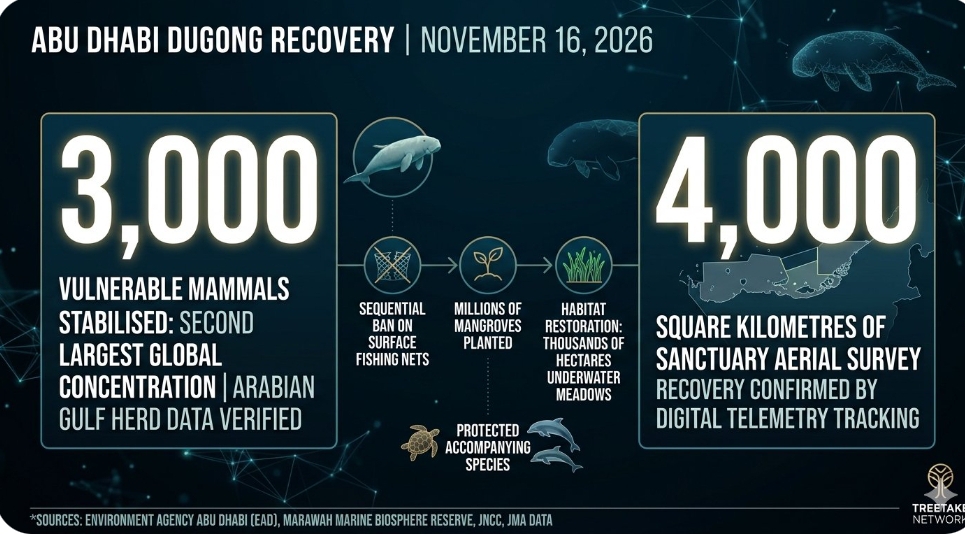
The Environment Agency Abu Dhabi released a comprehensive marine conservation assessment on November 16, 2026, confirming that the regional dugong population has stabilised and achieved total ecological recovery within the territorial waters of the United Arab Emirates. The scientific survey, which utilised advanced digital aerial telemetry across 4000 square kilometres of marine sanctuaries, reveals that Abu Dhabi now hosts more than 3000 individual dugongs. This metric establishes the Arabian Gulf herd as the second largest single concentration of the vulnerable marine mammals anywhere in the world. The findings highlight the successful restoration of critical seagrass habitats and the effective execution of targeted industrial mitigation frameworks designed to shield sensitive marine life from regional maritime transport threats.
Habitat restoration and the eradication of commercial fishing mortalities
The long-term stabilisation of the marine mammals stems from a sequential ban on destructive surface fishing nets, which historically accounted for dozens of accidental by-catch drownings annually. By combining strict legal enforcement across the Marawah Marine Biosphere Reserve and the Al Yasat Marine Protected Area with the planting of millions of mangroves, conservation managers have successfully rehabilitated thousands of hectares of underwater meadows. These expansive seagrass fields serve as the exclusive grazing grounds for the herbivorous species, providing the foundational nourishment required to support natural herd expansion.
"The recovery of our dugong population is a definitive verification of what can be accomplished when scientific data forms the absolute foundation of environmental legislation," stated Dr Shaikha Al Dhaheri, the Secretary General of the Environment Agency Abu Dhabi, during an executive briefing at the main headquarters. "Our marine species teams have monitored these herds for decades, and observing this growth trend confirms that our protected networks are functioning exactly as intended. By combining rigorous habitat management with technology-driven field aerial tracking, we have successfully preserved an irreplaceable component of our national natural heritage."
Defending vulnerable marine biodiversity against regional environmental hazards
The agency's report also detailed the rapid operational deployment of emergency protection protocols following recent shipping accidents within the busy maritime corridors of the Arabian Gulf. Environmental containment units utilised predictive risk maps to instantly implement surface booming, preventing industrial contaminants and toxic hydrocarbon leakages from settling into the sensitive seagrass corridors. The quick defensive action neutralised potential mortality spikes among local herds and protected accompanying wildlife, including four distinct species of sea turtles and multiple species of coastal dolphins.
"I am incredibly proud that our teams were completely prepared for severe environmental contingencies, allowing us to insulate our marine life from external industrial threats," stated Maitha Al Hameli, the Section Manager of Marine Biodiversity Assessment and Conservation at the agency, while reflecting on the milestones. "Seeing the dugong population thrive today proves that active local stewardship creates resilient ecosystems capable of withstanding unexpected crises. The environment was the precise resource that sustained our ancestors in this region, and ensuring its absolute health remains our highest modern priority."
Editor's Note
The recovery of the dugong population in Abu Dhabi proves that local legal protection can reverse the decline of vulnerable marine mammals when applied alongside massive habitat restoration. By pairing commercial fishing restrictions with extensive mangrove and seagrass cultivation, the emirate has created a highly effective template for marine corridor defence. Moving forward, the primary challenge will be to insulate these newly restored sanctuaries from the long-term impacts of regional coastal development and rising sea temperatures. True environmental protection requires persistent ecological monitoring to ensure that rapid urban growth does not erode the hard-won biological baselines established over decades of conservation work.



Leave a comment