

TreeTake Network
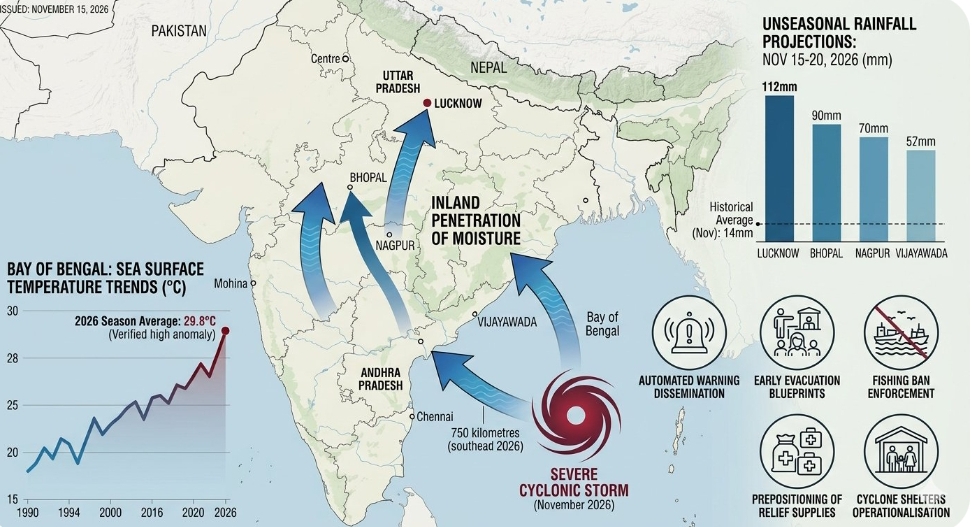
The India Meteorological Department has officially upgraded a low-pressure depression over the Southeast Bay of Bengal today, November 15, 2026, warning that the system is intensifying rapidly into a severe cyclonic storm. The atmospheric anomaly, currently situated roughly 750 kilometres east-southeast of Chennai, is tracking northwestward at a speed of 14 kilometres per hour. Whilst the primary landfall zone targets the eastern seaboard, satellite modelling indicates that the deep moisture plume will interact directly with an incoming mid-latitude western disturbance, triggering unseasonal rainfall, sharp temperature drops, and severe squalls across Northern India, including Lucknow and adjacent districts of Uttar Pradesh.
State disaster response authorities across both coastal zones and landlocked northern states have been placed on high alert. National disaster management groups have already begun prepositioning relief supplies and coordinating with local administrations to mitigate severe agricultural and logistical disruptions. The unseasonal interaction between the tropical system and northern atmospheric troughs is projected to break regional climate baselines by mid-week.
Meteorological parameters and structural mechanics
The core structural consolidation of the depression is being driven by exceptionally high sea-surface temperatures hovering near 30 degrees Celsius, paired with low vertical wind shear. These factors are enabling the cyclonic core to systematically draw vast amounts of thermal energy from the ocean surface, accelerating the creation of a defined low-level vortex.
"The thermal profiles across the Bay of Bengal are significantly above historical baselines for mid-November, providing an aggressive fuel source for this system," stated Dr Mrutyunjay Mohapatra, Director General of the India Meteorological Department. "We are closely monitoring the upper-air structural components. Current trajectories strongly indicate that this system will mature into a severe cyclonic storm within 24 hours, demanding absolute vigilance from all state maritime boards and emergency response networks along the eastern seaboard."
Northern inland penetration and impact on Uttar Pradesh
As the cyclonic storm advances inland, meteorological models indicate its outer convective bands will inject immense amounts of maritime moisture into the central plains. This convergence is expected to dramatically alter weather patterns in landlocked northern regions, bringing persistent overcast conditions and heavy localized downpours to urban centres like Lucknow.
"The computational data confirms that the storm's inland moisture trajectory will interface directly with a trough over central India," explained Dr Alok Kumar Sikka, a senior climate resilience scientist and former meteorological specialist. "This means cities like Lucknow will experience significant unseasonal rain and a sudden, sharp dip in day temperatures by Wednesday. This atmospheric interaction creates a double challenge, disrupting ongoing winter crop sowing across the agricultural belts of Uttar Pradesh whilst straining local municipal infrastructure."
Emergency preparedness and municipal governance
In response to the escalating meteorological assessments, emergency operations centres have been activated across multiple vulnerable belts. Municipal corporations in Northern India have ordered immediate preventative checks on urban drainage networks and electrical grids to counter the effects of sudden squalls.
"We have mobilised specialised local teams to manage any sudden waterlogging or structural damage caused by the unseasonal winds," noted Inderjit Singh, Municipal Commissioner of Lucknow. "The district administration is actively coordinating with the state power distribution utilities to secure overhead lines and prevent prolonged outages. Emergency response protocols are fully aligned to handle the ripple effects of this tropical system, ensuring public safety and maintaining essential urban services across the capital."
Editor's Note
The expanding reach of cyclonic systems from coastal zones deep into the northern plains highlights the growing volatility within South Asian atmospheric corridors. As warming marine environments alter traditional monsoon timelines, landlocked regions can no longer consider themselves insulated from the devastating impacts of tropical storms. Moving forward, regional planning bodies must transition toward cross-regional climate modelling and build adaptive urban infrastructure capable of handling sudden, extreme moisture influxes. True environmental security relies on modernising localised drainage systems, insulating agricultural supply chains, and establishing collaborative state-level warning networks that bridge coastal disaster management with inland municipal governance.



Leave a comment