

TreeTake Network
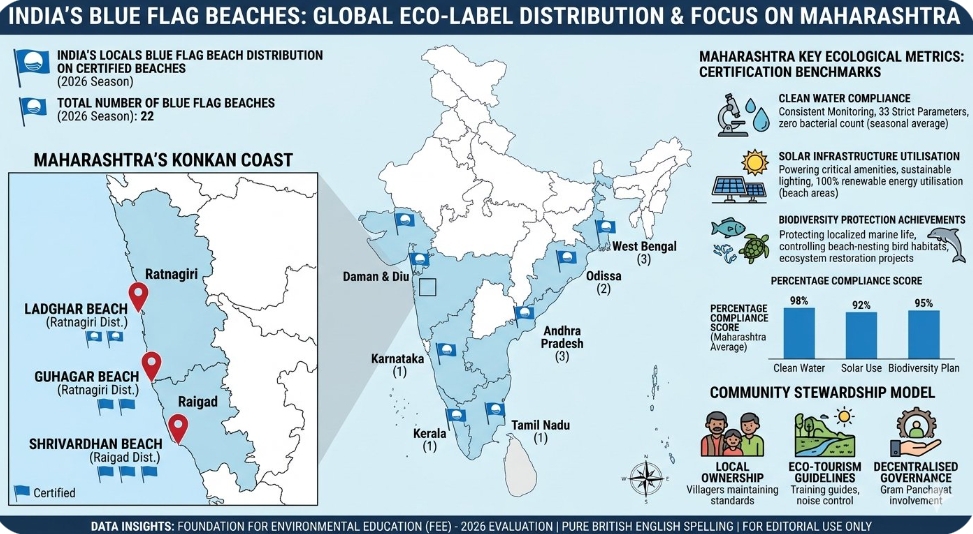
The international Blue Flag eco-label season has officially commenced today, November 15, 2026, across 22 certified beaches in India, highlighted by the historic, first-ever inclusion of three pristine coastlines along the Konkan region of Maharashtra. Ladghar and Guhagar beaches, situated within the Ratnagiri district, alongside Shrivardhan beach in the Raigad district, successfully hoisted the prestigious global standard flags. This certification marks the culmination of a rigorous environmental upgrade programme executed by local bodies to satisfy 33 stringent ecological criteria.
The international jury awarded the seasonal certification after verified assessments confirmed absolute compliance with global benchmarks. These metrics mandate pristine coastal water quality, advanced solid waste segregation, comprehensive solar-powered sanitation infrastructure, strict protection of localised coastal biodiversity, and robust safety protocols for visitors. The entry of Maharashtra into this global network expands India's total footprint to 22 internationally certified sustainable beaches, creating an eco-conscious blueprint for the country's extensive peninsular shoreline.
Ecological profiles of the certified shorelines
Each of the three newly inducted Konkan beaches displays unique biodiversity characteristics that required tailor-made conservation management plans to achieve compliance:
- Ladghar Beach. Popularly recognised for its distinctive shoreline sands, the local management plan focused heavily on regulating eco-tours and mitigating marine noise pollution.
- Guhagar Beach. Spanning a highly sensitive stretch of sand, this site features dense plantations where local groups monitor coastal erosion and implement low-impact bamboo infrastructure.
- Shrivardhan Beach. Boasting a tranquil crescent-shaped topography, the local administration established community-led waste segregation centres to prevent plastic infiltration into marine breeding zones.
"Securing the Blue Flag certification is a transformative milestone for the entire Konkan coastline," stated Pankaja Munde, Maharashtra State Minister for Environment and Climate Change. "This achievement, realised under the strategic guidance of our administration, realigns our regional goals by proving that robust rural development can coexist harmoniously with strict nature conservation. We are utilising community-led models to ensure that local fishing communities are direct beneficiaries and stewards of these preserved habitats."
Community-led coastal stewardship
The operational framework that enabled this global recognition relied heavily on decentralised community action. Prior to the installation of water treatment systems and safety beach patrols, local conservation societies executed comprehensive clean-up campaigns to eliminate persistent marine debris. Educational centres have also been permanently constructed at each beach site to inform domestic and international tourists about the surrounding coastal ecosystems and sensitive marine life.
"The true strength of this programme lies in the complete ownership displayed by the coastal villagers," observed State Minister Aditi Tatkare whilst tracking the final structural checks at Raigad. "Maintaining a Blue Flag requires continuous, daily adherence to rigorous environmental standards, emphasis placed on waste management, sanitation, and biodiversity preservation. The fact that local communities have successfully adapted their daily practices to shield these fragile zones provides an inspiring template for marine conservation across South Asia."
Editor's Note
The successful deployment of the Blue Flag framework across the Konkan coastline demonstrates that community-rooted ecological governance is highly effective at preserving vulnerable marine interfaces. As commercial tourism continues to threaten fragile global shorelines, shifting toward highly regulated, eco-labelled coastal management is essential. To sustain these environmental gains, the state must strictly enforce coastal regulation zones, prevent industrial effluent discharge into adjacent estuaries, and resist the temptation of high-density commercial overdevelopment. The long-term vitality of these marine sanctuaries depends on keeping local fishing communities at the centre of conservation policy, ensuring that global ecological standards translate directly into secure, sustainable regional stewardship.



Leave a comment