

Travelogue
HN SINGH
Lions International Faculty, Member SPHEEHA, HAM Radio Licensee, Trekker & Mountaineer; An admirer of mountains, nature, heritage and the timeless spirit of exploration
There are some journeys that remain etched in our memory forever. Years may pass, roads may change, hotels may become modern and destinations may attract thousands of tourists, but the memories of a particular morning, a breathtaking mountain view or an unexpected adventure never fade away.
My journey through the beautiful Kumaon region of Uttarakhand was one such experience. Kausani, Garur, Jageshwar and Bageshwar were the destinations on our itinerary.
This was a journey from an era when electricity was not available everywhere, mobile phones were not part of our lives and travelling itself was an adventure..
Kausani -The Switzerland of India
Our journey to Kausani began with great enthusiasm. However, as often happens during mountain travel, things did not proceed according to plan. Due to a technical problem with our bus, we were delayed considerably. The journey took much longer than expected, and by the time we finally reached Kausani, the sun had already disappeared behind the mountains.
It was getting dark and the surroundings were almost completely enveloped in darkness. In those days, electricity was not available in many remote mountain settlements, and Kausani was no exception to the occasional uncertainty of power supply.
Our accommodation was the Kumaon Mandal Vikas Nigam (KMVN) Holiday Home. Unlike today's well-connected tourist destinations, reaching the Holiday Home itself was an adventure. We had to get down from the bus and walk along the dark mountain path carrying our luggage.
Somehow we finally reached the KMVN Holiday Home. The day's unexpected difficulties had exhausted us and we soon retired to bed.
The morning that took our breath away
The next morning, I was still enjoying the warmth of my bed when there was a gentle knock on the door. A person had arrived with our morning tea. As we welcomed him, he walked towards the window and drew aside the curtains. And then came the moment! Oh, what a scene!
Before our eyes stretched an enormous panorama of the mighty Himalayas. A series of majestic snow-covered peaks stood proudly against the clear blue morning sky. The early sunlight touched their summits, turning the white snow into shades of golden yellow, pink and silver. It was as if someone had suddenly opened a gigantic window into heaven.
The most celebrated peaks visible from the Kausani region include Nanda Devi, Trishul and other towering Himalayan summits. Depending on weather conditions and visibility, the panorama can extend across a vast stretch of the Himalayan range.
Discovering the beauty of Kausani
Kausani is situated in the Bageshwar district of Uttarakhand, at an altitude of approximately 1,890 metres above sea level. It is often called the Switzerland of India, a name associated with its extraordinary natural beauty and panoramic Himalayan views.
Kausani is also historically associated with Mahatma Gandhi. In 1929, Gandhi visited this beautiful hill station and stayed here for some time. The place where he stayed is now known as Anasakti Ashram.A visit here offers not only a beautiful view but also an opportunity for quiet contemplation.
Kausani is also the birthplace of Sumitranandan Pant (1900–1977), one of the most celebrated Hindi poets and a leading figure of the Chhayavaad movement in modern Hindi literature. His birthplace has been preserved as a memorial and museum, where visitors can learn about his life, literary journey and contribution to Hindi literature..
Another spiritually significant place in the surrounding region is Dhaulchina Ashram of Maa Anandamayi. Situated amidst the serene Himalayan surroundings, the Ashram is associated with the spiritual legacy of Maa Anandamayi, one of India's most revered spiritual personalities.
Another attraction of Kausani is its tea garden. The Kausani tea estate is known for its organic tea cultivation. Walking through the green tea bushes, with the mountains forming a magnificent backdrop, is a delightful experience. The region is also famous for its natural vegetation, particularly pine and oak forests.
The nearby Rudradhari Waterfall and ancient Shiva temple are also worth visiting..
Garur – A beautiful valley and the heritage of Baijnath
The drive to Garur was a memorable experience in itself. The road passed through picturesque mountain slopes, terraced agricultural fields, small Kumaoni settlements and stretches of beautiful greenery. At several points, the valley opened up, revealing a landscape of extraordinary charm.
Garur is a beautiful town in the Bageshwar region, situated in the picturesque Garur Valley. The area is known for its fertile surroundings, traditional villages, scenic countryside and historical importance. The most remarkable attraction in this region is Baijnath Temple, situated on the banks of the Gomti River.
The temple complex contains several ancient stone shrines, with the principal temple dedicated to Lord Shiva. The architecture reflects the traditional North Indian Nagara style, with beautifully constructed stone towers and intricate details.
The main shrine is believed to date to the 12th century. Garur and Baijnath were a delightful excursion from Kausani. The day gave us a glimpse of the historical and cultural richness hidden in the Kumaon hills.
Jageshwar – Where the Gods reside among deodar trees
Another day was reserved for a visit to Jageshwar, one of the most fascinating religious and archaeological destinations in Uttarakhand.
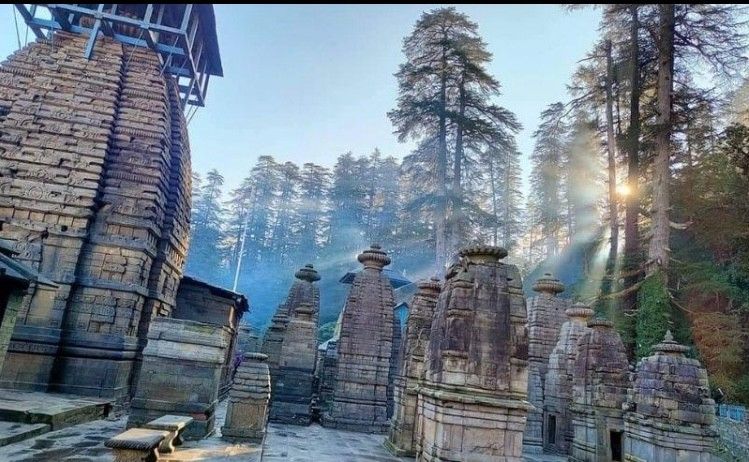
The journey itself was beautiful. As we moved through the winding mountain roads, the scenery kept changing. Hills covered with pine and deodar trees, deep valleys, traditional houses and occasional glimpses of distant mountain ranges accompanied us throughout the journey. Jageshwar is located in the Almora district, at an altitude of approximately 1,870 metres. It is surrounded by dense deodar forests, which give the entire region a mysterious and spiritual atmosphere.
The Jageshwar Dham temple complex consists of approximately 125 ancient stone temples and numerous sculptures. Most of these temples are dedicated to Lord Shiva in different manifestations.
The archaeological significance of Jageshwar is equally impressive. The temple complex is protected by the Archaeological Survey of India and contains inscriptions and sculptures that help us understand the religious and cultural history of the region.
One of the most beautiful aspects of Jageshwar is the presence of the Jata Ganga stream, which flows through the valley. The sound of flowing water, the fragrance of deodar trees and the silence of the surrounding forest create an atmosphere that is difficult to describe in words.
Walking through the temple complex was like travelling several centuries back in time.
Bageshwar – The sacred confluence of two rivers
Bageshwar is a beautiful and historically important town in the Kumaon region. Situated at the confluence of the Saryu and Gomti rivers, it is surrounded by the Bhileshwar and Nileshwar mountains.
The town has a distinctive character. It is a combination of religious heritage, traditional Kumaoni culture, beautiful riverbanks and the everyday life of a Himalayan settlement.
The first thing that attracts a visitor is the natural setting. The two rivers meet here and their waters flow through the valley, creating a beautiful landscape.
The most important attraction of Bageshwar is the famous Bagnath Temple. It is dedicated to Lord Shiva and occupies a special place in the religious history of Kumaon.
The most fascinating natural feature of Bageshwar is the confluence of the Saryu and Gomti rivers. In Indian tradition, the meeting of two rivers is considered sacred. Such places have attracted pilgrims, saints and spiritual seekers for centuries.
We had two days to explore Bageshwar. This gave us sufficient time to visit the temple, enjoy the river confluence and experience the atmosphere of this small Himalayan town.
There are several other interesting places in the surrounding region, including Gauri Udiyar, a cave temple with religious significance, and the beautiful mountain landscapes beyond the town.
Bageshwar is also an important gateway for several high-altitude Himalayan treks. The region attracts trekkers interested in exploring the Pindari Glacier, Kafni Glacier and Sunderdhunga Valley.
The Kumaon Himalayas - More than a holiday
Looking back, this journey was much more than visiting four destinations.
Kausani introduced us to the breathtaking grandeur of the Himalayas. Garur and Baijnath revealed the historical legacy of the Katyuri dynasty. Jageshwar offered an extraordinary encounter with ancient temple architecture and spirituality. Bageshwar brought us to the sacred meeting point of two rivers and introduced us to the cultural traditions of Kumaon.
Each destination had its own personality. The Kumaon Himalayas taught me once again that the greatest luxury in life is not necessarily a comfortable room or an expensive holiday. Sometimes, it is simply a cup of morning tea, a window opening towards the snow-clad mountains and a heart filled with gratitude.



Leave a comment