

TreeTake Network
The United Nations Environment Programme alongside the International Cryosphere Climate Initiative launched a pair of landmark scientific assessments today, November 02, 2026, delivering an ultimatum to global governments regarding the permanent collapse of the Earth’s ice systems. The joint publications, titled State of the Cryosphere 2026: The Cost of Overshoot and Overshoot and the Cryosphere: Averting Global Meltdown, warn that relying on late-century carbon removal technologies to reverse atmospheric warming represents a catastrophic policy miscalculation. According to the data, passing 1.5 degrees Celsius of atmospheric warming will lock in millennia of severe sea-level rise and accelerate immense permafrost carbon release, even if global thermal levels are later brought back down.
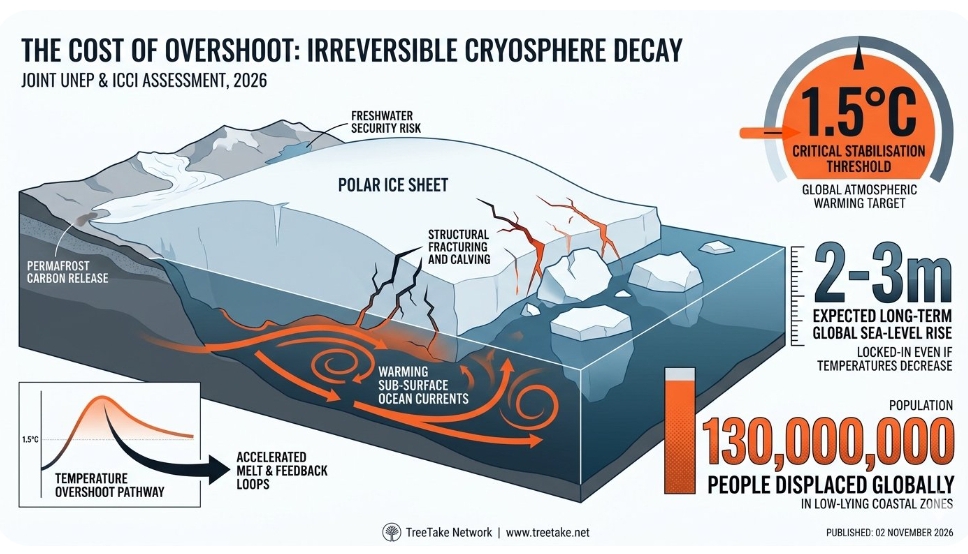
The structural tracking models reveal that key planetary ice sheets, glaciers, and polar marine zones are hitting structural limits far earlier than anticipated. Marine geologists indicate that the prolonged exposure of the West Antarctic Ice Sheet and Greenland to elevated sub-surface ocean currents is already establishing irreversible fracturing lines. Even if global average temperatures return to pre-industrial benchmarks by 2100 through speculative geoengineering or massive carbon capture networks, the thermal inertia absorbed by deep ocean systems will continue driving ice-shelf disintegration for generations.
Severe Economic and Ecological Toll of Structural Overshoot
The scientific consensus notes that an atmospheric overshoot window lasting a mere 30 to 40 years will permanently reshape coastal geography on a global scale. Oceanographic frameworks project that this structural failure will guarantee an additional 2 to 3 metres of global sea-level rise over the coming centuries, displacing an estimated 130,000,000 people living in low-lying coastal communities and delta ecosystems. Concurrently, the rapid thawing of Arctic permafrost under an overshoot scenario is projected to release between 100,000 and 200,000 megatonnes of carbon equivalent, establishing a dangerous natural feedback loop that diminishes human capacity to stabilise the climate.
The economic infrastructure required to combat this degradation is unprecedented. Mountain glaciers across the European Alps, Scandinavia, and western North America are projected to lose over 70 per cent of their remaining volumetric mass by mid-century under current global emission curves. This structural retreat jeopardises the continuous freshwater supply for over 1,500,000,000 people who depend heavily on seasonal glacial runoff for agrarian systems, municipal usage, and industrial hydropower generation.
Global Institutional Vetting and Expert Warnings
During the formal presentation of the data at the climate portal headquarters, Dr Inger Andersen, Executive Director of the United Nations Environment Programme, emphasised the dangerous illusion of modern mitigation timelines: "The core findings of these dual assessments reveal that the cryosphere does not possess a simple on-off switch. Expecting polar systems to neatly reconstruct themselves after a multi-decade thermal overshoot is an ecological fallacy. Once these multi-thousand-year-old ice structures fracture and melt into warming oceans, no amount of future carbon drawdown can physically reconstitute them. Governments must internalise that preventing the overshoot altogether is the only path to atmospheric survival."
Echoing these deep structural anxieties, Dr Pam Pearson, Director of the International Cryosphere Climate Initiative, highlighted the immediate political stakes: "We are observing structural changes at 1.2 degrees Celsius of warming that models predicted would only manifest at much higher thresholds. The cost of overshoot is not a abstract mathematical metric for future generations; it is a permanent lock-in of marine transgression, severe permafrost feedback loops, and catastrophic mountain water scarcity. Our message to negotiators ahead of global climate talks is unequivocal: a temporary breach of 1.5 degrees Celsius is not a safe parking spot, but a threshold of irreversible global damage."
Adding a definitive regional perspective to the cryosphere's collapse, Dr Pema Gyamtsho, Director General of the International Centre for Integrated Mountain Development, focused on the immediate human fallout across Asia: "The Hindu Kush Himalaya region is undergoing a massive hydrological crisis that directly threatens regional stability. When we lose seasonal glacial mass, we are actively destabilising the headwaters of 10 major river systems that sustain human life and agricultural output across southern Asia. The current rate of cryosphere degeneration means that an atmospheric overshoot will turn predictable seasonal flows into unpredictable cycles of severe flash flooding followed by prolonged, structural drought."
Editor's Note
The dual cryosphere assessments dismantle the widespread political assumption that global society can safely overshoot climate boundaries now and fix the damage later through mid-century technological interventions. This scientific framework proves that the Earth's critical ice infrastructure operates on non-linear tipping points with immense systemic inertia. Treating 1.5 degrees Celsius as a negotiable milestone rather than a rigid ecological boundary invites an irreversible cascade of sea-level rise and greenhouse gas releases that human engineering cannot contain. The way forward requires an immediate termination of fossil fuel expansion paired with rapid structural upgrades to global carbon mitigation strategies to ensure permanent cryosphere stabilisation.



Leave a comment