

TreeTake Network
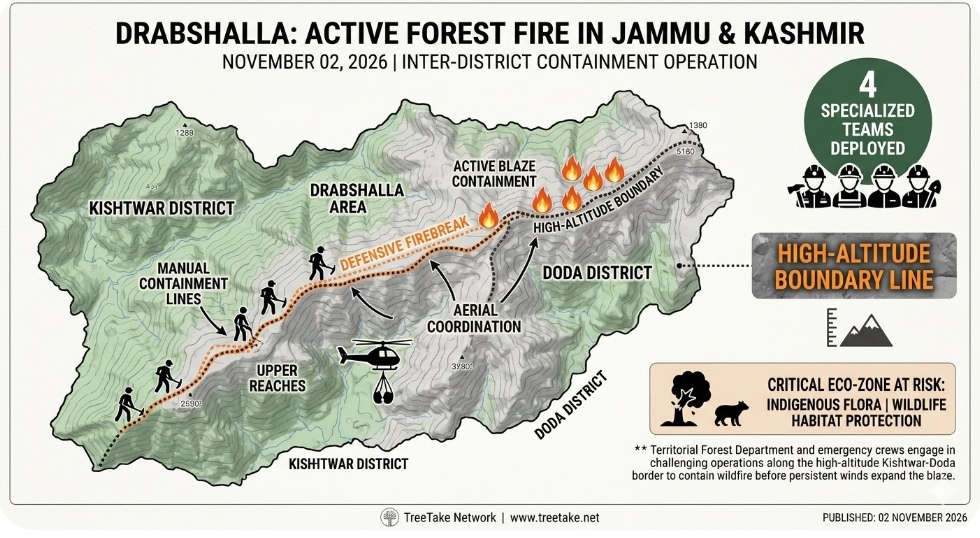
An active forest fire has broken out in the upper reaches of the Drabshalla area, positioned directly along the high-altitude boundary line separating the Kishtwar and Doda districts in Jammu and Kashmir. Official updates from emergency dispatch centres confirmed that the blaze erupted early today, November 02, 2026, across densely wooded slopes, with flames quickly spreading through dry undersea foliage and mountainous brushwood. Because the affected sectors interface directly with adjacent eco-zones, the territorial Forest Department has immediately mobilised specialized wildfire crews to initiate containment operations before persistent high-altitude winds expand the fire's operational perimeter.
The structural tracking layout indicates that the blaze is concentrated near highly flammable conifer compartments that characterise the regional geography. Forest protection personnel are actively deploying manual fire-fighting techniques, utilising specialized hand tools and creating defensive lines to clear organic debris. Local administrative bodies have placed nearby alpine settlements on alert, whilst tracking cells monitor smoke plume density to safeguard public respiratory health against sudden particulate contamination.
Rugged Terrain Hampers Ground Control Operations
Field reports detail that the local terrain presents extreme geographical friction for the responding emergency personnel. Ground operations are restricted by steep gradients and a total absence of vehicular access roads, forcing containment teams to trek several kilometres with manual firefighting apparatus. To counter these limitations, forestry teams are working in shifts to establish continuous firebreaks along critical ridges, aiming to break the fuel continuity of the dry pine needles blanketed across the forest floor.
The lack of recent precipitation throughout the region has left sub-surface organic matter highly vulnerable to rapid ignition, complicating the containment timelines. Forestry experts indicate that if the current rate of atmospheric wind velocity persists, the fire could breach regional compartment lines and shift into deep old-growth reserves. Consequently, extra manpower from adjacent ranges is being re-routed to fortify the existing containment corridors.
Official Statements and Professional Assessments
Confirming the strategic deployment from the regional control center, an senior official from the Forest Department outlined the ongoing mitigation protocol: "Our primary containment teams rushed to the spot immediately after receiving reports of visible smoke columns along the inter-district boundary line. We have successfully established initial containment sectors around the primary ignition points to ensure the flames are isolated from the adjoining dense forest compartments. The terrain remains highly challenging, but our field personnel are trained to construct rapid earth barriers to starve the fire of fuel."
Emphasising the acute environmental risks to the regional landscape, a senior conservation officer attached to the division provided context on the local habitat vulnerability: "The dry spell experienced over the past few weeks has created a highly flammable environment across the upper reaches of Drabshalla. This structural dryness means that small sparks can instantly grow into dangerous, fast-moving canopy fires that directly threaten vulnerable sub-alpine flora and native wildlife. We are focusing our collective manpower on creating clean, wide firebreaks along the ridge lines to permanently arrest the lateral spread of the flames."
Detailing the tactical resource allocation, a regional field coordinator stated: "We have deployed exactly 4 specialized teams to different sectors of the fire front to maintain constant pressure on the blaze. Our teams are utilizing a combination of counter-firing techniques and traditional manual tools to secure the perimeter. We are also coordinating directly with local revenue officials to ensure that any pastoral communities grazing near the upper zones are safely moved away until the entire sector is declared clear of secondary hotspots."
Editor's Note
The sudden eruption of a forest fire along the Kishtwar-Doda boundary highlights the escalating vulnerability of Himalayan forest compartments to climate-induced thermal stress and seasonal dryness. As dry spells become more prolonged, traditional reactive firefighting protocols must be structurally upgraded with real-time digital monitoring and community-led response frameworks. The immediate pathway forward requires the immediate deployment of remote sensor networks for early thermal detection, paired with a permanent expansion of wide silvicultural firebreaks around vulnerable biodiversity corridors to insulate primary forest blocks from uncontrollable seasonal fires.



Leave a comment