

TreeTake Network
An international analysis released today, November 02, 2026, by Zero Carbon Analytics has established a definitive correlation between extreme, climate-induced heatwaves and a severe escalation in premature births across South Asia. Focusing heavily on urban and rural health patterns within India and Bangladesh, the clinical and environmental assessment maps an alarming rise in obstetric complications during periods of unprecedented thermal stress. The report highlights that prolonged atmospheric heat exposure directly compromises maternal health mechanics, leading to a substantial increase in early spontaneous labor and adverse neo-natal health outcomes across vulnerable demographic sectors.
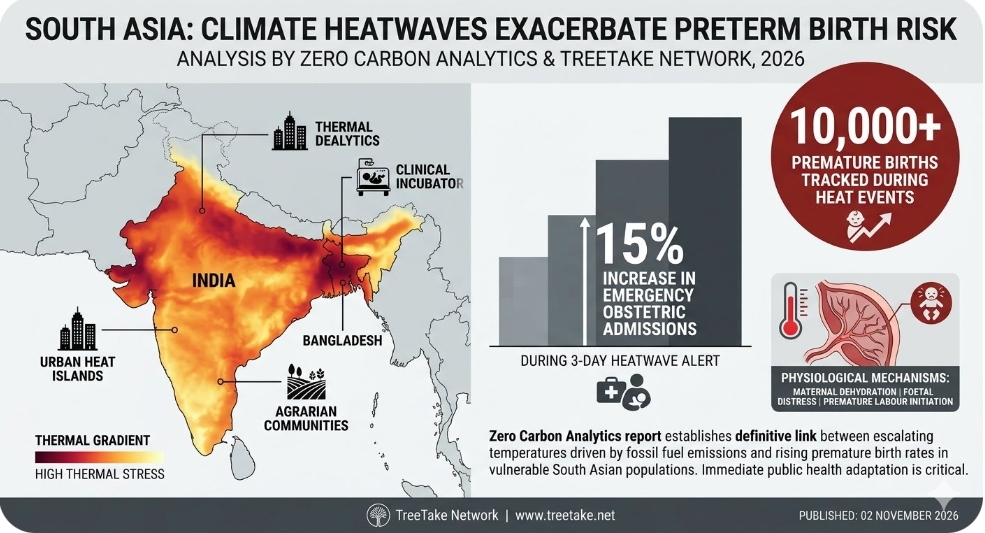
Public health data integrated into the study details how extreme heat acts as an acute physiological stressor on expectant mothers. When ambient temperatures remain consistently above regional baselines for more than 3 consecutive days, the risk of preterm delivery increases substantially. Epidemiologists involved in the research tracked over 10000 premature births tied directly to intense heat spikes, noting that sub-surface urban heat islands and a lack of adaptive cooling infrastructure within lower-income residential blocks significantly magnifies the biological risk.
Clinical Disruptions and Societal Vulnerabilities
The physiological impacts of climate breakdown are no longer abstract projections but active public health emergencies. Medical researchers explain that severe heat exposure triggers an endocrine response characterized by elevated secretion of cortisol and oxytocin, which can prematurely initiate uterine contractions. Furthermore, maternal dehydration induced by thermal stress reduces placental blood flow, compromising the structural transmission of vital nutrients to the foetus and inducing acute foetal distress that necessitates immediate, early clinical intervention.
The structural impact falls disproportionately on agrarian labourers and informal sector workers who face mandatory, prolonged exposure to outdoor environments. In states such as West Bengal, Bihar, and across neighbouring Bangladesh, pregnant women working in agricultural fields or dense industrial settings lack the institutional protections required to avoid thermal exhaustion. The analysis reveals that during the peak heatwave windows, regional hospitals registered a 15 per cent increase in emergency admissions for premature delivery, overwhelming local neo-natal intensive care infrastructure.
Health Infrastructure Mobilisation and Expert Commentary
Presenting the findings during an online global health panel, Dr Marina Romanello, a leading climate health analyst and executive contributor to the study, emphasized the critical link between fossil fuel emissions and maternal health: "This exhaustive dataset demonstrates that the health costs of global warming are being borne by the most vulnerable members of human society. We are witnessing a clear, quantifiable relationship between rising regional temperatures and obstetric emergencies. If global greenhouse emissions are allowed to continue their current trajectory, the strain on neo-natal healthcare networks across developing nations will reach a breaking point, locking in lifelong health challenges for millions of children."
Addressing the regional emergency, Dr Fahmida Khatun, an environmental economist specializing in South Asian climate adaptation, pointed out the systemic economic and structural deficits that amplify the crisis: "The findings published by Zero Carbon Analytics confirm that our current public health infrastructure is entirely unprepared to manage the multi-faceted impacts of climate change. A premature birth does not merely represent a temporary medical crisis; it places an immense, permanent financial burden on low-income families and fractures local rural economies. True climate adaptation must move beyond building physical sea walls and directly encompass maternal healthcare subsidies, mandatory heat-shelter access, and strict occupational safety laws for pregnant workers."
Stressing the immediate medical reality on the ground, Dr K Srinath Reddy, a distinguished public health expert, called for a comprehensive overhaul of primary healthcare tracking systems: "We must train our primary healthcare personnel to treat extreme heatwaves with the same clinical urgency as an infectious disease outbreak. Maternal health clinics require immediate structural retrofitting with passive cooling technologies, and local medical staff must be equipped to proactively monitor hydration levels and uterine activity in high-risk zones during thermal alerts. The failure to integrate climate tracking into reproductive healthcare represents a massive gap in our current defensive frameworks."
Editor's Note
The pioneering study by Zero Carbon Analytics marks a critical turning point in how society must conceptualise the human cost of climate change, transitioning the discourse from abstract ecological damage to immediate public health degradation. The clear mathematical connection between fossil-fuel-driven heatwaves and preterm births reveals that climate change is actively compromising human development at its earliest stage. Mitigating this subterranean crisis requires an integrated approach that pairs aggressive emission cuts with a structural reimagining of public health delivery, guaranteeing targeted cooling resources, legal workplace exemptions, and dedicated neo-natal support to protect maternal systems from an increasingly volatile atmosphere.



Leave a comment