

TreeTake Network
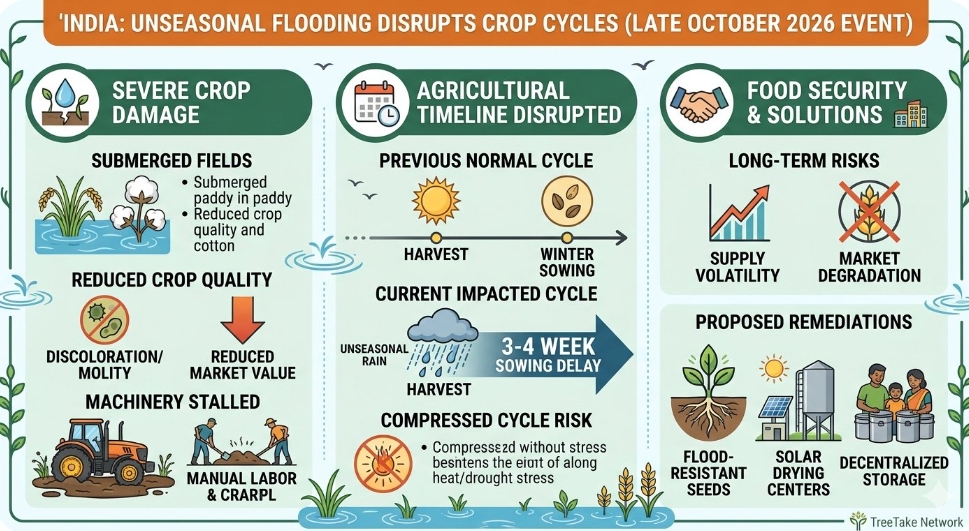
Agriculture sectors across several prominent Indian cultivation belts are facing severe operational shocks due to unexpected, unseasonal heavy rainfall and localised flash flooding. Breaking standard historical meteorological patterns for late October, prolonged precipitation events have inundated thousands of hectares of mature farmland on October 27, 2026. The unpredicted moisture surge has arrived at a critical juncture for domestic food production, directly interrupting the final harvesting phases of summer-sown crops and completely stalling the field preparation timelines for upcoming winter-sown staples.
Severe crop damage and disrupted harvesting windows
The immediate crisis stems from an atmospheric misalignment that delivered heavy rain downpours precisely when fields required dry conditions for processing. Across the affected agricultural zones, standing fields of paddy, cotton, pulses, and oilseeds have been partially or completely submerged under water. Farmers are encountering severe physical constraints as heavy machinery cannot navigate the waterlogged terrain, forcing manual labour costs to spike amid deteriorating crop quality.
Beyond the immediate loss of standing crops, the unseasonal moisture has triggered widespread concern regarding fungal infestations and grain discolouration, which drastically lowers the commercial market value of the remaining harvest. Agricultural cooperative boards report that the extreme soil moisture saturation will delay the sowing of critical winter cash crops, including wheat and mustard, by at least three to four weeks. This delay compresses the overall winter growth cycle and increases the vulnerability of these crops to terminal heat waves during the upcoming spring season.
Agricultural experts and field assessments
Detailing the ground-level impact on rural food systems, regional agricultural scientists and field directors have warned that the frequency of these late-season downpours is outstripping traditional farming wisdom. In an official field directive issued on October 27, 2026, crop protection specialists stated: "The sudden arrival of intense rainfall during the peak harvest window has caught local cultivation networks entirely unprepared. We are observing severe lodging in paddy fields, where mature stalks have collapsed under the weight of water, leading to immediate grain loss and long-term soil compaction issues."
Independent agrarian analysts have noted that the current economic safety nets, including state-backed crop insurance frameworks, are experiencing administrative backlogs due to the sheer volume of sudden damage claims. Field inspectors emphasise that while standard monsoon cycles are thoroughly documented, the sudden emergence of intense, post-monsoon localised cloudbursts presents an entirely new tier of financial and logistical risk for independent smallholders who operate without climate-controlled storage infrastructure.
Editor's Note
The extensive unseasonal flooding sweeping through multiple Indian agricultural zones highlights a critical structural flaw in relying on historical weather baselines to manage modern food security. As warming oceanic currents alter regional precipitation windows, the traditional boundaries separating the dry harvesting months from wet sowing seasons are rapidly dissolving. For the Indian agricultural sector, the way forward requires moving aggressively past simple post-disaster financial compensations toward systemic climate-proofing. Governments must heavily incentivise the adoption of short-duration, flood-resistant crop varieties that can withstand brief periods of total submergence. Furthermore, public capital must be systematically redirected to construct decentralised, community-level solar-powered drying centres and modern storage silos. Ensuring that harvested grains can be rapidly dried and insulated from moisture directly at the village level is the single most definitive strategy to preserve rural livelihoods and stabilise national food supplies against an increasingly chaotic climate trajectory.



Leave a comment