

TreeTake Network
The high-altitude region of Ladakh has officially been declared India's first 100 per cent organic Union Territory. The landmark declaration was finalised on October 25, 2026, marking a monumental achievement for ecological conservation and sustainable mountain farming across the frontier territory. The sweeping transition is designed to protect the fragile Himalayan ecosystem, reverse soil degradation, improve water quality, and significantly elevate agricultural livelihoods through chemical-free farming systems.
Comprehensive legislative prohibitions and transition frameworks
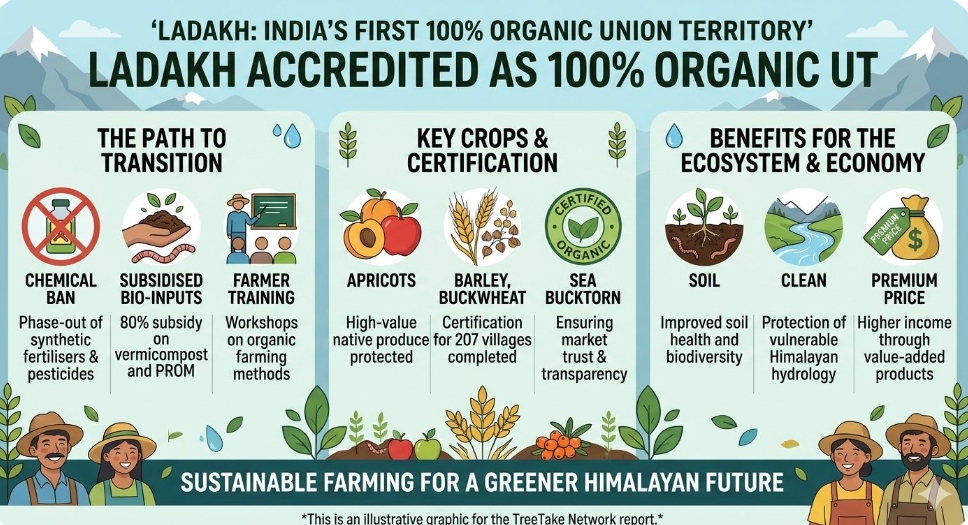
This milestone culminates a highly structured, multi-year administrative campaign to eliminate all synthetic additives from local agricultural practices. The administration implemented a decisive enforcement measure: an absolute legal prohibition on the procurement, distribution, marketing, and physical use of synthetic fertilisers and chemical pesticides across all regional agricultural holdings. To guarantee absolute compliance, local authorities have established a statutory baseline fine of 10,000 rupees for any unauthorised chemical usage.
To cushion the transition, the Ladakh administration distributed large consignments of certified organic inputs ahead of the primary sowing windows. Under the comprehensive Special Development Package (SDP), the government successfully procured and distributed over 20,000 quintals of bio-fertilisers, including high-grade vermicompost, potash, and Phosphate Rich Organic Manure (PROM). These natural fertilisers were heavily subsidised, provided to local cultivators at an 80 per cent subsidy to actively encourage wide adoption. A total of 207 mountain villages spanning the districts of Leh and Kargil achieved rigorous organic certifications, securing the agricultural foundation for native crops such as apricots, sea buckthorn, buckwheat, and high-altitude barley.
Administrative and executive assessments
In an official statement broadcast directly to the public, Lieutenant Governor Vinai Kumar Saxena stated: "A proud moment for Ladakh as it becomes India's first 100% Organic Union Territory, thanks to the dedication and hard work of our farmers. This milestone reflects our commitment to fulfilling environmental conservation and sustainable livelihoods." Highlighting the economic roadmap, Saxena added that the organic transition is expected to create new opportunities for Ladakh's farmers by improving the aggregate value of locally grown produce, adding: "Organic certification, better post-harvest management, value addition, branding and stronger market linkages can help farmers access consumers who increasingly seek authentic, traceable and organically produced food."
Complementing the executive summary, regional agricultural coordinators elaborated on the field operations, explaining that the administration has completely halted the bulk procurement of all external chemical fertilisers. Field officials noted that the primary objective remains focused strictly on enhancing baseline soil biology, improving domestic crop yields, and permanently insulating the highly vulnerable Himalayan hydrology from chemical runoff.
Editor's Note
Ladakh's successful elevation to a 100 per cent organic territory presents a powerful blueprint for sustainable high-altitude agriculture globally. The combination of direct legislative bans, heavy subsidies on bio-fertilisers, and village-level certification showcases the efficacy of aggressive top-down environmental regulation matched with community participation. However, the long-term viability of this ecological victory hinges on two upcoming challenges. First, local regulators must implement strict quarantine protocols to prevent the unmonitored commercial entry of chemically treated fruits and vegetables from neighbouring states, which could compromise internal market integrity. Second, the administration must aggressively finance state-backed supply chains, cold storage hubs, and global branding networks. Transforming this ecological designation into a premium economic advantage is the single most definitive way to secure the livelihoods of Himalayan farming communities against broader climate volatility.



Leave a comment