

TreeTake Network
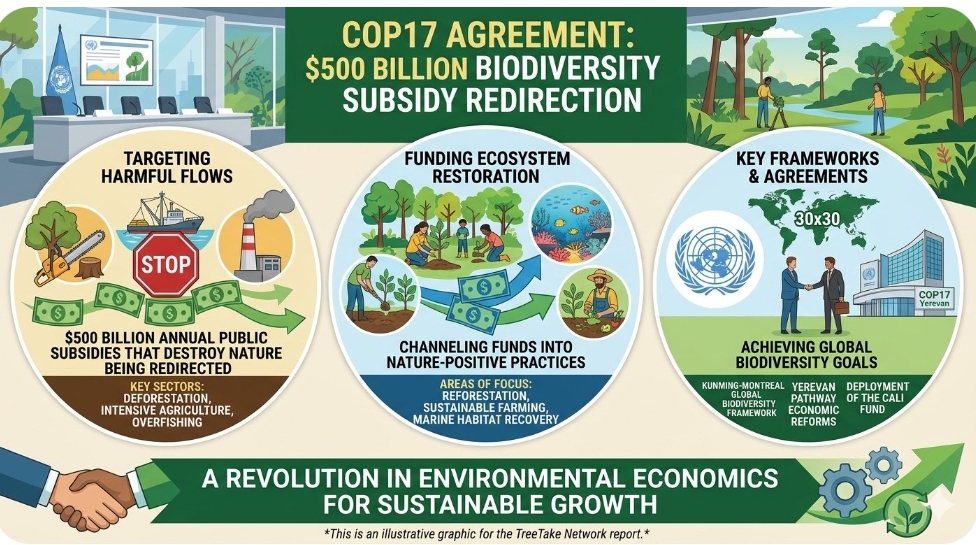
Governments navigating the high-stakes United Nations Biodiversity Conference (COP17) in Yerevan, Armenia, have reached a historic breakthrough to identify and repurpose massive financial flows currently devastating Earth's biospheres. Meeting at the critical midpoint of the global summit on October 27, 2026, a leading coalition spearheaded by Colombia, Finland, and France finalised a sweeping agreement to target, decouple, and redirect 500 billion US dollars of annual public subsidies that directly fund environmental destruction. The landmark economic shift is engineered to systematically defund activities causing deforestation, intensive monoculture depletion, and marine habitat collapse, effectively channelling those multi-billion-dollar streams into restorative, nature-positive ecological practices.
Closing the massive biodiversity finance deficit
The comprehensive framework tackles the single most structural operational barrier to international conservation: the extreme global deficit in ecological funding. By shifting financial incentives away from harmful exploitation, the agreement directly underpins the broader Kunming-Montreal Global Biodiversity Framework, which mandates the absolute protection of 30 per cent of the planet's terrestrial and marine ecosystems by 2030. To bridge the remaining implementation gaps, the agreement establishes strict international timelines to operationalise the newly formed Cali Fund. This specialised mechanism ensures the fair, equitable sharing of economic benefits derived from the commercial usage of digital sequence information on genetic resources, guaranteeing that indigenous communities receive direct financial compensation for protecting native biomes.
Diplomatic and economic executive assessments
Addressing delegates at the plenary session in the Armenian capital, the United Nations Ambassador for Armenia, Paruyr Hovhannisyan, emphasised the critical financial scale required to prevent global ecological collapse. In an official address delivered on October 27, 2026, Hovhannisyan stated: "The framework calls for at least 200 billion dollars annually from all sources by 2030, including at least 30 billion dollars in international biodiversity finance." Highlighting the urgency of the economic transition, Hovhannisyan added that moving from diplomatic rhetoric to verifiable execution remains the absolute priority of the Yerevan summit, noting that "COP17 is essentially about moving from promises to delivery".
Complementing the legislative roadmap, international environmental economists at the summit noted that under half of existing national ecological targets are currently on track to hit the 2030 deadline. Representatives from the United Nations Environment Programme (UNEP) added that while over 90 per cent of signatory states have formally established national biodiversity targets, these conservation efforts will remain entirely stalled on the ground unless governments aggressively execute the structural economic adjustments and subsidy eliminations formalised in the new Yerevan Pathway.
Editor's Note
The half-trillion-dollar subsidy redirection agreement achieved at COP17 marks a profound, long-overdue evolution in global environmental governance, addressing the fundamental economic drivers of ecological degradation. Historically, international conservation treaties have failed precisely because public funds actively subsidised the destruction of the very biomes that diplomatic declarations pledged to protect. By directly confronting these deeply entrenched economic distortions, the coalition of Colombia, Finland, and France has established a highly practical template for meaningful atmospheric and biological preservation. However, the definitive way forward relies entirely on national implementation and rigorous domestic accountability. Signatory states must immediately withstand intense internal lobbying from industrial agriculture, commercial logging, and marine extraction sectors that have long relied on these artificial financial cushions. Furthermore, wealthy nations must rapidly scale up their contributions to the Cali Fund to bridge the acute trust deficit between the Global North and developing nations. Without transparent, verifiable tracking mechanisms to ensure that these redirected funds are genuinely utilised for local ecosystem restoration, this half-trillion dollar breakthrough risks remaining a paper victory in an accelerating planetary crisis.



Leave a comment