

TreeTake Network
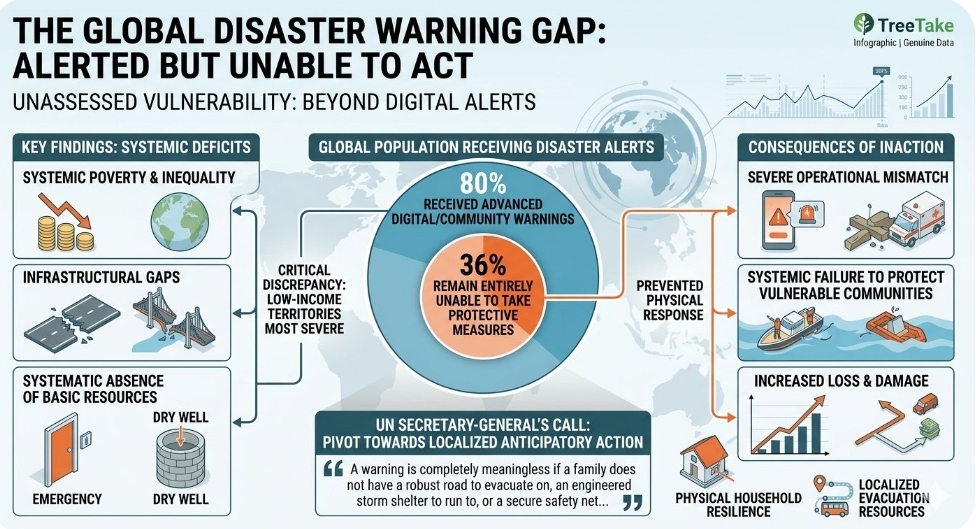
A major international assessment spearheaded by the United Nations Office for Disaster Risk Reduction has revealed an alarming global agency gap, finding that roughly 36 per cent of individuals who receive active emergency alerts remain entirely unable to take protective measures. Drawing on comprehensive data from the Lloyd's Register Foundation World Risk Poll released ahead of the International Day for Disaster Risk Reduction on October 13, 2026, the report confirmed that while nearly 80 per cent of disaster-exposed individuals over the last five years received advanced digital or community warnings, systemic poverty and infrastructural deficits frequently prevented any physical response. The structural discrepancy is most severe across low-income territories where basic transport links, emergency shelters, and community resources are systematically absent.
Commenting directly on the severe operational mismatch, United Nations Secretary-General António Guterres emphasised the critical necessity of physical safety infrastructure over mere digital infrastructure, stating:
"Sovereign nations are increasingly falling behind rising atmospheric vulnerabilities, and coordinated state action remains our most effective tool for collective survival. A warning is completely meaningless if a family does not have a robust road to evacuate on, an engineered storm shelter to run to, or a secure safety net to prevent total economic ruin."
The global body has called for a fundamental pivot towards localised anticipatory action, shifting focus away from simply distributing text-based alerts and moving toward building physical household resilience and localised evacuation resources.
Editor's Note
The data proves that technology alone cannot replace physical safety structures. Future funding models must prioritise local civil infrastructure and emergency mobility logistics over mere digital warning applications to bridge the survival divide.



Leave a comment