

Thinking Point
Shreyansh Singh
Uttar Pradesh Pollution Control Board Headquarters, Lucknow, Uttar Pradesh
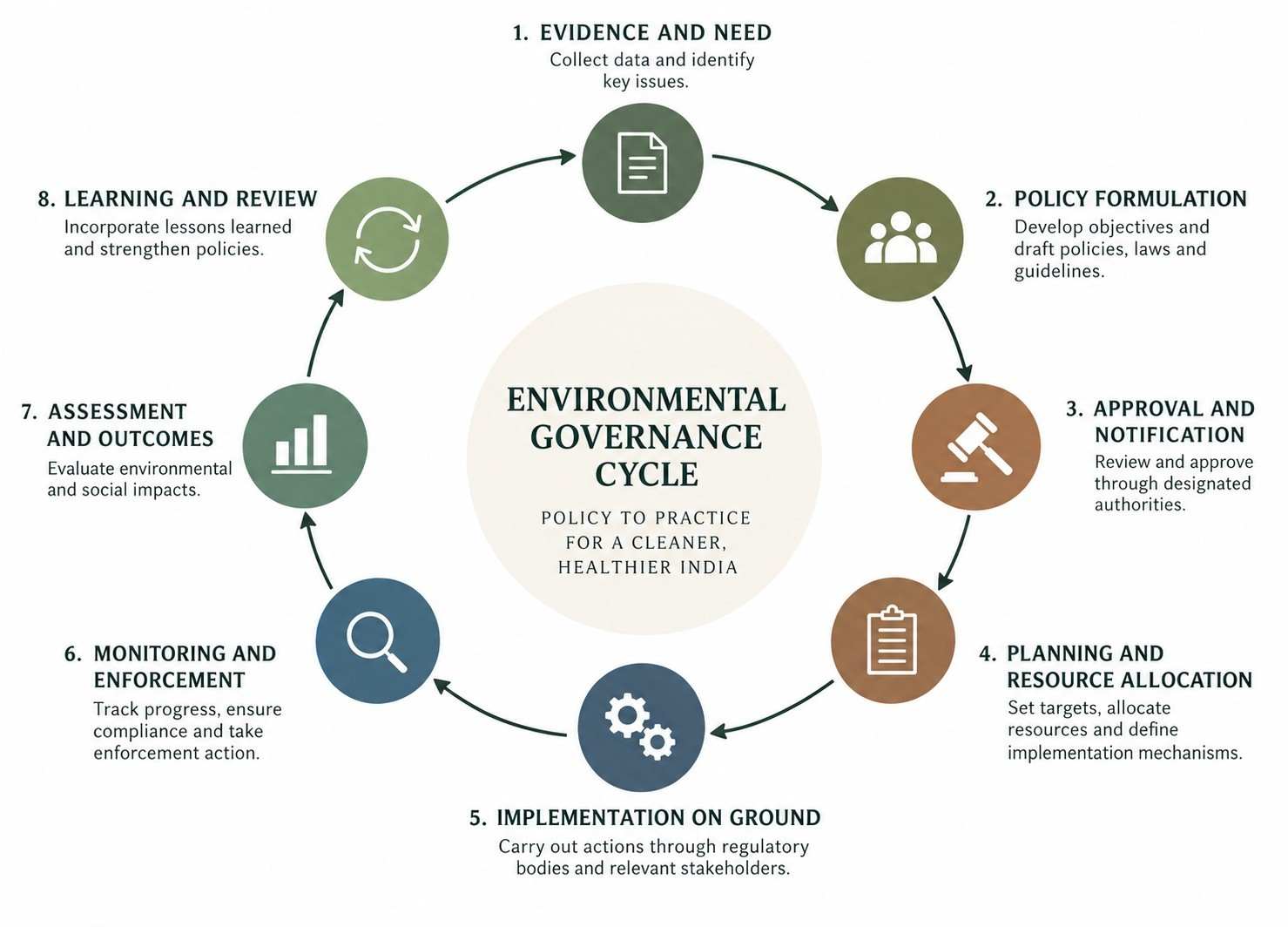
India’s environmental challenge is no longer a question of whether policies exist. The country has a wide and expanding framework of environmental laws, rules, standards, missions and climate commitments. The harder question is whether these commitments translate into consistent action where environmental pressures are actually felt: in districts, cities, industrial clusters, villages, farms, and river basins. This is where environmental governance becomes real. A policy can be designed in Delhi, a ministry can notify a rule, and the government can announce a national target, but its success ultimately depends on the quality of implementation on the ground.
This makes the district level particularly important. Districts sit between national and state policy and the communities, industries, local bodies and ecosystems that experience environmental change. They are also diverse. The environmental priorities of a drought-prone district in Bundelkhand are not the same as those of a rapidly industrialising district in western Uttar Pradesh, a flood-prone district in Bihar, or a coastal district facing erosion and saline intrusion. A uniform policy framework therefore needs local interpretation, local data and local enforcement to become effective.
India’s climate risks are already highly localised. A district-level climate risk assessment released in 2024 mapped flood and drought hazards, exposure and vulnerability across 698 districts. It identified substantial concentrations of districts facing very high or high flood and drought risks. Such assessments demonstrate an important point: climate change is a national problem, but its consequences are experienced at specific locations. Heat stress, water scarcity, flooding, crop losses, forest degradation and urban pollution do not occur at the national level in an abstract sense. They occur in particular landscapes and affect particular communities.
This is why climate action cannot remain primarily a matter of national targets. India has established the National Action Plan on Climate Change and State Action Plans on Climate Change to translate broad climate priorities into sectoral and state-level action. The next step is to make implementation sufficiently granular. District administrations, urban local bodies, panchayats, pollution control authorities, development agencies and line departments need to understand what climate and environmental risks mean for their own jurisdictions. Without this local connection, climate policy can become a document rather than a management system.
The same issue is visible in environmental regulation. India has developed an extensive legal structure covering air pollution, water pollution, waste management, environmental impact assessment, forest and biodiversity protection, hazardous substances and industrial operations. Yet the existence of a rule does not automatically produce compliance. Compliance depends on inspection quality, monitoring infrastructure, reliable records, technical capacity, laboratory support, enforcement decisions and follow-up. Where these elements are weak, even a well-designed regulation can have limited practical impact.
The gap between policy and practice is often described simply as an enforcement problem. That is only partly correct. In many cases, it is also a capacity problem. Local institutions may have limited technical staff, inadequate equipment, fragmented data and competing responsibilities. Recent national assessments of India’s net-zero transition have also recognised institutional capacity as a constraint, particularly for implementation agencies such as State Pollution Control Boards, urban local bodies and other delivery institutions. Stronger environmental governance therefore requires more than issuing stricter rules. It requires institutions capable of implementing them.
Waste management provides a useful illustration. Recent national data indicate that India generates around 1.85 lakh tonnes of solid waste every day. Although most waste is collected, a significant quantity is still not processed or treated and continues to place pressure on disposal systems. The notification of the Solid Waste Management Rules, 2026, which expands responsibilities and brings rural local bodies more explicitly into the framework, reflects the growing need for shared responsibility. But expanding legal responsibility without strengthening institutional capacity can create a compliance framework that is ambitious on paper but uneven in practice.
District-level environmental governance should therefore move from reactive administration to continuous environmental management. Instead of responding only after pollution complaints, flooding, waste accumulation or industrial violations become visible, districts can use environmental data to identify risks before they become crises. Air quality trends, groundwater levels, waste generation, land-use change, industrial emissions, forest cover, rainfall patterns and heat exposure can be combined to identify local priorities. The objective is not to create another complicated dashboard. It is to create a simple decision system that tells administrators where the environmental pressure is increasing and where intervention is most urgent.
Technology can support this transition, but technology alone will not solve the governance problem. Online monitoring systems, satellite data, geographic information systems, remote sensing, digital consent and compliance systems can make environmental management faster and more transparent. However, data are useful only when institutions have the authority, expertise and willingness to act on them. A sensor that records an exceedance but does not trigger verification or corrective action adds information without necessarily improving environmental outcomes. The real value of digital governance lies in connecting monitoring with inspection, enforcement and follow-up.
Another essential reform is convergence. Environmental issues are rarely confined to a single department. Urban flooding may involve drainage, land use, roads, solid waste and wetland protection. Groundwater depletion can involve agriculture, industry, drinking water supply and local planning. Air pollution can involve transport, industry, construction, waste burning and energy use. District-level governance can provide a practical platform for bringing these departments together around shared environmental outcomes rather than separate departmental targets. Climate action becomes much more meaningful when it is integrated into routine development decisions.
Local governments also need a stronger role. Municipalities and panchayats are closest to waste collection, water management, local infrastructure, sanitation, public spaces and many decisions that shape environmental quality. Yet local institutions often face financial, technical and human-resource constraints. Giving them additional responsibilities without adequate resources risks shifting accountability without creating capacity. Environmental governance should therefore be accompanied by predictable financing, technical support, training and clear division of responsibilities between departments and levels of government.
India’s climate goals make this shift increasingly important. The country’s transition toward a lower-carbon and more climate-resilient economy will involve decisions about energy, transport, buildings, industry, agriculture, water, forests and waste across thousands of local jurisdictions. National progress will be the combined result of these individual decisions. A district that improves industrial energy efficiency, protects wetlands, strengthens waste processing, reduces open burning, restores degraded land and prepares for heat and flood risks is not merely solving a local problem. It is contributing to national resilience and climate objectives.
The way forward is therefore not to create another layer of bureaucracy, but to make existing institutions work better together. Every district should be able to identify its major environmental risks, maintain reliable baseline data, assign responsibility, monitor compliance and measure whether interventions are producing results. Environmental performance should be judged not only by the number of inspections conducted or projects approved, but by measurable changes in pollution, resource efficiency, ecosystem condition and community exposure. This would move governance from counting activities to measuring outcomes.
India has already built much of the policy architecture required for environmental and climate action. The next challenge is implementation at the scale where environmental reality exists. National policies provide direction, states provide frameworks and resources, but districts and local institutions convert those frameworks into everyday decisions. Strengthening that last mile is therefore not a minor administrative reform. It is central to whether India’s environmental laws, climate commitments and sustainability ambitions produce visible results. The future of environmental governance will depend less on how many new policies we create and more on how effectively existing ones are understood, enforced, coordinated and delivered on the ground.



Leave a comment