

Green Update
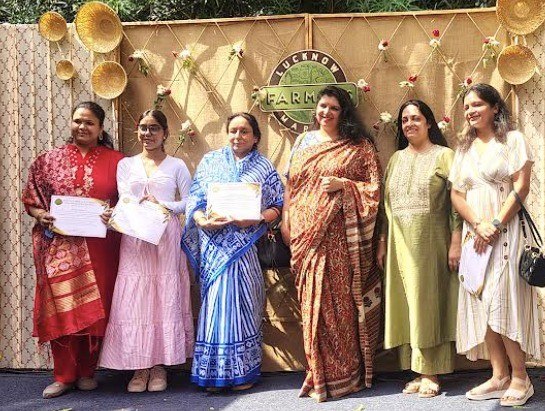
The October edition of the Lucknow Farmers Market (LFM) event stood out as a powerful testament to innovation, community impact, and environmental stewardship, placing the spotlight firmly on women entrepreneurs who are redefining business through the lens of sustainability. Organised as a celebration of conscious living, the event brought together a diverse group of trailblazers dedicated to driving ecological and social change. From transforming temple waste into premium corporate gifts to educating the next generation on climate action and circular economies, these leaders are proving that profit and purpose can seamlessly coexist. Treetake Magazine presents an inspiring look at the remarkable women and youth initiatives honoured at this month’s event.
1. Holy Shrine Incenses: Creating Value and Dignity. Led by Ujjwala Shanker
Guided by the mission statement, "creating value in the lives we touch," Holy Shrine Incenses addresses environmental degradation by recycling floral waste from temples. This innovative intervention prevents the eutrophication of the Gomti River and diverts massive amounts of waste from landfills. The partnership firm utilises these recycled flowers across two impactful verticals:
• Kaushal Bodh Initiative: Providing vital skill development in incense making for school children as part of the Kaushal Bodh program.
• Premium Corporate Gifting: Supplying eco-friendly, high-quality incense products perfectly aligned with corporate Environmental, Social, and Governance (ESG) parameters.
Operating under the empowering tagline "jeet tumhari hai," the venture champions a win-win model for all concerned parties. The project actively trains rural women and specially-abled individuals, fostering true social inclusion. Beyond teaching a life skill, the training enhances inner calm, focus, and motor control while instilling a collaborative approach to labour. This holistic project proudly introduces a curious, entrepreneurial mindset in young minds, leading them directly toward sustainable development goals. The project aligns with 9 out of the 17 United Nations Sustainable Development Goals (SDGs), proving that commercial viability can elevate human dignity and protect the planet.
2. SparkLiv: Driving Actionable Behaviour Change. Co-founded by Radhika Mishra & Priyank Mishra
For the founders of SparkLiv, the journey into sustainability began on the streets of Lucknow, sparked by the sight of municipal sanitation workers manually sorting mixed waste by hand. Realising how something as simple as segregating waste at source could make a huge difference, not just for the environment but also for the dignity and safety of those handling our waste, the venture evolved from waste management awareness to addressing global plastic crises and circularity. After a decade-long career in Human Resources, the founder chose to channel her extensive experience of working with people into creating long-lasting behaviour change for a more sustainable future. Alongside her husband and co-founder, Priyank, she established SparkLiv to partner with institutions on sustainability education, waste management, circularity, climate action, and sustainable living. Through targeted workshops, educational campaigns, community collection points, and unique upcycling initiatives, SparkLiv successfully transitions citizens from passive awareness to active daily action. The venture operates on the core belief that sustainability does not require grand gestures; it begins with the small, conscious choices we make every single day.
3. FICCI FLO Lucknow Chapter: Championing the Circular Economy. In-charge Sonam Sinha
Leading the charge for systemic change, the In-charge of the Circular Economy at the FICCI FLO Lucknow Chapter is deeply passionate about creating a sustainable future and inspiring collective climate action. Focusing heavily on grassroots mobilisation, her initiatives focus on encouraging reduced plastic use, organising community plastic and e-waste collection drives, and seamlessly connecting local waste collectors with professional recyclers to promote responsible waste management. Education forms a cornerstone of her strategy. By conducting immersive awareness sessions in schools, she educates children on the life cycle of plastics, the severe impact of plastic on the environment, and challenges them to take on sustainability challenges. Her ongoing work continues to expand throughout the region, successfully motivating communities, individuals, and youth to safeguard Mother Earth through responsible, real-world waste management.
4. Fresh Flowers Direct: Everyday Art Infused with Purpose. Founded by Sheza Nabi
Fresh Flowers Direct, founded by Sheza Nabi, is a dynamic, women-led floral venture built on the principle that flowers can be more than just an occasion—they can be an everyday form of art, expression, and design. The brand has matured into a comprehensive floral solutions company spanning bespoke bouquets, subscriptions, weddings, events, floral décor, and large-scale corporate installations. Each arrangement is treated carefully as a sculptural medium, blending contemporary international aesthetics with highly personalized customization. Accessibility remains central to their operations, offering premium floral experiences ranging from everyday arrangements to midnight deliveries across Lucknow. Operating in an industry centred around beautiful but highly perishable products, Fresh Flowers Direct is actively integrating sustainable practices into its growth. The brand is systematically implementing mindful sourcing protocols, thoughtful packaging, reducing unnecessary waste, using reusable elements, and finding creative ways to give flowers a second life through dried-flower applications, repurposing, and composting. As a commercially ambitious yet highly conscious business, the venture focuses on generating meaningful employment opportunities for women, supporting local ecological ecosystems, and demonstrating that creativity, entrepreneurship, and sustainability can grow together.
5. KOFFECO & VitaMuch Active: Mindful Living at Home. Founded by Ankita Agrawal
Ankita Agrawal, the entrepreneurial force behind KOFFECO and VitaMuch Active, firmly believes that the true foundation of global sustainability begins within the domestic sphere. Alongside scaling her consumer brands, she advocates for embedding mindful, eco-friendly choices into the fabric of everyday family life, within her home, and local neighbourhoods. Reflecting on her philosophy, Ankita notes: “Sustainability, for me, starts with small things. It could be reusing something instead of throwing it away, giving old things a new purpose, or simply being more conscious about what we consume. I also love involving my children in these little efforts, because I feel the values we practice at home stay with them. We may not be able to change everything overnight, but if each of us makes a few thoughtful choices every day, together they can create a much bigger difference.”
6. The Possibility Project: Youth-Led Climate Innovation. Led by Yashasvi, Disha and Riya
Emerging from the Vartaalaya youth group, the Possibility Project asks powerful questions: What if leftover clay could become a keychain? What if an old newspaper could become a school bag? Recognising that young people thrive when given creative agency rather than rigid instructions, the project blends art, storytelling, games, and community dialogue to transform ordinary waste into functional objects. The project has catalysed three distinct youth-led eco-initiatives:
• Creative Chaos by Yashasvi: Rooted in a "Waste to Best" philosophy, this initiative repurposes leftover paper, clay, and other materials into origami, paper bags, painted bags, and handmade keychains. Yashasvi’s work has scaled remarkably, engaging over 1,000 children at a major UNICEF event, introducing waste-paper crafts to students at Aminabad Inter College, and designing sustainable handmade keychains for over 70 participants across 12 organisations at the Lucknow Dialogue League.
• The Art Circle by Disha: Built on the belief that creative expression belongs to everyone, Disha hosts youth art workshops, designs creative spaces, and curates public art stalls. Notably, she executed collaborative wall art in partnership with the Badlav Foundation. Her recent 21 Days of Mental Well-being Journal uniquely marries sustainability with mental health, featuring over 60 reflective activities that invite individuals to pause and express themselves.
• Humdhara by Riya: Launched at the Tata Institute of Social Sciences (TISS), Riya structured a sustained six-month educational journey for local school students. Rather than relying on static, one-day awareness seminars, the program provided long-term opportunities for over 30 children to explore sustainability principles.
For Vartaalaya, the physical objects created through the Possibility Project are merely entry points. A paper bag can become a conversation about consumption, or a game can become a conversation about relationships. The true value lies in the shifts in mindset, consumer awareness, and community relationships that follow. Over the past few years, these youth spaces have empowered young leaders to design tools, facilitate complex conversations, work with communities, create art, experiment with waste, and design learning journeys for others. The Possibility Project is therefore not simply about eco-friendly crafts; it is about nurturing a resilient mindset that sees boundless potential where others see waste.



Leave a comment