

Selfless Souls
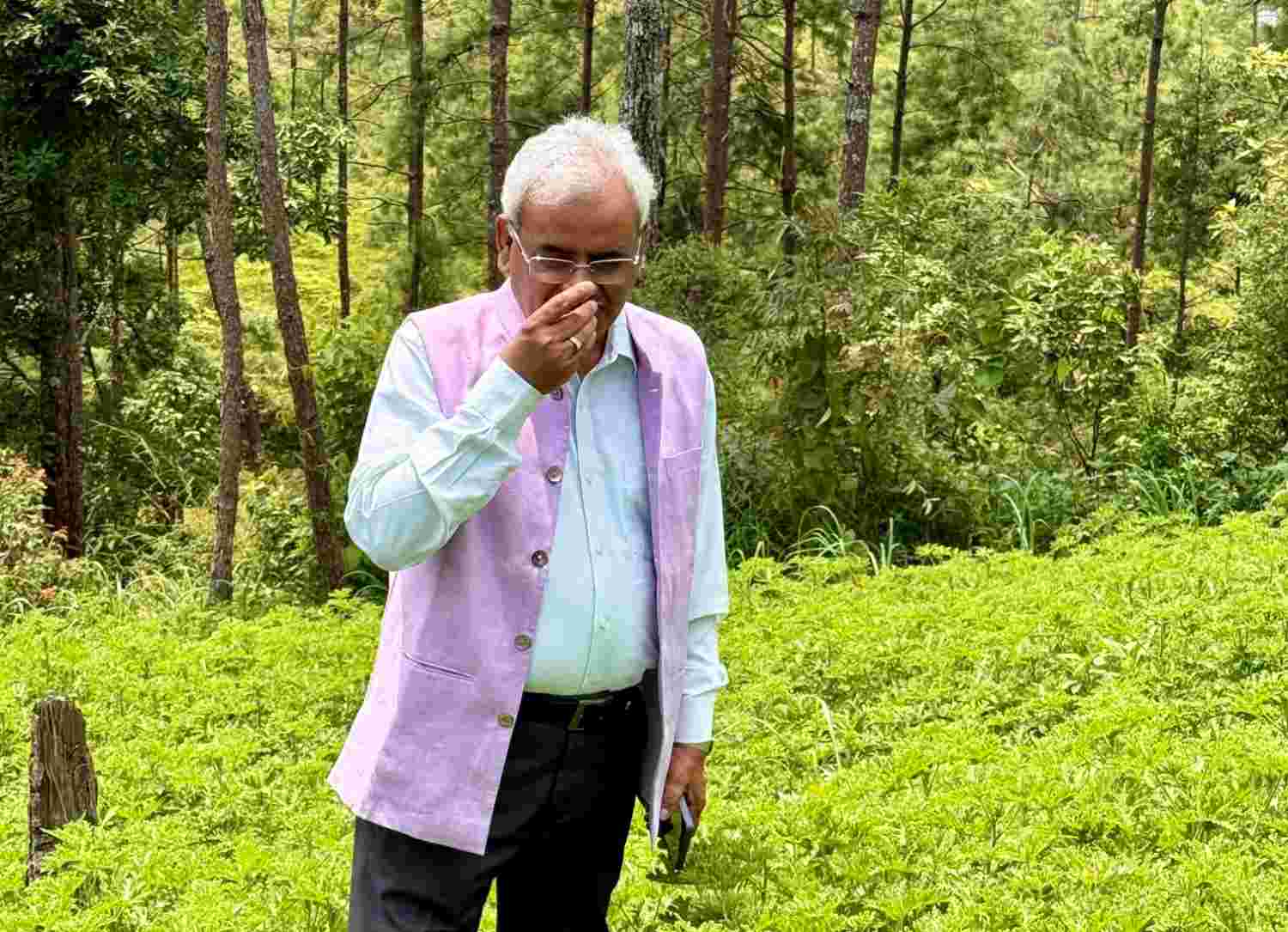
Dr Prabodh Kumar Trivedi, director of CSIR-Central Institute of Medicinal and Aromatic Plants (CSIR-CIMAP), is a distinguished scientist with over three decades of pioneering contributions to plant genomics and biotechnology. His research has advanced the understanding and engineering of plant systems at the molecular level, particularly through elucidation of biosynthetic pathways and their regulatory networks in medicinal, aromatic, and crop plants, bridging fundamental science with translational applications. He provides visionary leadership in interdisciplinary research at CSIR-CIMAP and currently serves as theme director of CSIR’s AgriNutriBiotech programme and mission director of the CSIR Aroma Mission and Plant Genome-editing Mission.
Q: You have achieved the highest academic honours as a Fellow of India's premier science academies, yet your work heavily impacts the grassroots levels. How do you structurally align CIMAP’s advanced plant genomics and biotechnology with a selfless mission to uplift the country’s most marginal and resource-poor farmers?
I have always believed there should be no divide between cutting-edge science and the farmer standing in the field. In fact, the purpose of advanced science is ultimately to solve problems that matter to society. At CIMAP, we try to create a complete pathway, from gene to field and from laboratory to livelihood. Our work in genomics, biotechnology, breeding, metabolomics and phytochemistry is directed towards developing superior varieties and technologies, but we do not consider the job complete when a paper is published or a technology is patented. The real test is whether a farmer can access the variety, cultivate it successfully, obtain good productivity and quality, and ultimately improve his or her income. This is why CSIR-CIMAP works through demonstration plots, farmer training, planting material distribution, field trials, distillation technologies, entrepreneurship programmes and partnerships with state agencies and industries. We particularly focus on regions where farmers have limited resources and medicinal and aromatic plants can provide an additional or alternative source of income. For me, scientific excellence and social responsibility are not two different objectives. They are two parts of the same responsibility. The better our science, the greater its ability to serve society should be.
Q: In a world focused on corporate profits, how does CIMAP preserve the ethos of open science and public welfare—ensuring that high-yielding medicinal varieties reach the fields as a service to humanity rather than commercial monopolies?
I don't see industry and public welfare as opposing forces. Industry is an important partner in scaling technologies, but public research institutions have a different responsibility. Our primary responsibility is to ensure that the knowledge and technologies generated through public investment create broad societal value. At CSIR-CIMAP, we therefore strive to maintain a balance among intellectual property protection, technology transfer, and accessibility. When we develop an improved medicinal or aromatic plant variety, the objective is not simply to create an intellectual property asset. The objective is to make that innovation useful. We work with farmers, entrepreneurs, government agencies and industry so that technologies can move beyond the laboratory. At the same time, we remain conscious that technologies developed with public resources should not become inaccessible to the very communities they are intended to benefit. I would put it very simply: science should create value, but that value should not be confined to those who can afford to buy it. We aspire to create a system in which scientific innovation generates economic activity while retaining its fundamental character as a public good.
Q: CSIR-CIMAP’s recent initiatives focus heavily on recycling temple flower waste to provide livelihood and employment. What was the personal, empathetic spark that turned a simple environmental issue into a social enterprise that restores dignity and sustenance to rural communities?
For me, the important part of the temple-flower-waste problem was not only the waste itself. It was the question: Can something that we consider waste become a source of dignity and livelihood for someone else? Every day, enormous quantities of flowers are offered in temples with great devotion. After the religious purpose is fulfilled, those flowers often become waste and can contribute to pollution. As a scientist working with plants, I naturally began to look at them differently, not as waste, but as a biological resource containing valuable molecules. But the scientific opportunity was only one part of the story. The more important question was how to connect that opportunity with people who need livelihoods. That led us to think beyond extraction or recycling and towards a complete livelihood model: collection, processing, value addition, product development, training and entrepreneurship. What touches me most is that such initiatives can create opportunities for people who may not have access to advanced education or substantial capital. They can participate in the value chain with their skills and labour. For me, that is what responsible science means: finding value where society sees waste and finding opportunity where society sees disadvantage. The greatest success is not the product that comes out of the laboratory; it is when someone says, “Because of this initiative, I can support my family.”
Q: During your career or leadership at CSIR-CIMAP, what has been a personal sacrifice or silent challenge you had to navigate to ensure that life-changing agricultural technologies didn't stall in labs but reached the people who needed them most?
I would not describe my journey as a sacrifice. I would describe it as persistence. One of the biggest challenges in public-sector science is that moving an idea from the laboratory to the field is much harder than generating it. A promising variety or technology has to undergo scientific validation, multiplication of planting material, field demonstrations, regulatory processes, training, market development, and finally adoption by farmers. There are many points at which a technology can stop moving. Over the years, there have been periods when administrative responsibilities, scientific work, field programmes and institutional commitments demanded very long hours and considerable travel. But I have always felt that if a technology has the potential to improve someone's livelihood, we have a responsibility to keep pushing it forward. There are also disappointments: technologies that take longer than expected, programmes that face logistical difficulties, and ideas that do not work the first time. One learns to accept these as part of public science. I have never considered the effort extraordinary. If we have been allowed to work with public resources and public institutions, perseverance is simply part of the responsibility that comes with that privilege.
Q: As a scientist and mentor, you routinely open CSIR-CIMAP’s doors to hundreds of school and college students during foundation days. Beyond teaching them molecular biology, how do you intentionally spark a sense of community responsibility and selfless national service in these young minds?
When young students visit CIMAP, I don't want them to leave simply knowing what DNA, genes or plant biotechnology. I want them to leave with a different question in their minds: “What can I do with the knowledge I acquire?” India has invested enormously in science education and scientific institutions. The next generation, therefore, has a responsibility to use that knowledge not only for personal success but also for society. I try to tell students that there are many ways of serving the nation. A scientist can develop a new technology; an entrepreneur can create employment; a doctor can serve patients; a teacher can transform a child's future; and an engineer can solve a problem affecting millions. During their visits, I try to show them the entire journey of science, from a laboratory experiment to a farmer's field, from a plant variety to a livelihood and from an idea to a societal impact. I also tell them that success should not be measured only by the position we eventually occupy. It should also be measured by how many people are better off because we were there. If even a few students carry that thought with them, I consider the interaction worthwhile.
Q: When your journey in scientific administration is eventually looked back upon, what is the 'unseen footprint' you hope to leave behind? Would you measure your ultimate legacy by the academic papers published, or by the silent, profound changes in the lives of the farmers you have served?
Papers, patents, awards and positions are visible markers of a scientific career. They are important, but they are not the legacy I would ultimately measure myself by. I would like my unseen footprint to be in three places. First, in the institution: to leave CSIR-CIMAP stronger, more collaborative, more innovative and more connected to society than when I had the opportunity to serve it. Second, in young scientists: if some of the students and colleagues I have mentored become better scientists, better human beings and better citizens, that would give me enormous satisfaction; and third, in the lives of farmers and communities. If a medicinal or aromatic plant variety developed at CSIR-CIMAP provides a farmer with a better income; if a technology creates employment; if a young person finds an opportunity because of something we developed; those are outcomes that may never appear in a citation index, but they are perhaps the most meaningful measure of science. Ultimately, I would like to be remembered less for the number of papers I published and more for the number of doors I helped open for other people. Science gives us knowledge. Leadership allows us to convert that knowledge into service. For me, that is the real meaning of a scientific career.



Leave a comment