

TreeTake Network
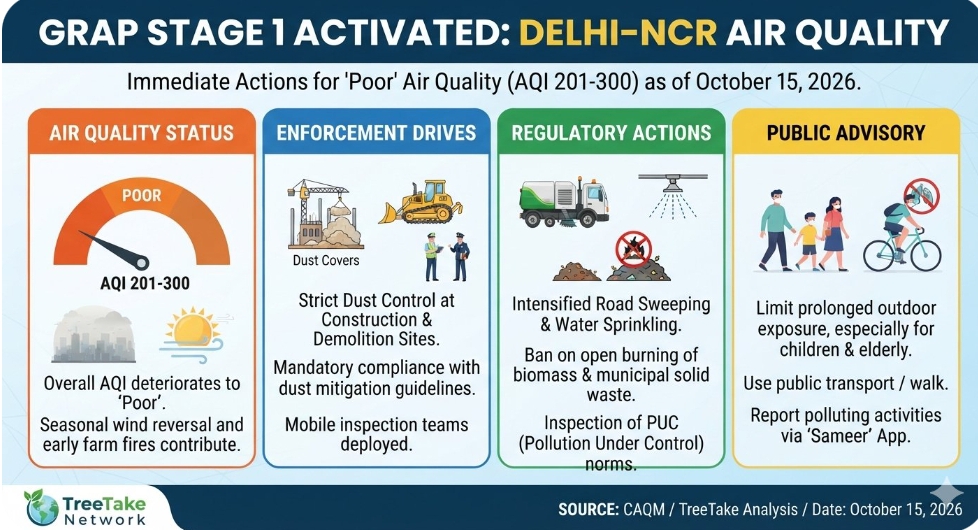
The Commission for Air Quality Management (CAQM) on October 15, 2026, officially ordered the implementation of Stage 1 of the Graded Response Action Plan (GRAP) across the National Capital Region. The sudden structural intervention follows a sharp deterioration in the local air quality index, which crossed the threshold into the 'poor' category due to a combination of seasonal wind reversals and early-harvest agricultural operations.
According to regional meteorological stations, high particulate matter levels have begun accumulating across central monitoring corridors. "We are observing a typical seasonal atmospheric boundary layer descent combined with calm surface winds," stated Dr Ananya Sen, a senior atmospheric physicist specialising in urban airshed dynamics. "The next forty-eight hours remain critical as wind vectors shift entirely towards the north-west, meaning local dust mitigation must happen immediately."
Under the newly activated mandates, heavy dust mitigation protocols have been imposed across active infrastructure projects. State pollution control boards have deployed mobile inspection units to penalise open waste burning and regulate commercial diesel generator operations. Heavy road-sweeping machinery and water-sprinkling trucks have also been mobilised across high-density traffic junctions to suppress resuspended road dust.
"Enforcement agencies must show zero tolerance for violations during this initial phase," noted Dr Rajesh Malhotra, an environmental policy analyst monitoring regional compliance. "If we do not strictly curtail urban dust emissions right now, the cumulative effect when transport smoke arrives will be exponentially harder to manage." Local health networks have simultaneously issued advisories recommending vulnerable demographics limit intensive early-morning outdoor physical activities.
Editor's Note: The immediate, proactive activation of Stage 1 highlights an improved administrative readiness compared to previous years. However, long-term regional air stabilisation requires shifting away from reactionary seasonal containment towards year-round systemic transitions in agricultural residue management and transport infrastructure optimisation.



Leave a comment