

TreeTake Network
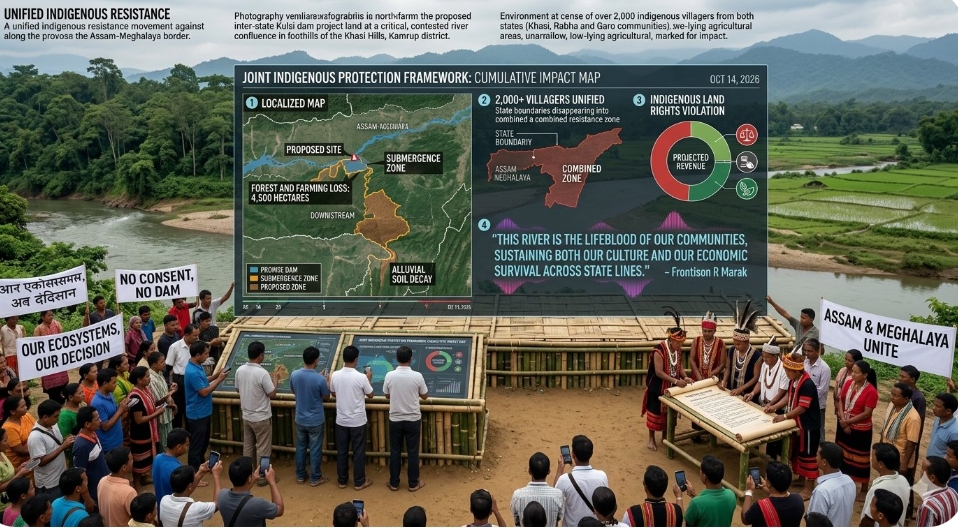
A powerful grassroots alliance comprising over 2,000 indigenous villagers along the volatile Assam-Meghalaya border has formally organised a unified resistance campaign today, Oct 14. The joint mobilisation aims to halt the planned construction of the massive multi-purpose hydropower dam project over local river networks, which communities argue will cause irreversible ecological devastation and displace thousands of forest-dependent families.
Indigenous Communities Form United Protection Front
The inter-state coalition was cemented during an emergency joint council meeting held in the border district of Kamrup. The gathering brought together traditional village headmen, indigenous farming collectives, and local youth organisations from both states, who signed a binding solidarity pact to resist any unilateral land acquisition or geological surveying by state engineers.
The targeted multi-purpose project, designed to generate electricity and control seasonal floods, is projected to submerge vast tracts of community-managed forests and agricultural lowlands along the Khasi Hills foothills. Environmental reviews conducted by local ecological groups indicate that the damming of these continuous river channels will completely disrupt downstream sediment flows, effectively destroying the fertile alluvial soil systems that support the region's traditional betel nut and ginger cultivation.
Grassroots Leaders Condemn Lack of Environmental Consent
Community representatives stated that the state governments have systematically excluded indigenous populations from the project's planning phases, violating statutory frameworks that mandate prior informed consent for developmental interventions on traditional lands.
"We will not allow our ancestral lands, rivers, and forests to be drowned under the guise of state development," stated field organiser and local coordinator Frontison R Marak during the border convention. "This river is the lifeblood of our communities, sustaining both our culture and our economic survival across state lines. The governments have hidden the true environmental impact assessments from us. Our united coalition represents a clear, uncompromising declaration that we are prepared to legally and physically defend our ecosystems from this destructive infrastructure."
Editor's Note
The emergence of a unified, cross-border grassroots coalition reflects a growing resistance against top-down infrastructure projects that ignore local ecological realities. For decades, inter-state boundary disputes between Assam and Meghalaya have stalled cooperative environmental planning, allowing state corporations to push resource-extracting agendas with minimal joint oversight. By overcoming historic political divisions to form a single ecological protection front, these indigenous communities are demonstrating a sophisticated understanding of watershed governance. The sustainable path forward requires the immediate suspension of all dam-related engineering tenders and the implementation of a comprehensive, independent cumulative impact assessment that treats the entire river basin as a shared ecological asset. Until the constitutional rights of forest-dwelling populations are integrated directly into regional development models, infrastructure expansion will continue to trigger intense social and environmental conflict.



Leave a comment