

TreeTake Network
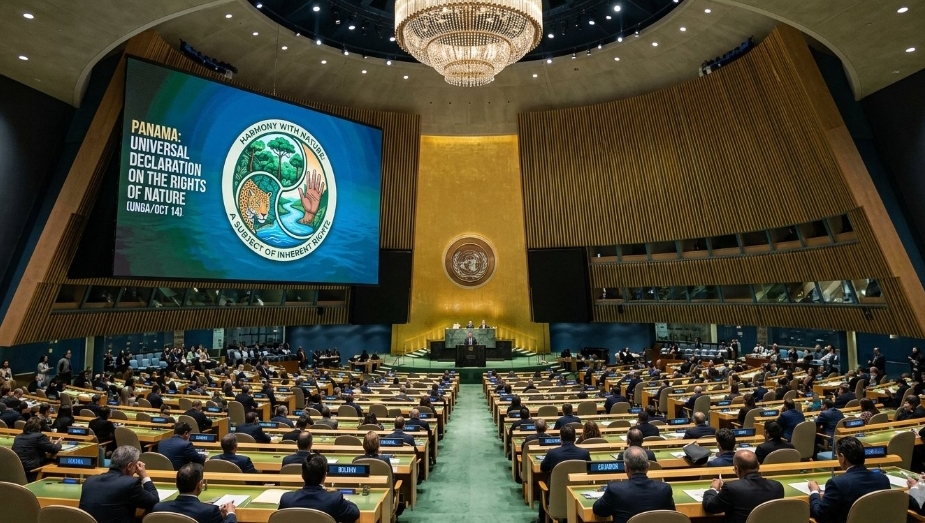
The Republic of Panama has formally submitted a legislative framework to the United Nations General Assembly today, Oct 14, calling for a universal declaration that recognises ecosystems as living entities with legal rights. The diplomatic initiative seeks to elevate nature from a mere resource under human ownership to a distinct subject of international law possessing inherent rights to exist, persist, and regenerate.
Pushing Ecocentric Law Onto the Global Stage
The official proposal was presented under the United Nations Harmony with Nature agenda in New York. Panama’s framework outlines a comprehensive legal structure modelled after its own national legislation, which enshrined the rights of nature into state law. The international document argues that traditional environmental regulations have failed to stop global biodiversity collapse because they merely manage the rate of destruction rather than preventing it.
The proposed UN declaration would establish a statutory obligation for member states to evaluate the impact of industrial, agricultural, and infrastructural projects through an ecocentric lens. It also includes mechanisms for local and indigenous communities to act as legal guardians for threatened river basins, forests, and marine ecosystems, allowing them to file lawsuits on behalf of damaged habitats in international courts.
Moving From Resource Ownership to Inherent Rights
Panamanian delegates stated that treating nature as a legal person is a necessary evolutionary step in international law to counter accelerated climate instability and habitat fragmentation.
"We are addressing the United Nations because local environmental laws are no longer enough to stop transboundary ecological destruction," stated Juan Carlos Navarro, Panama's Minister of Environment, during the General Assembly presentation. "Ecosystems do not recognise political borders. Just as human rights were universalised last century, we must now formally recognise that nature has an inherent legal right to exist and recover. To continue treating the biosphere as mere property is to guarantee our own collective ruin."
Editor's Note
Panama's bold diplomatic move highlights a profound philosophical shift that is steadily gaining traction within international environmental jurisprudence. For decades, the global legal order has operated on an anthropocentric model, viewing the natural world as a passive economic asset to be exploited, partitioned, or minimally conserved. By demanding a UN declaration, Panama is attempting to institutionalise a model where nature is given a permanent voice in courts of law. However, the true hurdle for this framework will be enforcement. Without a binding global tribunal or severe economic penalties for non-compliance, such a declaration risks being reduced to symbolic rhetoric by major industrialised nations. The path forward requires integrating these rights directly into international trade agreements, forcing economic blocs to penalise imports tied to ecosystem destruction.



Leave a comment