

TreeTake Network
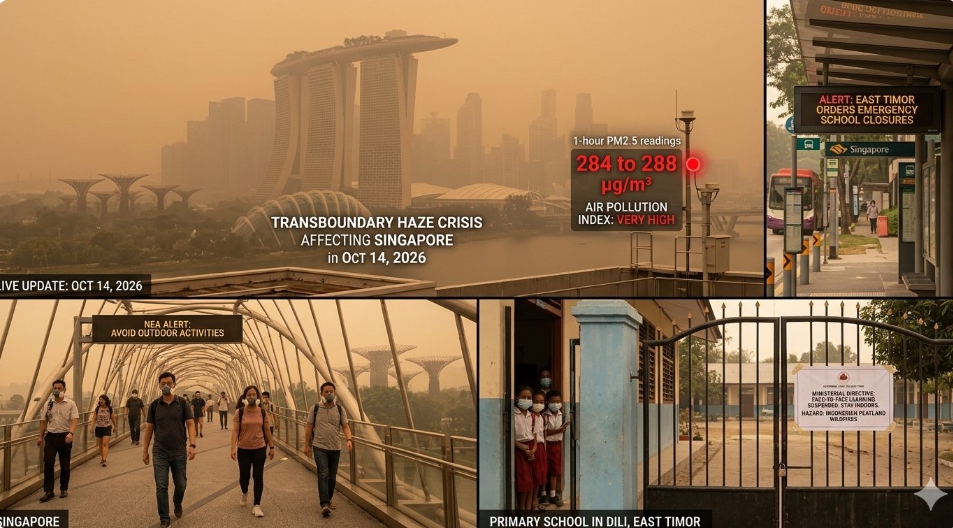
A severe transboundary environmental crisis has gripped Southeast Asia today, Oct 14, as intensifying smoke from massive peatland wildfires in Indonesia blankets neighbouring nations. The sudden influx of toxic haze has forced regional governments to activate emergency public health protocols, driving Singapore's air pollution metrics to their highest levels of the year and prompting East Timor to execute a total shutdown of physical classrooms.
Singapore Trapped in Critical Haze Band
In Singapore, atmospheric monitoring frameworks tracked a rapid deterioration in air quality throughout the day. Official data published by the National Environment Agency confirmed that the 1-hour PM2.5 readings peaked at a dangerous 284 micrograms per cubic metre in the western region, officially pushing the state's air index deep into the "very high" pollution band. The persistent, acrid smog has triggered widespread respiratory complaints, prompting health authorities to advise all vulnerable citizens, children, and the elderly to avoid outdoor activities entirely.
The National Environment Agency reported that the localised spike is directly linked to a massive surge in wildfire hotspots across the Indonesian territory, particularly within the low-lying peatlands of Sumatra and Kalimantan. Due to an unusually prolonged and intense El Niño climate phase, these carbon-rich soils have dried out completely, making the seasonal, illegal slash-and-burn land clearing methods deployed by commercial entities highly unmanageable and destructive.
Academic Operations Suspended in East Timor
Concurrently, the extreme density of the drifting toxic plumes has caused an immediate public health emergency further south in East Timor. The central government issued an extraordinary ministerial directive today ordering a three-day nationwide suspension of all face-to-face classroom learning, effective from tomorrow morning, to shield millions of school-aged children from prolonged particulate exposure.
Medical facilities across East Timor's capital have already reported an acute influx of patients presenting with severe respiratory infections, asthma exacerbations, and ocular inflammation. "The air quality index in our urban centres has completely collapsed due to this transboundary smoke," stated Dr. Manuel da Costa, director of respiratory medicine at the National Hospital in Dili, during a press briefing today. "Suspending schools is a critical preventative measure. The concentrations of fine particulate matter currently blanketing our streets are far too dangerous for developing lungs, and we must keep children indoors until the wind patterns shift."
Editor's Note
The escalating transboundary crisis highlights the ongoing failure of regional diplomatic mechanisms to resolve Southeast Asia's annual burning problem. Despite decades of multilateral clean-air agreements, commercial entities continue to exploit weak local enforcement to clear vast tracts of land using cheap, highly destructive fires. Relying on defensive actions like school closures and air filtration setups only treats the medical symptoms of a deeper geopolitical failure. The sustainable path forward requires the immediate operationalisation of cross-border corporate liability laws, allowing affected nations to legally penalise and seize the assets of supply-chain companies whose fires originate across international borders. Until land management practices are forcefully overhauled, regional health will remain entirely dependent on shifting wind directions.



Leave a comment