

TreeTake Network
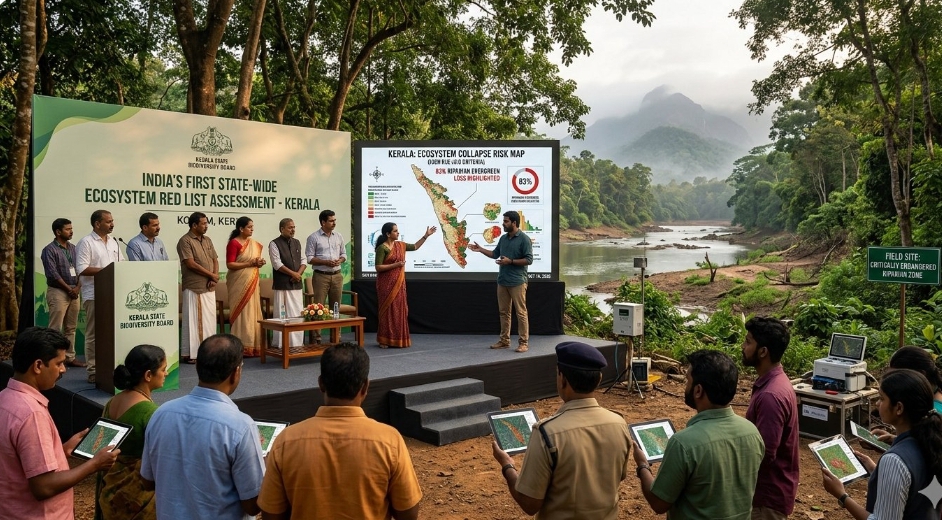
The Kerala State Biodiversity Board formally launched India's inaugural state-wide Red List Assessment of Ecosystems during a high-level scientific convention in Kollam on Oct 14. The ambitious one-year environmental undertaking has been designed to systematically evaluate, map, and classify the accelerating collapse risks of distinct natural habitats across all 14 districts of the state. This urgent macro-level intervention follows comprehensive botanical and geographical reviews confirming that specialised tropical riparian evergreen forests across the southern Western Ghats have suffered a devastating 83 per cent reduction in structural area over the past century.
Implementing Global IUCN Criteria to Target Severe Habitat Fragmentation
The state-wide scientific project is being executed through a specialised collaborative research consortium comprising the Kerala Forest Research Institute and the Centre for Ecology, Taxonomy, Conservation and Climate Change at MES Asmabi College. The project applies the International Union for Conservation of Nature Red List of Ecosystems Version 2.0 guidelines across five core criteria. These parameters mathematically assess the rate of habitat loss, restricted geographical distribution, structural degradation, and severe hydrological disruption.
Field data indicate that specialised tropical riparian evergreen forests are currently tracking toward a classification of Critically Endangered, with predictive ecological models projecting complete functional collapse within the next 20 to 40 years if current degradation rates continue. Beyond riparian zones, the state-wide study will establish dedicated baselines for other highly vulnerable and climate-sensitive biomes, including low-altitude coastal mangroves, high-elevation shola-grassland mosaics, and prehistoric Myristica swamps.
Moving From Isolated Species Conservation to Complete Landscape Governance
The final outputs of this scientific project will include a comprehensive state Ecosystem Risk Register, an advanced Ecosystem Typology Atlas, and localised ecorestoration blueprints provided directly to local village-level panchayats. By shifting the focus from isolated single-species conservation to entire landscape functionality, the board hopes to institutionalise a model where complete river basins are managed as unified ecological defence infrastructure.
Lead scientists involved in the launch emphasised that the project addresses deep historical data deficiencies that have plagued regional conservation planning for decades, particularly across heavily exploited river systems. As Dr Deepu Sivadas noted, "True resilience demands that we restore our ecosystems in their entirety, which is why we are simultaneously assessing the red list of species alongside this initiative". Co-lead Dr Amitha Bachan K.H. further elaborated on the strategic goals, adding that the project "addresses this long-standing research gap by identifying risks of collapse and the factors governing it".
Editor's Note
The implementation of the Ecosystem Red List Assessment marks a progressive shift toward proactive, data-driven landscape governance in India. For too long, environmental policy has relied on blunt forest canopy measurements that fail to register the hidden, internal collapse of biodiverse understoreys and river corridors. While this project provides vital diagnostic tools, its ultimate success depends entirely on whether these risk classifications are given statutory teeth within local planning laws. Until a 'Critically Endangered' ecosystem designation carries the immediate legal authority to unconditionally veto commercial real estate permits, industrial mining leases, and destructive highway zoning, the Red List will remain a passive academic record rather than an active shield for the Western Ghats.



Leave a comment