

TreeTake Network
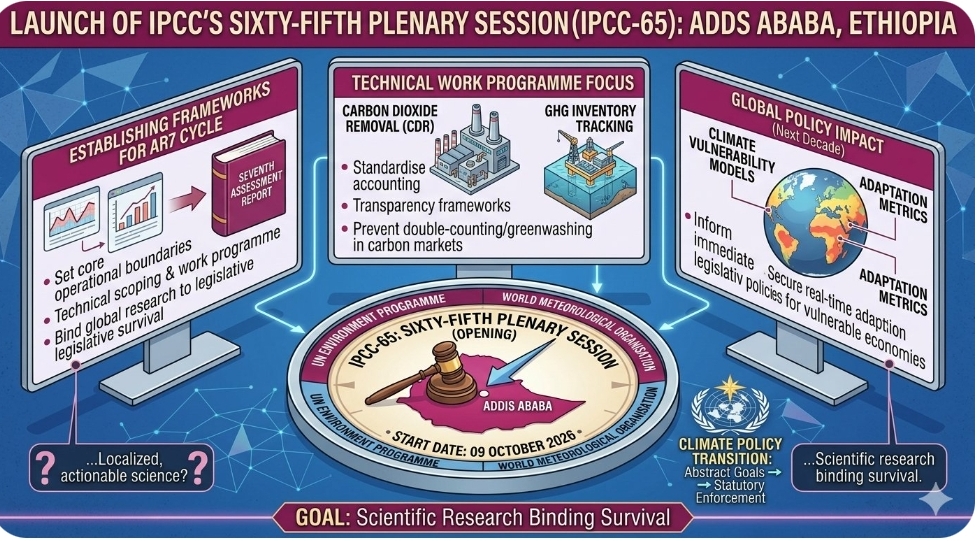
The Intergovernmental Panel on Climate Change has officially commenced its Sixty-Fifth Plenary Session in Addis Ababa, Ethiopia. The high-level international assembly, opening on October 9, 2026, marks the formal gathering of global atmospheric scientists, climate economists, and government delegates under the joint administrative oversight of the United Nations Environment Programme and the World Meteorological Organisation. This session is designed to establish the core operational boundaries and structural outlines for the upcoming Seventh Assessment Report cycle.
A primary technical focus of the plenary involves finalising the methodology and transparency frameworks for carbon dioxide removal technologies and greenhouse gas inventory tracking. Delegations are reviewing draft guidelines to standardise how individual nations quantify and report carbon capture verification on a global scale. Leading atmospheric scientists at the venue noted that stabilizing rising temperatures requires immediate, internationally uniform accounting protocols to prevent double-counting and greenwashing within voluntary carbon credit markets.
United Nations policy advisers tracking the proceedings stated that the strategic outlines established this week will directly govern climate vulnerability models and adaptation metrics for the next decade. Addressing the opening session, climate panel representatives emphasised that the Seventh Assessment Report must deliver actionable, localized science that directly informs immediate legislative policies. The panel has structured a tight, three-day timeline to harmonise technical differences between member states before publishing the official work programme and scoping documents for the upcoming assessment cycle.
Editor's Note
The launch of the sixty-fifth session represents a critical operational step as global climate policies shift from abstract reduction goals to strict statutory enforcement. With extreme weather anomalies scaling in frequency and intensity, the scientific community cannot afford delayed or ambiguous assessments. The way forward dictates that the panel delivers highly precise, regional risk metrics that enable vulnerable economies to secure real-time adaptation financing, fundamentally binding global scientific research to practical legislative survival.



Leave a comment