

TreeTake Network
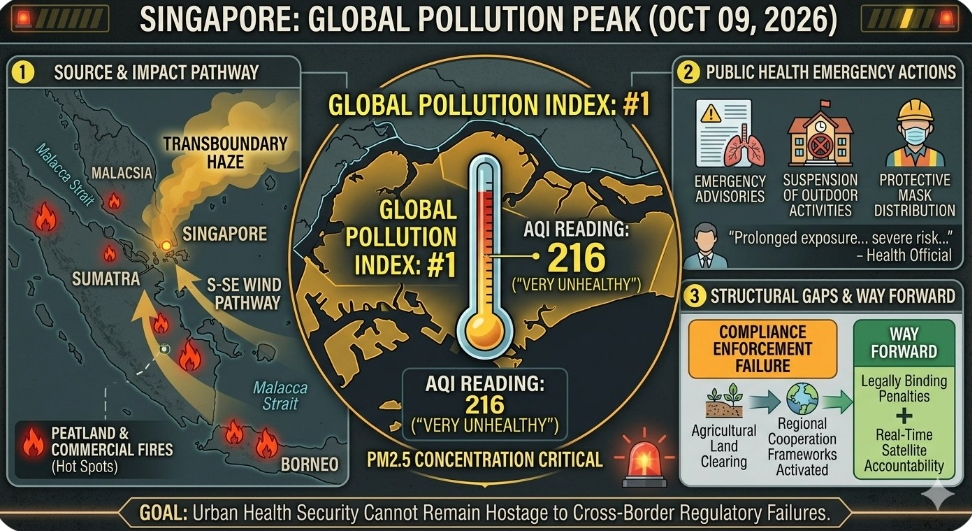
The National Environment Agency of Singapore has issued a severe public health alert after the city-state registered a "very unhealthy" Air Quality Index reading of 216 on October 9, 2026. This escalation officially places Singapore at the top of global real-time pollution trackers as the most polluted city in the world. Environmental monitors across the island confirmed that the dense, toxic smog is a direct result of transboundary smoke moving along maritime pathways from intensifying peatland and commercial plantation fires in neighbouring Borneo and Sumatra, Indonesia.
Regional meteorological centres reported a dramatic spike in hot spots across Sumatra over the past forty-eight hours, which coincided with strong south-southeasterly winds pushing the particulate matter directly across the Malacca Strait. Health officials have recorded a surge in emergency room admissions for acute respiratory distress, prompting the Ministry of Health to activate targeted medical advisories across all public hospitals. Senior medical specialists stated that prolonged exposure to high densities of PM2.5 particles poses a severe risk to vulnerable populations, including senior citizens and individuals with pre-existing cardiopulmonary conditions.
Addressing the environmental emergency in an official press briefing, Singaporean environmental protection officials stated that regional cooperation frameworks must be activated immediately to suppress the root fires. Speaking on the condition of absolute transparency, regional air quality experts emphasised that current climate models show changing wind patterns are likely to trap the transboundary haze over urban coastal hubs for several consecutive days. The government has ordered the immediate suspension of outdoor physical activities across all primary and secondary schools, whilst distributing protective filtration masks to essential open-air municipal work crews.
Editor's Note
This sudden regional air crisis underscores the fragile nature of international environmental pacts when confronted by local commercial interests and changing climate patterns. Despite years of multilateral discussions regarding transboundary haze mitigation, the seasonal recurrence of toxic agricultural smoke highlights a massive structural gap in compliance enforcement. The only viable way forward is the implementation of legally binding economic penalties and real-time satellite accountability mechanisms that target land-clearing violations at their source, proving that urban health security cannot remain hostage to cross-border regulatory failures.



Leave a comment