

TreeTake Network
The balance between industrial development and ecological conservation reached a critical milestone on November 23, 2026, as Union Environment Minister Bhupender Yadav chaired the pivotal 92nd Standing Committee Meeting of the National Board for Wildlife in New Delhi, India. The high-level statutory body convened to deliberate on urgent public utilities, regional infrastructure expansion, and national wildlife safety protocols. Recognising the pressing developmental needs of remote areas, the committee meticulously balanced habitat protection with human welfare by introducing a series of stringent environmental safeguards. The session marked a significant shift towards data-driven habitat management, with senior scientists and administrative heads presenting multi-year conservation blueprints designed to protect endangered terrestrial and marine biomes from escalating anthropogenic pressures.
Standing Committee grants statutory clearances for multi-sector public infrastructure proposals
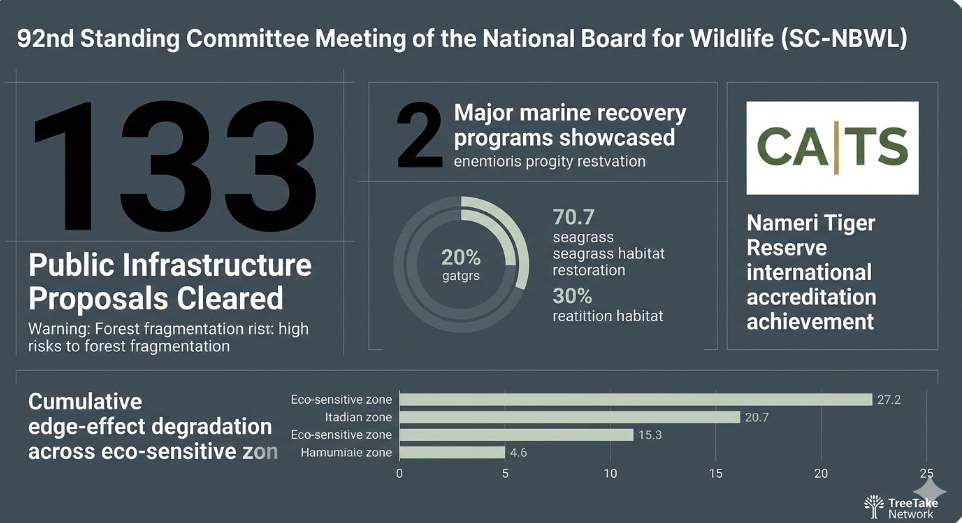
The apex wildlife body evaluated and subsequently cleared 133 multi-sector public infrastructure proposals, focusing primarily on linear projects such as drinking water pipelines, telecommunication networks, and rural road modernisations. These clearances were strictly confined to projects of public importance that intersect or skirt the boundaries of protected areas and eco-sensitive zones across multiple states. To mitigate the inevitable fragmentation of pristine habitats, the committee mandated the construction of state-of-the-art wildlife crossing structures and continuous ecological monitoring frameworks. Addressing the assembly of conservationists and bureaucrats, Union Environment Minister Bhupender Yadav stated that "our administrative responsibility is to ensure that essential developmental benefits reach the most isolated communities without compromising our foundational conservation ethics." He emphasised that "the approval of these 133 public utility proposals is strictly conditional upon the implementation of robust mitigation strategies, thereby proving that infrastructure modernisation and biodiversity preservation can co-exist through rigorous scientific planning."
The decision to clear these linear projects was supported by detailed impact assessments submitted by regional forest departments, which outlined defensive strategies to prevent human-wildlife conflict during the construction phases. Members of the board reiterated that no commercial or non-essential projects would be permitted within core tiger habitats or critical wildlife corridors. Commenting on the rigorous evaluation process, Director General of Forests Jitendra Kumar remarked that "every single proposal cleared today underwent exhaustive multi-layered scrutiny to eliminate any permanent damage to our protected areas." He noted that "by prioritising public utilities like water supply lines and connectivity projects, the ministry is fulfilling an essential social mandate whilst holding project proponents legally accountable for the absolute restoration of surrounding vegetative covers."
Environmental scientists raise serious alarms over cumulative fragmentation and habitat degradation
Despite the administrative safeguards mandated by the ministry, independent conservationists and landscape ecologists raised intense resistance regarding the long-term ecological toll of simultaneous linear intrusions. Experts argued that clearing 133 projects under an umbrella session severely dilutes the spatial scrutiny required for delicate edge habitats, potentially opening up vulnerable wildlife sanctuaries to edge effects and microclimatic disruptions. The primary criticism centred on the cumulative impact of these clearings, which independent models suggest could systematically sever critical migratory pathways for large mammals and disrupt endemic canopy dwellers. Voicing deep structural apprehensions, renowned landscape ecologist Dr Prerna Singh Bindra explained that "approving more than 100 linear infrastructure projects through protected zones risks turning our remaining wildlife sanctuaries into isolated ecological islands." She emphasised that "wildlife crossings are merely engineered band-aids that cannot replicate continuous, undisturbed forest floors," adding that "the continuous slicing of wilderness areas under the guise of public utility systematically erodes the evolutionary resilience of our most vulnerable species."
Further resistance emerged from regional conservation groups who cautioned that linear clearing frameworks frequently overlook the secondary influx of human settlements and unregulated invasive species along the newly cleared right-of-way corridors. Field biologists warned that even a minor pipeline trench or telecommunication clearing can alter localised hydrology and degrade fragile topsoil configurations permanently. Critiquing the institutional evaluation criteria, wildlife biologist Dr Anish Andheria observed that "the statutory vetting mechanism must transition from looking at individual project plots to evaluating the collective, multi-year degradation footprint on the wider landscape." He maintained that "clearing dozens of utility corridors simultaneously inside eco-sensitive boundaries creates a compounding disturbance web that permanently drives wild animals out of their natural territories and into escalating confrontations with agrarian communities."
Scientists present landmark milestones for specialised marine recovery initiatives
A major highlight of the session was the presentation of technical progress reports by the Wildlife Institute of India detailing the implementation of the comprehensive Dugong and Marine Turtle recovery programmes. Marine biologists showcased significant population stabilisations along the Gulf of Mannar, the Andaman and Nicobar Islands, and the coastal stretches of Gujarat, attributing the success to community-led seagrass restoration and the deployment of advanced satellite tracking telemetry. The scientists underscored the need for expanded marine protected areas to buffer vulnerable aquatic species against commercial shipping lane disturbances and illegal fishing activities. Presenting the empirical data to the board, Wildlife Institute of India Scientist Dr Bilal Habib stated that "the measurable recovery of our dugong populations demonstrates the immense efficacy of combining local community surveillance with rigorous spatial tracking systems." He observed that "marine ecosystems are facing unprecedented thermal stresses, and scaling up these specialised recovery frameworks to encompass wider territorial waters is absolutely imperative to preserve our coastal biodiversity."
The board subsequently approved an enhanced financial allocation for the secondary phase of the marine recovery scheme, which will introduce automated acoustic monitoring arrays along critical cetacean habitats. The updated framework will also strengthen the enforcement capabilities of coastal forest divisions, enabling real-time detection of habitat violations. Emphasising the global significance of India's marine conservation policies, ocean policy specialist Dr Coralie D'Lima explained that "coastal ecosystems serve as the frontline defence against climate disruptions, making the protection of keystone species like the dugong a matter of international ecological security." She maintained that "the board's decision to institutionalise these long-term marine frameworks provides a highly replicable scientific model for South Asian maritime governance."
Nameri Tiger Reserve achieves elite international certification for habitat management excellence
The standing committee formally announced that Assam's Nameri Tiger Reserve has successfully achieved the prestigious Conservation Assured Tiger Standards accreditation, joining an elite group of globally recognised protected areas. The international certification follows a comprehensive external audit that evaluated the reserve's anti-poaching infrastructure, community engagement initiatives, and scientific habitat management methodologies. Nameri's success in reversing localised degradation trends and maintaining a stable tiger population density was lauded as a benchmark for the entire northeastern conservation landscape. Celebrating the global recognition, Assam Chief Wildlife Warden Sandeep Bhooshan stated that "attaining the international accreditation validates the tireless endeavours of our field staff and the unwavering support of our forest-fringe communities." He noted that "this milestone elevates Nameri Tiger Reserve to a global stage, reinforcing our collective commitment to uphold the highest international benchmarks in apex predator conservation and landscape protection."
The meeting concluded with the adoption of a national resolution to standardise wildlife monitoring protocols across all certified reserves, ensuring that population data and threat assessments are integrated into a single unified grid. The ministry directed all state governments to fast-track the delineation of eco-sensitive zones around their remaining sanctuaries to prevent unregulated commercial incursions.
Editor's Note
The deep divide over the 92nd Standing Committee decisions highlights the growing friction between essential rural infrastructure deployment and uncompromised wilderness conservation. While the integration of engineered mitigation measures and the expansion of marine programmes represent vital progress, the serious concerns raised by landscape ecologists regarding cumulative forest fragmentation cannot be dismissed as mere dissent. The way forward demands an immediate institutional shift towards a unified landscape-level planning model, ensuring that infrastructure thresholds are legally bounded by the true carrying capacity of our remaining natural ecosystems before statutory clearances are issued.



Leave a comment