

TreeTake Network
An intensive wildlife tracking operation commenced on November 23, 2026, as the Kerala Forest Department officially initiated Mission Chakkakompan within the dense, fractured ecosystems of Chinnakkanal and Santhanpara in Idukki, India. The high-stakes intervention aims to locate, tranquilise, and fit a GPS radio-collar onto a large, wild bull elephant known locally as Chakkakompan, celebrated and feared for his habitual raiding of local jackfruit orchards. The complex operation was sanctioned following an alarming escalation in crop damages and structural incursions into nearby agrarian outposts. Moving with extreme caution through the rugged terrain, wildlife veterinarians, forest rangers, and rapid response teams established a tactical base camp to orchestrate a surgical capture sequence, aiming to safeguard human life whilst ensuring the biological integrity and welfare of the elephant.
Specialised tracking teams and veteran Kumki elephants establish strategic base camp at Cement Palam
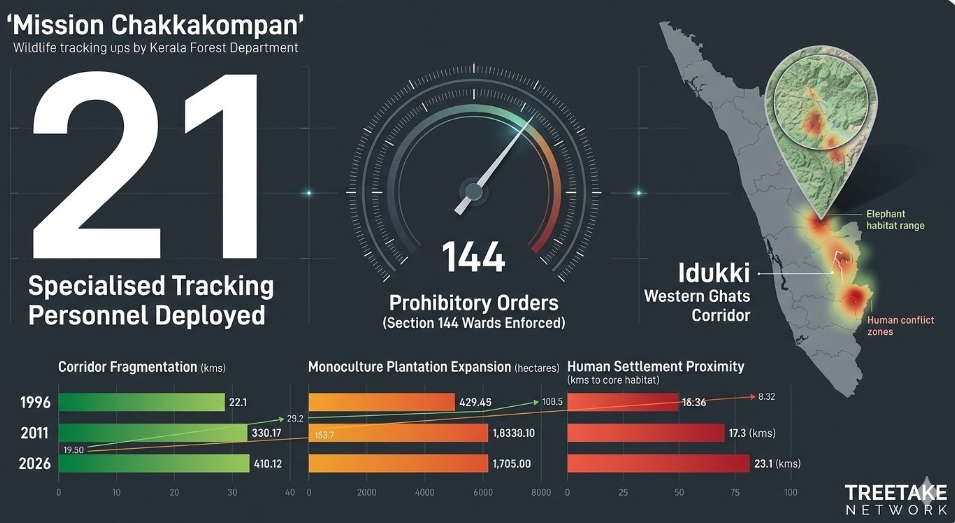
An elite 21-member forest tracking unit, supported by two heavily experienced Kumki elephants named Vikram and Bharat, successfully completed their primary deployment at the Cement Palam base camp to initiate real-time surveillance corridors. The Kumki elephants, brought in from the high-security Muthanga elephant camp, are designated to provide critical physical shielding for the veterinary team and assist in managing the wild bull if he charges after darting. Tracking experts equipped with handheld thermal imagers and satellite telemetry systems have mapped the target animal's current movement metrics to a narrow three-kilometre valley strip dominated by dense eucalyptus plantations. Outlining the structural layout of the field deployment, Chief Conservator of Forests D.K. Vinod Kumar stated that "the technical execution of Mission Chakkakompan requires absolute spatial precision due to the highly volatile nature of the Idukki topography." He emphasised that "our tracking teams are monitoring the elephant's vital signs and social proximity from a distance, ensuring that the darting sequence occurs only when the animal is entirely isolated from neighboring herds, thereby eliminating any risk of group stampedes."
The ground strategy relies heavily on the tracking expertise of local tribal watchers who possess an intimate understanding of the animal's traditional foraging pathways. Forest officials have set up temporary observation towers along the periphery of the target zone to prevent curious onlookers from disrupting the operation. Detailing the physical readiness of the rescue assets, Senior Veterinary Officer Dr Arun Zachariah noted that "the chemical formulation for the tranquilising dart has been precisely calibrated based on the estimated body mass and physical maturity of the tusker." He observed that "the presence of veteran Kumki elephants like Vikram is an absolute logistical necessity, as they provide the crucial physical restraint needed to secure the animal safely once the sedative takes full effect, minimising the window of structural or physical trauma."
Local communities demand immediate translocation while wildlife ecologists warn against severe habitat displacement
The operational launch has laid bare the deep, systemic fractures between human settlement safety demands and the uncompromised preservation of wild elephant habitats. Local agrarian unions and tribal settlement councils staged minor demonstrations near the range offices, demanding the complete permanent translocation of the elephant to an alternate sanctuary, rather than a mere radio-collaring and release exercise. Conversely, independent wildlife biologists and landscape ecologists have mounted strong resistance, arguing that capturing and altering the home range of keystone megaherbivores fails to address the underlying drivers of conflict, which are deeply rooted in the aggressive commercialisation and fragmentation of elephant corridors. Expressing deep ecological concern, wildlife biologist Dr Vidya Athreya explained that "simply treating an individual elephant as a rogue entity ignores the larger reality of severe landscape degradation across the Western Ghats." She stated that "displacing or heavily sedating these highly intelligent, wide-ranging mammals induces profound psychological stress and disrupts established herd dynamics," adding that "unless we legally restrict the unchecked expansion of commercial resorts and cash-crop plantations within these traditional migratory corridors, new elephants will inevitably occupy the vacant niche, rendering these high-cost capture missions entirely futile."
The resistance is further reinforced by conservation groups who point out that the Idukki landscape has been historically altered by major hydroelectric projects and cash-crop monocultures, leaving the resident elephant population with highly fragmented foraging patches. Field researchers emphasized that the elephant's preference for jackfruit is a direct evolutionary adaptation to the severe depletion of native bamboo and reed forests. Critiquing the administrative pressure for quick translocations, Asian elephant specialist Prof Raman Sukumar observed that "the management of high-conflict tuskers must transition from reactive capture sequences to robust, long-term spatial zoning." He maintained that "radio-collaring Chakkakompan will yield valuable movement metrics, but the true path forward lies in the aggressive ecological restoration of fractured corridors and the creation of non-penetrable community barriers, rather than the repeated uprooting of native wildlife from their ancestral ranges."
Rapid Response Teams establish strict safety corridors across vulnerable forest fringe settlements
To prevent any collateral casualties during the active darting phase, the district administration has enforced strict prohibitory orders under Section 144 across five highly vulnerable wards of the Chinnakkanal panchayat. Rapid Response Teams have been deployed at 12 critical intersection points to restrict vehicular movement and ensure that local residents remain indoors during the early morning operational windows. Forest department wireless networks have been linked with local community notification groups to provide real-time updates on the elephant’s proximity. Explaining the civilian containment strategy, Idukki District Forest Officer Subhash K. Jha noted that "the safety of our forest-fringe populations remains an absolute, non-negotiable priority throughout the duration of this wildlife intervention." He concluded that "all localized plantation activities have been suspended, and our emergency rescue vehicles are stationed at key points to handle any unexpected contingency with maximum efficiency."
As the tracking squads close the distance under favorable weather conditions, wildlife veterinarians remain poised to execute the primary darting maneuver at dawn, provided the elephant remains within an accessible, low-gradient terrain sector that allows for safe execution and immediate veterinary monitoring.
Editor's Note
Mission Chakkakompan serves as a stark reminder of the unsustainable ecological crisis unfolding within the Western Ghats. While the deployment of tracking units and radio-telemetry is necessary to mitigate immediate civilian peril, the long-term solution cannot be achieved through continuous tranquilisation or the forced displacement of keystone species. True ecological stability requires an uncompromising political commitment to reclaim fragmented wildlife corridors, phase out destructive monoculture plantations, and establish science-based buffer zones that respect the natural territorial boundaries of India's elephant populations.



Leave a comment