

TreeTake Network
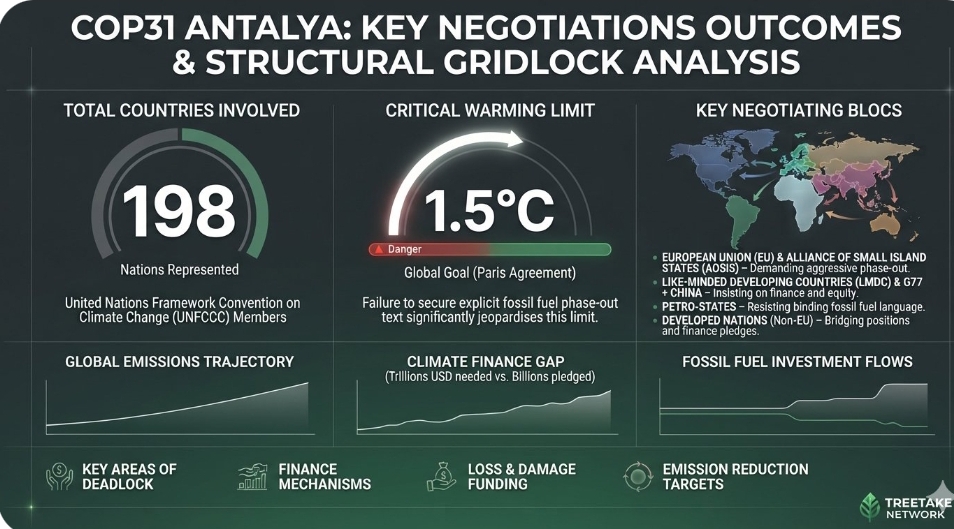
An unprecedented diplomatic breakdown occurred at the United Nations Climate Change Conference COP31 on November 23, 2026, as marathon negotiations collapsed after extending a record 48 hours into overtime in Antalya, Turkey. The international summit, which brought together delegates from nearly 200 countries, dissolved without the adoption of a central political declaration when a powerful loose coalition of approximately 130 nations openly rebelled against the final compromise text proposed by the Turkish and Australian conveners. The acute structural gridlock was triggered by the total omission of any explicit language regarding the transition away from or phasing out of global fossil fuels, effectively reversing the foundational language established three years prior during the historic Dubai accords. As standard committee mechanisms ground to a halt, the closing plenaries turned into an arena of sharp recriminations between petro-states defending their export architectures and climate-vulnerable communities fighting for systemic planetary protection.
European Union leads fierce institutional revolt against the controversial Antalya Pact draft text
A powerful coalition led by the European Union and supported by the Alliance of Small Island States launched an unyielding diplomatic offensive to embed a strict, time-bound fossil fuel phase-out timeline into the primary legislative text. This faction argued that the voluntary pledges established in previous summits have failed to bend the global emissions curve rapidly enough to keep the critical 1.5-degree Celsius warming threshold within technical reach. Addressing an emergency assembly of delegates, EU Climate Commissioner Wopke Hoekstra stated that "the global community has passed the point where constructive ambiguity can save the planetary ecosystem." He emphasised that "the collective transition cannot be treated as an open-ended dialogue," adding that "the treaty text must contain explicit, binding targets that hold every single major emitting economy legally accountable for its industrial outputs."
This position was strongly reinforced by vulnerable nations who claimed that any dilution of the transition mandates would result in immediate catastrophic consequences for low-lying coastal topographies. Highlighting the existential threat facing developing maritime territories, Dr Pa'olelei Luteru, speaking on behalf of the small island coalition, remarked that "the diplomatic stalling witnessed in the negotiating chambers is an absolute insult to communities already facing displacement from rising sea levels." He noted that they are not asking for rhetorical expressions of solidarity or vague long-term aspirational targets, declaring that "we require an uncompromised, legally binding commitment to dismantle fossil fuel dependencies starting this decade, without which any final agreement is fundamentally worthless."
Developing coalitions raise serious structural objections over missing financial adaptation infrastructure
The push for aggressive mitigation timelines met with immediate resistance from major developing economic blocs, including the G77 plus China coalition and the Like-Minded Developing Countries group, who argued that Western nations are attempting to impose severe industrial restrictions without delivering the requisite financial enablement frameworks. Representatives from these blocs pointed out that the historically promised 100 billion dollar annual climate finance commitment has remained structurally inadequate, and that the new collective quantified goal must be scaled into trillions of dollars to make domestic green transitions economically viable. Articulating the consensus of the developing coalitions, Ali Mohamed, the lead negotiator for the African Group, explained that "it is economically impossible to ask nations to abandon their foundational energy infrastructure while simultaneously withholding the capital required to build sustainable alternatives." He observed that "transition without finance is not an environmental strategy but a prescription for institutional poverty," maintaining that "they will not sign a text that front-loads heavy decarbonisation obligations whilst leaving adaptation funding entirely conditional on voluntary market mechanisms."
The debate grew further complicated as major South Asian and Latin American delegations argued that Western industrialised powers, having driven the vast majority of historical cumulative emissions, are attempting to shirk their differentiated responsibilities. They demanded that any transition text include explicit guarantees of direct, non-debt-creating public grants for clean technology transfers and domestic grid modernisations. Echoing these concerns during a heated panel discussion, Indian climate policy expert Harjeet Singh noted that "the current draft text displays a complete lack of historical equity by treating unequal partners as equals." He emphasised that developed countries must acknowledge their disproportionate atmospheric consumption, stating that "trying to force developing economies to compromise their basic energy security without a guaranteed, multi-trillion-dollar public finance architecture is an entirely unjust demand that undermines the very foundation of international climate cooperation."
Summit presidency convenes frantic closed-door plenaries to break the institutional deadlock
With the official summit deadline looming, COP31 President Murat Kurum took the extraordinary step of suspending standard working groups to convene a series of highly restricted, closed-door ministerial plenaries in an urgent effort to hammer out a compromise text. The presidency presented a series of alternative bridging documents that attempted to replace the controversial phase-out phrase with more flexible terminology focusing on the rapid deployment of carbon capture technologies and renewable energy capacity tripling. Emerging briefly from a consultation session with regional coordinators, President Murat Kurum stated that "the presidency is working around the clock to find a balanced pathway that respects the developmental imperatives of emerging economies whilst maintaining a high level of global environmental ambition." He warned that "a total failure to deliver a consensus text in Antalya would severely damage the credibility of the entire United Nations framework," concluding that "every delegation must prepare to make difficult domestic concessions to secure a collective global future."
As the late-night negotiations extended into overtime, teams of legal experts and policy analysts continued to pore over the draft sections, searching for a linguistic formula that could satisfy both the strict emission reduction demands of the West and the robust financial protection requirements of the Global South. Diplomatic sources indicated that the outcome hinges on whether developed countries will agree to a legally binding financial roadmap in exchange for a stronger, more explicit commitment to phase down coal and gas infrastructure globally.
Editor's Note
Escalating gridlock at COP31 exposes deep geopolitical fractures that continue to undermine the international climate governance model. As long as developed economies treat climate finance as a charitable contribution rather than an absolute historical debt, developing nations will rightfully resist any mitigation mandates that threaten their domestic economic stability. The way forward requires a complete restructuring of global climate economics, moving away from voluntary corporate pledges and establishing an enforceable, multilateral financial compact that directly links emission reduction targets with guaranteed public capital deployment.



Leave a comment