

Brij Khandelwal
The Brij Mandal—or the Taj Trapezium Zone (TTZ)—is once again under threat. This time, its trees are rapidly disappearing. The Supreme Court has granted approval for the felling of over 10,700 fully grown trees within the TTZ. These trees are to be sacrificed for roads, expressways, railway lines, airport expansions and other major projects. There is no doubt that development is essential. However, the question remains: must development come at the cost of greenery? Thousands of trees have already been cut down in Mathura, Vrindavan and Govardhan over the past few years.
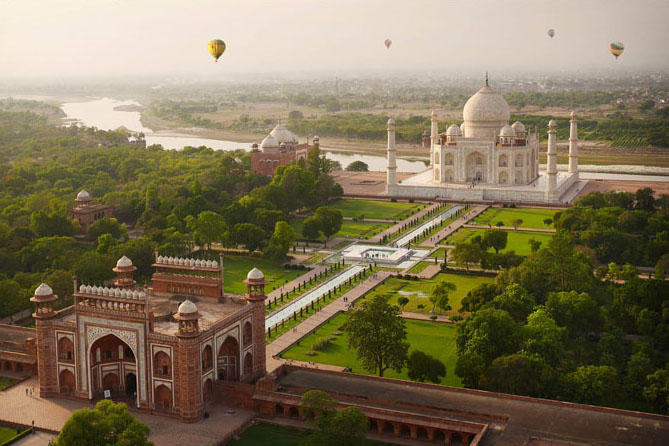
The TTZ was established in the 1990s following the Supreme Court's landmark M.C. Mehta case. Spanning approximately 10,400 square kilometres, this zone encompasses Agra, Mathura, Vrindavan, and surrounding districts. Its objective was to protect the Taj Mahal from pollution and environmental degradation. Today, that very protective shield is gradually crumbling. Thousands of trees vanish every year. Roads are being widened and expressways are under construction. Residential colonies and commercial complexes are springing up. Cities are expanding, while greenery shrinks. The concrete jungle is growing, while real forests are receding.
To shield the Taj Mahal from pollution, the Supreme Court created the Taj Trapezium Zone (TTZ) in 1996, covering an area of 10,400 square km. Despite this, the green cover continues to decline. In 2017, the forest cover across six districts stood at 664 sq km; by 2019, it had shrunk to 657.71 sq km. Agra alone saw a reduction of 9.38 sq km in forest cover. Urbanisation, construction, tree felling, encroachment, pollution and the water crisis are the primary reasons for this decline. While millions of saplings are being planted, their survival rate falls short of expectations due to a lack of maintenance. It is essential to not only plant trees but also conserve them.
Governments often claim that 10 saplings will be planted to replace a single tree. While this argument looks good on paper, nature does not operate based on official files. It takes decades for a tree to mature. A mature tree absorbs carbon, provides shade, purifies the air, offers shelter to birds and helps lower the city's temperature—benefits that a young sapling cannot match for years. Moreover, many planted saplings wither away due to lack of care. Agra is already grappling with poor air quality. Dust, vehicular emissions and incessant construction activities are driving up pollution levels. In such a scenario, cutting down trees will weaken the city's natural shield, leading to increased heat and further deterioration of air quality. The Yamuna's floodplain areas will also be affected. Trees prevent soil erosion, recharge groundwater and support biodiversity. Their loss weakens the entire ecosystem.
Environmentalist Dr Debashish Bhattacharya stated: "There is no opposition to development. However, for every project, the priority should be to determine how many mature trees can be saved. Felling thousands of trees should be the last resort, not the first." Senior environmental activist Dr Mukul Pandya added: "Agra's greenery is disappearing far more rapidly than it is being restored. Trees are not merely about aesthetics; they are the lungs of the city." Jagan Nath Poddar, a green activist from Vrindavan, observed: "Governments inaugurate roads and bridges, not forests. Trees have come to be viewed as obstacles rather than life-givers. That is the greatest tragedy." The real issue is not development versus the environment; it is about sensible development. Road alignments can be altered. Elevated corridors can be constructed. Trees can be scientifically transplanted. There should be independent monitoring of planted saplings and their survival rates must be made public. The TTZ (Taj Trapezium Zone) was the result of a visionary approach; it cannot be allowed to remain merely a 'paper tiger.'
Consider the irony: the Taj Mahal—the most beautiful symbol of love—is losing its natural guardians. Felling a century-old tree is easy, but it takes generations to bring it back. The Taj Mahal needs more than just gleaming stone; it requires clean air, a flowing Yamuna and living forests. Development achieved at the cost of nature is not true development; it is a debt imposed upon future generations.


.jpg?resize=120%2C90&ssl=1)



Leave a comment