

Talking Point
Supreme Court intervention is welcome, but government negligence is inexcusable, writes green activist Brij Khandelwal
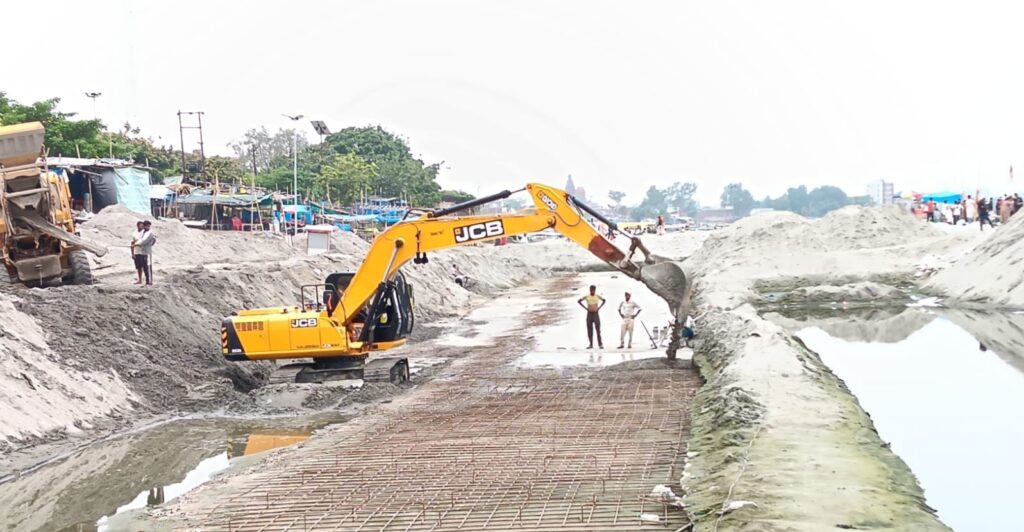
Ultimately, the country's apex court had to intervene to halt the proposed riverfront project in Vrindavan, delivering a stinging rebuke to the mindset that views a living river simply as a vacant plot of land on which cement and concrete can be poured at will.
While hearing a petition filed by the Brij Vrindavan Devalaya Samiti, the Supreme Court immediately stayed the ongoing construction work near Keshi Ghat. It also sought a detailed report from the Uttar Pradesh and Central governments within six weeks. Had the court not intervened in time, a massive platform—being created by filling the area with soil—would have buried yet another stretch of the Yamuna under concrete forever.
This is not the first time the court has had to step in to rectify the government's failures. For the past decade, the judiciary has repeatedly stepped forward to protect the Yamuna, while governments have been intent on strangling the river in the name of development.
In 2015, the National Green Tribunal (NGT) banned all forms of construction within the demarcated floodplain of the Yamuna. Orders were also issued to identify and remove illegal structures. Subsequently, the Supreme Court clearly stated in several cases that the floodplain was an integral part of the river, not a construction site. Even the Delhi Police were denied permission to build barracks in the floodplain. The court had sharply questioned how anyone could insist on building there when floodwaters had reached the Supreme Court complex itself. Recently, the Delhi High Court declared the illegal colonies built in the Yamuna's floodplain entirely unlawful and banned not only new construction but even repairs. The judiciary keeps reiterating a point that governments simply refuse to heed: the floodplain is an integral part of the river's body and cannot be encroached upon.
If any part of the Yamuna's floodplain remains intact today, the credit goes not to the governments, but to vigilant citizens and environmental activists. Initiatives like Agra’s 'River Connect Campaign' and Delhi’s 'Yamuna Jiye Abhiyan,' along with environmental enthusiasts from Vrindavan and various social organisations, have been knocking on the doors of the courts for years. They gathered evidence, filed Public Interest Litigations (PILs) and challenged every project that posed a threat to the river's existence. Individuals like advocates Rahul Choudhary and Akash Vashishtha fought this battle in the courts for years. This struggle continued without any publicity or government assistance. The truth is that whatever limited legal protection the Yamuna still enjoys is due to civil society, not government benevolence.
According to environmentalist Dr Debashish Bhattacharya, the situation is alarming. Approximately 80 per cent of the total pollution entering the Yamuna is discharged into the river within the 22-kilometre stretch passing through Delhi. Dissolved oxygen levels there often drop to zero. The Supreme Court has also expressed serious concern over this matter. Meanwhile, in Mathura and Vrindavan, millions of litres of untreated sewage are discharged directly into the Yamuna every day.
The biggest question is: why has the condition of the Yamuna not improved despite whopping amounts being spent on ambitious schemes like 'Namami Gange' over the last decade? The river is still counted among the most polluted in the world. Fish populations are dwindling, bird habitats are being destroyed, biodiversity is declining, the floodplain is shrinking and encroachments continue to rise. Yet, officials remain busy getting photographed at newly tiled riverfront ghats. The river will not be saved merely by polishing the surface while concealing the underlying ailment.
Jagannath Poddar, convener of 'Friends of Vrindavan', cited the Vrindavan riverfront project as the prime example of this. It was introduced years ago under the guise of expanding and beautifying the riverbank, a plan that faced judicial scrutiny even then. Now, the same project is being revived in a new avatar. This clearly indicates that warnings from scientists, environmental experts and the courts have had no impact on the government machinery. Even today, plans are dictated not by water experts, but by bulldozers and contractors.
Many cities across the world are now allowing their rivers to flow freely again; concrete walls are being dismantled to let rivers revert to their natural state. In India, however, the situation is the opposite. Here, in the name of development, rivers are being imprisoned within cement walls and broad platforms. This is labelled as development, yet it is, in reality, environmental destruction.
Social thinker Professor Paras Nath Chaudhary rightly observed that the identity of Braj was inextricably linked to the Yamuna. If the Yamuna dies, the ghats, temples, parikrama (circumambulation) routes, culture and faith would all lose their soul, he said. Without the river, Braj would be reduced to a mere city of buildings.
Activists want the Uttar Pradesh government to undertake substantive action. The discharge of untreated sewage into the river must stop immediately. Adequate environmental flow must be ensured in the Yamuna. Encroachments on the floodplain must be removed. Sewage treatment plants must operate at full capacity. The river must be given back the space it needs to breathe.


.jpg?resize=120%2C90&ssl=1)



Leave a comment