

Thinking Point
Sagari Gupta explores why national statistics miss local environmental pressure
India’s digital economy depends on infrastructure that remains largely invisible. Every UPI transaction, AI model, cloud application and digital government service is processed through data centres operating round the clock. As India accelerates investments in artificial intelligence and cloud computing, these facilities are becoming as essential to the economy as highways, ports and power plants. Their expansion has become a policy priority. State governments are competing to attract investments through dedicated data centre policies that offer fiscal incentives, faster approvals, reliable electricity and industrial land. The objective is clear: strengthen India’s position as a global digital hub while supporting the rapid growth of cloud services, AI and digital public infrastructure.
Yet the environmental implications of this transition have received far less attention than its economic benefits. Existing discussions often rely on national electricity and water statistics, which suggest that data centres account for only a modest share of India’s overall resource consumption. Those figures are important, but they answer only one part of the question. Public policy must also ask where these resources are being consumed and whether or not the ecosystems supporting this infrastructure can sustain growing demand over time.
At the national level, there appears to be little cause for concern. Government and industry estimates indicate that data centres account for only a small proportion of India’s total electricity demand and an even smaller share of national water consumption. Viewed through aggregate statistics, their environmental footprint appears limited. The limitation lies in the scale of measurement. National statistics describe aggregate consumption, whereas environmental pressures emerge locally. Groundwater availability differs across aquifers. River basins respond to local withdrawals rather than national demand. Electricity networks experience regional constraints that are often invisible in country-wide data. Infrastructure that appears environmentally sustainable in aggregate can therefore generate significant ecological pressure within a single metropolitan region.
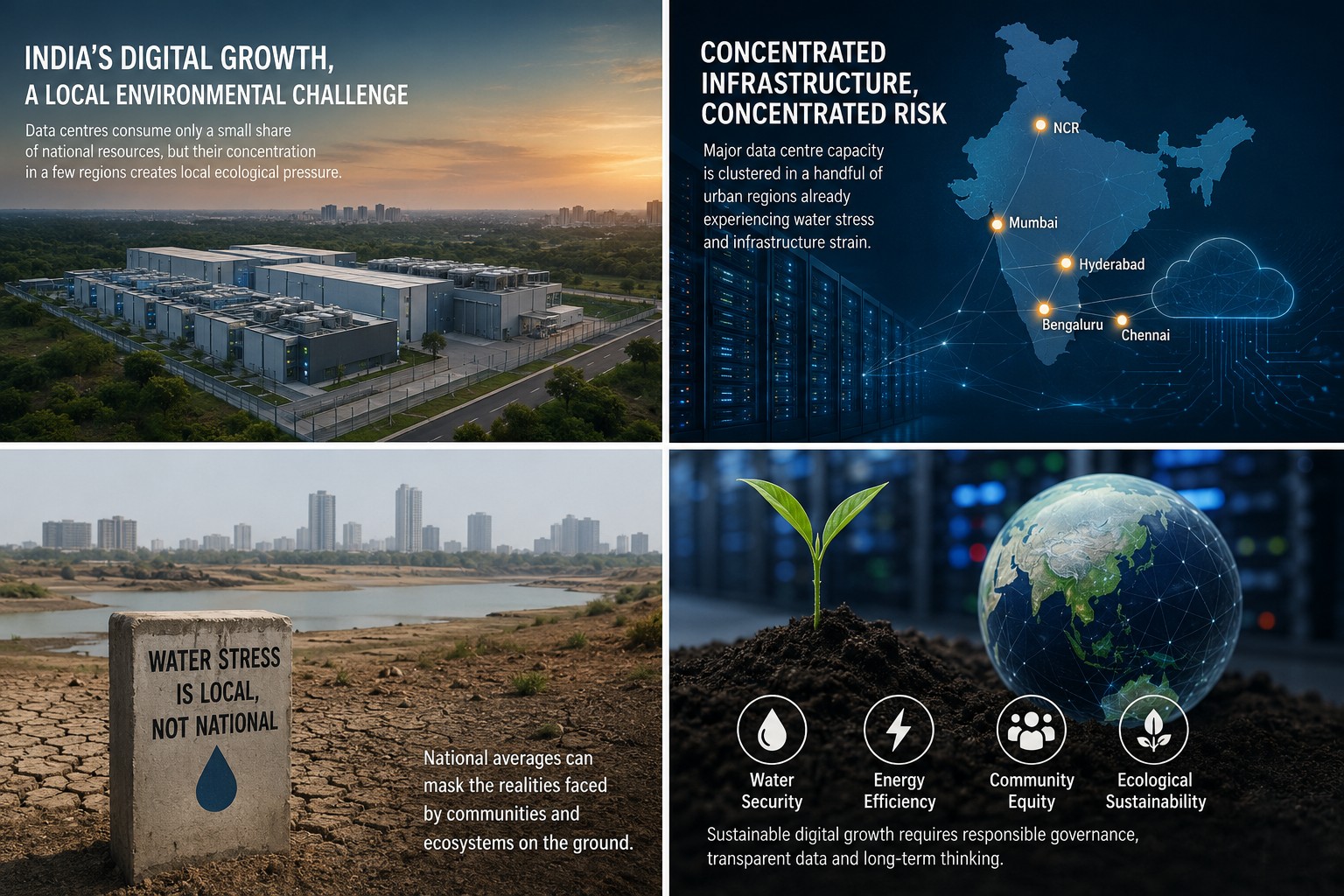
Water security, electricity infrastructure and environmental resilience are inherently local. Aquifers are local. River basins are local. Urban water distribution systems are local. Infrastructure that appears sustainable when measured against national resource availability may create significant pressure when concentrated within a single metropolitan region or watershed. This distinction becomes particularly important because India’s data centre ecosystem is geographically concentrated rather than evenly distributed. Chennai, Navi Mumbai, Hyderabad, Bengaluru and the National Capital Region have emerged as major hubs because they combine fibre connectivity, enterprise demand, reliable power infrastructure and supportive state policies. The concentration makes commercial sense. Ecologically, however, it means that environmental pressures accumulate within specific watersheds rather than across the country as a whole.
Most operational capacity is located around Chennai, Navi Mumbai, Hyderabad, Bengaluru and the National Capital Region. These locations have emerged as preferred destinations because they offer reliable fibre connectivity, proximity to commercial centres, access to skilled labour and supportive state policies. Several of these cities, however, have also experienced recurring water stress, increasing groundwater depletion and growing pressure on urban infrastructure. The issue, therefore, is not solely how much water data centres consume nationally. It is where that demand is concentrated and whether existing governance frameworks are equipped to assess its cumulative impact. Current environmental assessments largely examine projects individually. Each proposal is evaluated against regulatory standards before approval is granted. Yet ecological systems do not respond to individual projects in isolation. Groundwater aquifers, river basins and urban water networks respond to the combined effect of multiple users drawing upon the same finite resource.
This creates a structural blind spot in infrastructure governance. Infrastructure approvals may conclude that individual facilities satisfy environmental requirements while overlooking whether or not several approved projects collectively exceed the carrying capacity of the ecosystems on which they depend. This distinction is reflected in the experience of organisations working on urban water governance. According to Dr Rajib Das, Head of Monitoring, Evaluation, Research and Learning (MERL) at the Centre for Advocacy and Research (CFAR), national water statistics often conceal realities experienced by local communities. Dr Das’s observation illustrates why environmental accounting and public policy often diverge. National statistics remain valuable for macroeconomic planning, but they provide little guidance on whether a particular watershed, aquifer or urban water system can sustain additional industrial demand. Infrastructure decisions are ultimately made within these local ecological systems rather than across the country as a whole.
“National water statistics hide what we see on the ground every day: water stress is hyper-local, " he says. “In our climate vulnerability assessments in Bhubaneswar and Jaipur, households within the same ward face entirely different water realities depending on aquifer depth, pipe network quality, seasonal rainfall and proximity to extraction points. A national average tells you nothing about these fault lines”. His observations highlight an important challenge for infrastructure planning. Aggregate indicators are useful for understanding national trends, but they are less effective in identifying environmental risks that emerge at the scale where infrastructure actually operates. For data centres, this means evaluating projects against local aquifer conditions, competing water demands, seasonal variability and projected climate risks rather than relying solely on national benchmarks.
It also requires a rethinking of how environmental impacts are assessed. “Every major data centre should, therefore, be assessed against local aquifer conditions, competing demands, seasonal variability and projected climate risk rather than against national benchmarks”, Das argues. “Where multiple facilities cluster within a single watershed or urban region, cumulative impact assessment is essential”.
The distinction is fundamental. Environmental regulation evaluates projects individually, whereas ecosystems experience their impacts collectively. A project that appears environmentally sustainable on its own may contribute to unsustainable extraction once several similar facilities begin drawing upon the same resource base. The latter becomes increasingly important as cities continue to grow. Many urban regions that are attracting data centre investment already face competing demands from households, industries, commercial establishments and public utilities. Climate variability has further increased uncertainty, with prolonged dry periods, erratic rainfall and declining groundwater levels affecting water availability across several parts of the country.
Within this context, additional industrial demand raises questions not simply about efficiency but about allocation. Drawing on CFAR’s work across informal settlements in six Indian cities, Das argues that water governance is fundamentally an institutional issue. “Water allocation is a governance problem before it is a resource problem”, he explains, “Communities already contend with intermittent supply, unregulated groundwater dependence and infrastructure that was never designed for the population it now serves. Climate variability compounds every one of these pressures.” His research suggests that when high-demand infrastructure enters regions already experiencing water stress, the consequences are often distributed unevenly. “When a high-demand facility enters this landscape without corresponding investment in augmentation, efficiency or recharge, the communities with the least voice absorb the greatest cost”, he says. “Those who contribute least to extraction are often the first to lose access”.
These observations do not suggest that digital infrastructure should be viewed as incompatible with environmental sustainability. Rather, they point to limitations in the way sustainability is currently measured. The debate is, therefore, not about whether India should continue investing in digital infrastructure. Given the country’s economic trajectory and growing reliance on digital services, such investment is both necessary and inevitable. The more pressing question is whether public policy has kept pace with the changing nature of infrastructure itself. Data centres are no longer niche technological assets. They are becoming part of India’s critical infrastructure network, comparable in strategic importance to transport, energy and telecommunications. As that transition occurs, the policy frameworks used to evaluate them must also evolve.
National statistics remain indispensable for macroeconomic planning. They are far less effective in identifying the local ecological pressures created when resource-intensive infrastructure is concentrated within specific geographies. Bridging that gap between national accounting and local environmental realities may prove to be one of the most significant governance challenges of India’s digital transition. The challenge, therefore, extends beyond environmental management. It reflects how India measures infrastructure success. Existing policy frameworks primarily evaluate digital infrastructure through investment, employment, computing capacity and contribution to economic growth. Environmental assessments examine whether projects comply with statutory requirements. Both approaches are necessary, but neither fully captures the cumulative ecological costs associated with concentrated infrastructure development.
As digital infrastructure becomes increasingly critical to economic growth, infrastructure policy must evolve from measuring what these facilities produce to also evaluating what they consume. Economic indicators capture capital investment, employment generation and contribution to economic output. Environmental assessments examine whether individual projects comply with statutory requirements. Both are necessary. Yet neither fully captures the cumulative ecological costs that emerge when multiple infrastructure projects draw on the same natural resources.
According to Dr Saurabh Bandyopadhyay, Senior Fellow at the National Council of Applied Economic Research (NCAER), this represents a significant gap in current infrastructure assessment. “India’s current economic and infrastructure metrics primarily capture investment, output and employment, but often understate the environmental externalities associated with large infrastructure assets”, he says. “For data centres, greater emphasis should be placed on integrating indicators related to water use, energy intensity, carbon emissions and local ecological stress so that infrastructure growth is evaluated alongside its long-term resource sustainability”. His assessment reflects a broader evolution in public policy. Infrastructure is no longer judged solely by the assets it creates or the economic value it generates. Across sectors such as irrigation, transport and urban development, governments are increasingly recognising that long-term sustainability depends on whether infrastructure remains compatible with ecological systems. Digital infrastructure deserves similar scrutiny. The challenge is particularly evident in environmental regulation.
Most environmental approvals continue to assess projects individually. This approach is effective in determining whether a single project complies with prescribed standards. It is less effective in evaluating what happens when several facilities are approved within the same district, depend on the same groundwater aquifer or draw electricity from the same regional network. Ecological systems do not distinguish between individual approvals. Rivers, aquifers and watersheds respond to aggregate withdrawals rather than project boundaries. This is where cumulative impact becomes a policy issue rather than simply an environmental one. Drawing on implementation research across Indian cities, Dr Rajib Das argues that India’s current planning framework often overlooks these interactions. “Environmental risks are cumulative and interconnected”, he says. “Water extraction, energy demand, land-use change, urban expansion and climate hazards interact. A planning system that evaluates them in silos will systematically underestimate risk”.
The implication is that infrastructure which appears sustainable when assessed independently may collectively exceed the carrying capacity of the ecosystem within which it operates. This distinction matters because India’s digital infrastructure is developing through clusters rather than isolated investments. Chennai, Navi Mumbai, Hyderabad and the National Capital Region are emerging as major hubs for data centres because they offer reliable connectivity, access to customers and supportive state policies. These same regions also face increasing pressure on urban infrastructure, groundwater resources and electricity systems. Planning for such infrastructure, therefore, requires a shift in scale. Instead of evaluating only the environmental impact of individual facilities, governments may increasingly need to assess cumulative resource demand across an entire basin, metropolitan region or industrial corridor. Such an approach would better reflect how natural systems actually function. It would also improve long-term infrastructure planning. Location decisions for future data centres should be informed not only by commercial considerations but also by water availability, climate projections, groundwater conditions and electricity system capacity. Incorporating these variables into approval processes would allow digital infrastructure to expand without placing disproportionate pressure on already stressed regions.
Dr Bandyopadhyay argues that policy should move in precisely this direction. “Policy should move towards location-sensitive planning by aligning data centre approvals with local water availability, power-system capacity and environmental carrying capacity”, he says. “Mandatory resource-efficiency standards, greater use of renewable energy and recycled water and periodic sustainability disclosures would help ensure that digital infrastructure expansion remains consistent with local resource constraints”. Such reforms would also strengthen transparency. Unlike in many other infrastructure sectors, publicly available information on data centres’ environmental performance remains limited. Standardised disclosure of freshwater withdrawals, recycled water use, cooling technologies, Water Usage Effectiveness (WUE), Power Usage Effectiveness (PUE) and renewable energy consumption would enable regulators, researchers and local governments to evaluate environmental performance more effectively.
Better disclosure alone, however, will not resolve the governance challenge. Infrastructure planning also determines how environmental costs are distributed. Across Indian cities, access to water already varies significantly between neighbourhoods. Informal settlements frequently rely on intermittent municipal supply, groundwater or private tankers. Climate variability has further increased uncertainty, particularly in rapidly growing urban regions. When additional resource-intensive infrastructure is introduced into these landscapes, the consequences are not experienced equally. According to Dr Das, governance, therefore, becomes as important as engineering. “Water allocation is a governance problem before it is a resource problem”, he explains. “Communities already contend with intermittent supply, unregulated groundwater dependence and infrastructure that was never designed for the population it now serves”.
His research also highlights an institutional gap that extends beyond environmental assessment. “Communities are rarely meaningfully consulted despite holding granular knowledge of seasonal availability, local risks and service gaps. Participatory governance is not a procedural formality; it is the mechanism through which allocation decisions become equitable and durable.” This points to an often-overlooked aspect of digital infrastructure policy. Decisions about where data centres are located are not simply investment decisions. There are also decisions about how finite public resources are allocated, which risks are considered acceptable and whose voices are included in planning processes.
As India’s AI ambitions accelerate, these governance questions will become more pressing. The demand for computing infrastructure is expected to grow substantially over the coming decade, increasing pressure on electricity systems and cooling requirements. Waiting until environmental pressures become visible may prove considerably more expensive than incorporating ecological considerations into planning from the outset. The policy response is, therefore, not to slow digital expansion but to govern it differently. Future approvals should move beyond project-level compliance to include cumulative impact assessments across river basins and metropolitan regions. Location decisions should account for groundwater availability, projected climate risk and regional electricity capacity rather than investment considerations alone.
Standardised disclosure of freshwater withdrawals, recycled water use, cooling technologies and resource-efficiency indicators would improve regulatory oversight while enabling meaningful comparison across facilities. Equally important, community participation should become part of infrastructure governance rather than remaining a procedural requirement during project approval. India’s digital ambitions and environmental sustainability need not be competing objectives. They become compatible when public policy recognises that ecological systems respond to cumulative pressure rather than individual projects. National statistics will continue to describe the country’s overall resource use, but infrastructure planning must increasingly focus on the local environments where digital growth actually occurs. As artificial intelligence, cloud computing and digital public infrastructure continue to expand, the question is no longer whether India needs more data centres. It is whether its institutions are prepared to govern them within the ecological limits of the places that sustain them.
(The writer is a public policy researcher and writer with 8+ years of experience in governance, development, political economy, climate governance, technology policy, energy transitions, AI governance, and has worked with various prominent national think tanks and the Ministry of Consumer Affairs)



Leave a comment