

Thinking Point
Brij Khandelwal
The global scientific community and environmental conservation bodies have marked Evolution Day on November 24, 2026, amidst escalating calls from ecologists to realign Charles Darwin's historical legacy with severe modern planetary crises. Marking the publication of the seminal treatise On the Origin of Species in 1859, the anniversary has triggered intense institutional discussions regarding the profound scientific mysteries surrounding abiogenesis and the critical mechanics of natural selection. Progressive conservationist blocks argue that humanity's ongoing failure to comprehend its deep biological integration with the planet has fueled an aggressive anthropocentric hubris, driving the systematic destruction of fragile ecosystems.
The unresolved enigma of life's biological genesis
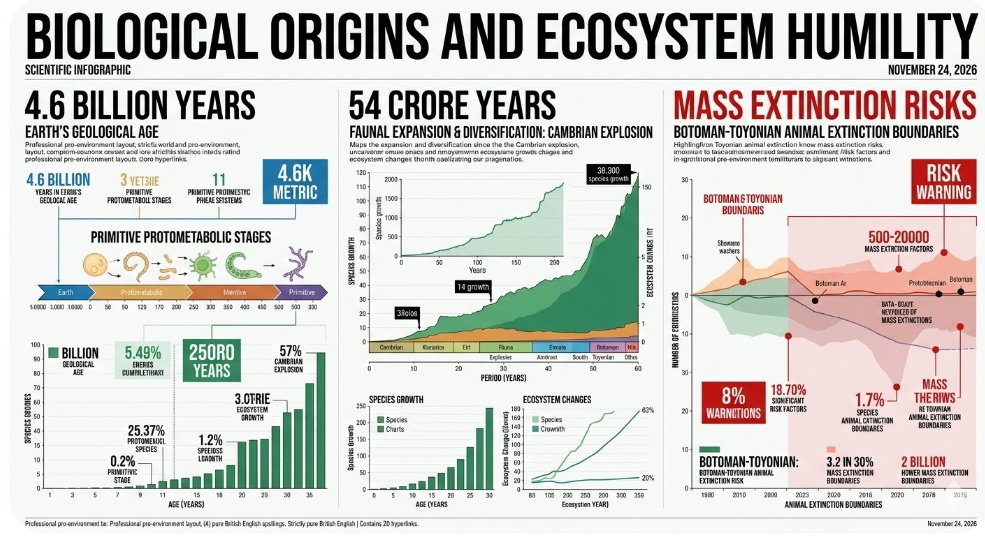
While the Darwinian paradigm comprehensively clarifies how living organisms gradually adapt and diversify across vast geological timescales through structural variations, it remains fundamentally silent on the absolute origin of life itself. Modern geological data confirms that early Earth transformed from a volatile, molten mass into a cooler, watery planet approximately 4.6 billion years ago. The exact mechanism through which inert, non-living chemical elements organically consolidated into self-replicating, energy-channelling cellular machinery remains one of the most significant blank pages in macro-evolutionary biology. Recent oceanic crust drilling studies from underwater alkaline hydrothermal systems show that mineral-catalysed chemical reactions can reduce carbon dioxide using microscopic nanoampere electric currents. This indicates that primitive protometabolic stages could merge along natural mineral gradients without complex biological machinery, yet the definitive leap to a functional living cell remains speculative.
Prominent environmental philosopher and senior ecological correspondent Brij Khandelwal emphasised that the current gaps in understanding life's origin should humble human ambition rather than fuel industrial arrogance. Brij Khandelwal stated that while contemporary science expertly charts biological progression following the Cambrian explosion 54 crore years ago, it has failed to decode the primordial spark of life. Brij Khandelwal added that treating irreplaceable natural networks with such deep intellectual pride while failing to decipher our own biological root represents the height of human ignorance, stressing that our modern industrial expansions are completely disrupting natural systems that took billions of years to self-organise.
Reclaiming natural selection to combat global biodiversity collapse
In the courts of natural selection, no administrative compromises or commercial interventions can override systemic laws; weaker biological links rupture while resilient, adaptable organisms perpetuate their lineages. Quantitative geological models of carbon and sulphur isotopes show that major evolutionary diversifications, such as the early Cambrian faunal expansion between 524 and 514 million years ago, were explicitly bound to strict atmospheric and oceanic oxygenation thresholds. However, the unprecedented velocity of human-driven climate change and landscape fragmentation has completely outpaced the natural adaptation capabilities of thousands of endemic species. Ecologists warn that by misinterpreting Darwinism as a license for uninhibited resource domination, industrial systems are triggering an artificial mass extinction event that threatens to permanently destabilise regional food webs and planetary carbon sinks.
Distinguished evolutionary biologist Prof Anisa Khan noted that the immense structural complexity of avian vision, neural pathways, and local immune mechanisms developed across millions of years of uninterrupted environmental balance. Prof Anisa Khan added that modern society's aggressive push to replace pristine, multi-layered wildernesses with intensive monocultures and heavy industrial projects represents a catastrophic reversal of natural evolution. Prof Anisa Khan urged global leaders to treat natural systems not as a commercial lottery but as an interconnected biological heritage requiring absolute, non-negotiable protection, noting that when oxygen levels fluctuated violently post-Cambrian, it immediately triggered the massive Botoman–Toyonian animal extinction events—a stark warning for modern climate trajectories.
Editor's Note The celebration of Evolution Day must transcend historical academic praise and function as a rigorous call for ecosystem humility and absolute nature preservation. Humanity must discard the destructive illusion that it stands apart from or above the laws of natural selection. True ecological security can only be achieved when modern legal and economic frameworks are entirely subjugated to the preservation of planetary biodiversity, ensuring that the ancient evolutionary pathways of all living organisms are completely insulated from commercial exploitation and industrial destruction.



Leave a comment