

Expert Expressions
CP Rajendran is a geoscientist and an adjunct professor at the National Institute of Advanced Studies, Bengaluru and co-author of the book: The Rumbling Earth – The Story of Indian Earthquakes
A new report published this month finds that Earth’s climate system is moving deeper into uncharted territory. The authors remind us: “This is no longer a warning for the future; it is a diagnosis of the present”. The 2026 State of the Climate report, published in the journal BioScience, examines 16 “planetary vital signs,” including greenhouse gas levels, ocean heat, the mass of major ice sheets, the number of hot days, and global surface temperature Seven of the 16 signs are at record extremes, and several others show acceleration or shifting abruptly (William J Ripple, Christopher Wolf, Michael E Mann, Johan Rockström, Unai Pascual, Jillian W Gregg, Chi Xu, Sarah E Perkins-Kirkpatrick, Thomas M Newsome, Jacob Bukoski, Anjal Prakash, The 2026 state of the climate report: challenges and opportunities, BioScience, 2026).
Last year’s report (2025) looked at 34 climate “warning signs.” The 2026 report looks at only 16 climate change signals. Because the two reports used different lists of warning signals, you can’t compare them directly. The main message is still the same: many important climate signals are getting close to dangerous tipping points. The overall picture, according to the report, is stark. Carbon dioxide, methane and nitrous oxide all reached record levels again in 2026. Glacier thickness and the mass of the Greenland ice sheet are at record lows, while Arctic sea ice and Antarctic ice mass are close to record extremes. Taken together, the authors argue, these findings show that the climate crisis is no longer a future risk but a present reality.
The report points to challenges and also opportunities. The COP31— the climate action summit is scheduled to happen in Türkiye (Turkey) from November 9 to 20, 2026, where the delegates from different countries will discuss the theme, "From Dialogue to Consensus, From Consensus to Action”. The 2026 report sets the backdrop for COP-31 talks on how quickly climate promises can be turned into action. The report’s value lies in synthesis: it treats the climate as an integrated system rather than a collection of isolated topics, and it frames the current moment not with fatalism, but as a time for action.
Overall scenario
The 2026 report notes that atmospheric CO₂ concentrations surpassed 428 ppm in May 2026—roughly 50% above pre-industrial levels. Primarily driven by fossil fuels, greenhouse gas concentrations are further intensifying Earth’s energy imbalance and long-term warming. The past four years have also set numerous temperature records.
The report flags concern about Earth’s energy imbalance—the difference between the solar energy the planet absorbs and the energy it radiates back into space—that reflects heat accumulation across the climate system. A growing energy imbalance means that more heat is generated, leading to higher air temperatures, ocean warming, sea-level rise and more frequent extreme weather.
The report further observes that glacier thickness and Greenland ice mass are undergoing repeated intense melting episodes, contributing to meltwater volumes that have increased sixfold. The oceans absorb most of the excess heat produced by greenhouse gas emissions. As a result, warmer water expands (thermal expansion) and melting ice sheets and glaciers drive sea-level rise, causing coastal flooding and erosion. Melting of the Arctic and the Greenland ice sheets may also weaken the Atlantic Meridional Overturning Circulation, which could alter precipitation patterns, disrupt marine ecosystems and increase drying in parts of the Amazon rainforest.
Although the population growth rate is slowing, the global human population currently reached a record high in 2026 and continues to grow by roughly 1.3 million people per year. Consequently, increased human activities, including energy use, food production, economic growth and land-use change, continue to result in rapid changes across the Earth system. Another concern in the report is the rise in livestock populations. Although total calorie production has risen in recent years, the calories available for direct human consumption in the food system increased by only 16.6%. This decline in efficiency was driven by greater use of calories for livestock feed and non-food purposes.
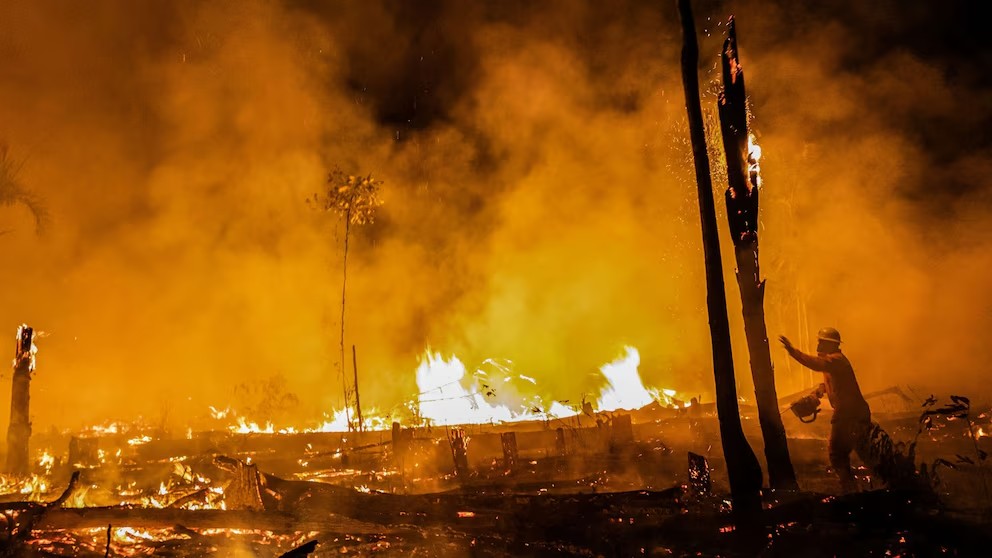
Tropical primary forest loss fell 36% in 2025 compared to 2024 estimates. The deforestation rate in the Brazilian Amazon declined for the fourth consecutive year, reaching its third-lowest level in 38 years. Globally, tree cover loss also declined in 2025 and remains at its sixth-highest level since 2001. Would this somewhat promising scenario last in the coming years? We must thank the Brazilian people for defeating Flavio Bolsonaro in the Presidential election. His Presidency would have raised serious environmental and indigenous concerns because of his pro-agribusiness platform and his promises to scale back protected Amazon areas. Clearing or degrading the Amazon pushes the rainforest closer to a tipping point at which it can no longer recycle moisture, potentially drying out the region and converting parts of it into savanna. Another concern is that conversion of native grasslands, savannas, and other non-forest ecosystems continues to contribute substantially to biodiversity loss and greenhouse gas emissions.
Although solar and wind energy consumption grew by about 18%, renewables still accounted for a much smaller share of total energy consumption than fossil fuels. Fossil fuel consumption is estimated to have reached record highs in 2025. This is reflected in annual energy-related CO₂ emissions that exceeded 41 Gt (gigaton) for the first time. Recent geopolitical tensions, including conflicts in West Asia and Ukraine, have exposed the inadequacies of global energy supply systems, leading to disruptions and price volatility and renewed attention to energy security and environmental impact.
The findings become important in the light of evidence from other independent studies. For example, oceanographers at the University of South Florida report that surface oil pollution in the Persian Gulf has doubled since the war began. Repeated attacks on commercial tankers and oil infrastructure—including the incidents involving ships—have caused multiple major oil spills. The war in Ukraine has caused extensive ecological damage and ecocide, including landmine contamination, soil contamination, and air pollution, with financial estimates ranging from $51 billion to over $85 billion and recovery expected to take decades. Direct military operations, combat and post-war reconstruction/mobilisation are estimated to pump 120 to 175 million metric tons of CO₂-equivalent into the atmosphere—rivalling the annual emissions of a medium-sized European nation.
According to the report, the world may be forced to shift toward domestic renewable energy as countries seek to reduce reliance on conventional energy. Emerging policy responses in regions such as Europe and Asia suggest that energy security concerns may now rival climate mitigation as a primary driver of renewable energy deployment.
Some encouraging signs
Growing evidence suggests the climate system may be entering a period of increasing instability, marked by accelerating warming, cascading feedback, tipping elements and rising risks of irreversible change. Increasing energy imbalance, rising ocean heat content, weakening carbon sinks and accelerating ice loss all indicate that climate-system imbalances may exceed earlier expectations. Recent years have brought increasingly destructive heatwaves, floods, droughts, storms, and wildfires, causing growing losses of life, infrastructure, food security, biodiversity and economic stability.
The report ends with a discussion on some encouraging signs. Recent progress in renewable energy, electrification, battery storage and ecosystem restoration indicates that positive social and technological tipping points may already be developing. At the same time, more effort is needed to lessen the environmental impacts of renewable energy infrastructure. Even as climate risks increase, broader societal transformations are beginning to appear. Rapid advances in renewable energy, battery storage, adaptation planning, ecosystem restoration and climate response tools suggest that large-scale change is still achievable.
Many existing options can help address mounting threats while also delivering valuable co-benefits, including cleaner air, greater biodiversity, stronger water security and more carbon storage. For instance, restoring mangroves can protect coastlines from storm surges while increasing carbon sequestration and reducing dependence on beef can make food systems less vulnerable to climate-related disruption. Certain responses—especially nature-based solutions such as urban forests, wetlands and mangroves—can improve climate resilience and advance mitigation goals at the same time.



Leave a comment