

TreeTake Network
A massive ground and telemetry tracking operation is underway across northern West Bengal and the Assam border after Dooars Rani, a three-year-old Royal Bengal tigress at the centre of West Bengal's flagship tiger reintroduction programme, escaped from her acclimatisation enclosure at Buxa Tiger Reserve for the second time in less than a week.
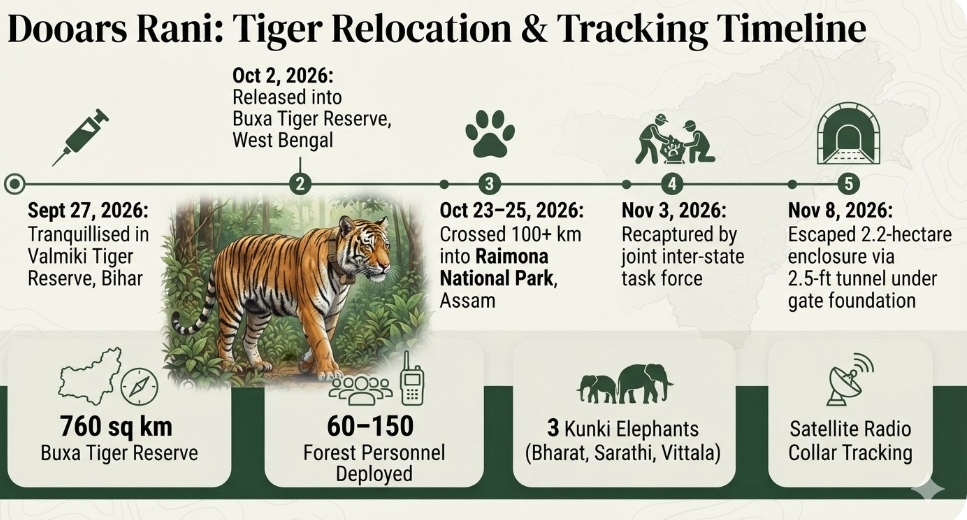
The tigress, officially catalogued as BTR-TF-1 and T-138, excavated a narrow tunnel beneath the concrete foundation of her 2.2-hectare soft-release enclosure near 25 Mile Tower on the afternoon of November 8, 2026, barely five days after a joint inter-state task force captured her in Assam and returned her to Alipurduar. Forest personnel discovered her absence during routine afternoon checks at around 2 pm, triggering a red alert across the 760-square-kilometre reserve and prompting authorities to cancel staff leave.
Tunnel Breakout and Ministerial Reaction
According to senior forest officials who inspected the perimeter on November 9, 2026, the tigress tested multiple points along the iron fencing over three to four days before excavating soft soil beneath a two-foot-thick and four-foot-deep concrete foundation. Investigators recorded scratch marks and digging attempts at 16 separate locations along the barrier before she carved an escape passage measuring between two and 2.5 feet in diameter beside the entry gate.
West Bengal Forest Minister Manoj Kumar Oraon, who visited the 25 Mile Tower enclosure with senior reserve officials to inspect the breach, remarked, "After all, she is the Queen of the Dooars. Why would she accept an enclosure created by us?"
Minister Oraon noted that authorities had already been preparing to release the animal back into the open forest within days, stating, "We will not say that she has fled. We will say that she has come out." He added that National Tiger Conservation Authority protocols stipulate keeping a translocated tiger in a soft-release enclosure for 10 days rather than prolonged captivity, explaining that officials had planned to open the enclosure gates shortly.
Telemetry Tracking and Ground Deployment
Field teams are monitoring signals from her high-frequency satellite radio collar, although dense forest canopy and terrain undulations periodically interrupt reception. Pugmark analysis indicates she has moved east across the Bala and Jayanti rivers toward the 27th Mile and Chunia Tower sectors, roughly five to 15 kilometres from her enclosure.
Between 60 and 150 forest personnel, wildlife veterinarians, and three trained kunki elephants named Bharat, Sarathi, and Vittala have been mobilised along Buxa's eastern boundary to monitor her trail and prevent a crossing of the Sankosh river into Assam. Confirming the deployment, Minister Oraon said, "Our teams are keeping the tigress under close observation and continuously tracking its movements. We will take all possible efforts to ensure that it does not move towards Assam again."
A senior forest official involved in the ground operation explained the animal's behaviour, noting, "Having roamed freely in Raimona for nearly 10 days, she developed a strong urge to move out again. She kept testing the perimeter until she found a weak spot beneath the gate foundation."
Expert Scrutiny and Inter-State Coordination
Dooars Rani was originally tranquillised in Bihar's Valmiki Tiger Reserve on September 27, 2026, airlifted to Hasimara on September 30, 2026, and released into Buxa on October 2, 2026, as part of West Bengal's tiger augmentation programme. Prior to her arrival, the department relocated 242 families from core forest settlements such as Bhutia Basti to bolster prey density.
Between October 23 and October 25, 2026, she crossed the inter-state boundary into Assam's Raimona National Park, travelling over 100 kilometres into Kokrajhar district where she preyed on livestock. A joint inter-state team tranquillised and recaptured her on November 3, 2026, an operation praised by Assam Environment and Forest Minister Jayanta Mallabaruah, who described it as "A commendable example of inter-state coordination and collective commitment to wildlife conservation."
However, conservation specialists emphasise that long-term habitat and staffing readiness remain critical for the success of the reintroduction programme. Retired senior forest official Pradeep Vyas observed, "A single tiger in a vast forest cannot establish a breeding population unless we resolve staffing shortages and complete village relocations."
Wildlife conservationist Biswajit Roy Choudhury echoed that concern, stating, "The security issues in Buxa tiger forest also need to be resolved properly, otherwise the reintroduction may face problems." Despite the operational hurdles, a second batch of tigers from Bihar remains scheduled to arrive later in November 2026.
Editor's Note
Dooars Rani's repeated cross-border movement demonstrates that apex predators recognise ecological corridors rather than administrative boundaries, linking West Bengal's Buxa Tiger Reserve directly with Assam's Raimona and Manas landscapes. Rather than treating natural dispersal as an operational setback, wildlife authorities in both states must formalise a joint transboundary telemetry protocol, resolve frontline staffing deficits, and accelerate voluntary village relocations to secure a viable breeding territory across the eastern Dooars.



Leave a comment