

TreeTake Network
A widespread post-Deepavali air pollution episode continued to grip northern India on November 12, 2026, with real-time monitoring networks across Punjab, Haryana, Delhi-NCR, and Uttar Pradesh recording sharp particulate concentrations driven by residual firecracker emissions, regional agricultural stubble burning, and calm nocturnal meteorology. While the national capital registered a 24-hour average Air Quality Index (AQI) of 313 to 323 in the very poor category under the Central Pollution Control Board (CPCB) bulletin, industrial and urban centres across Uttar Pradesh—including Meerut, Hapur, Bulandshahr, Noida, Ghaziabad, Kanpur, and the state capital Lucknow—experienced severe particulate spikes alongside heavy haze across the Indo-Gangetic Plain.
Pan-India Airshed Crisis and Northern Hotspots
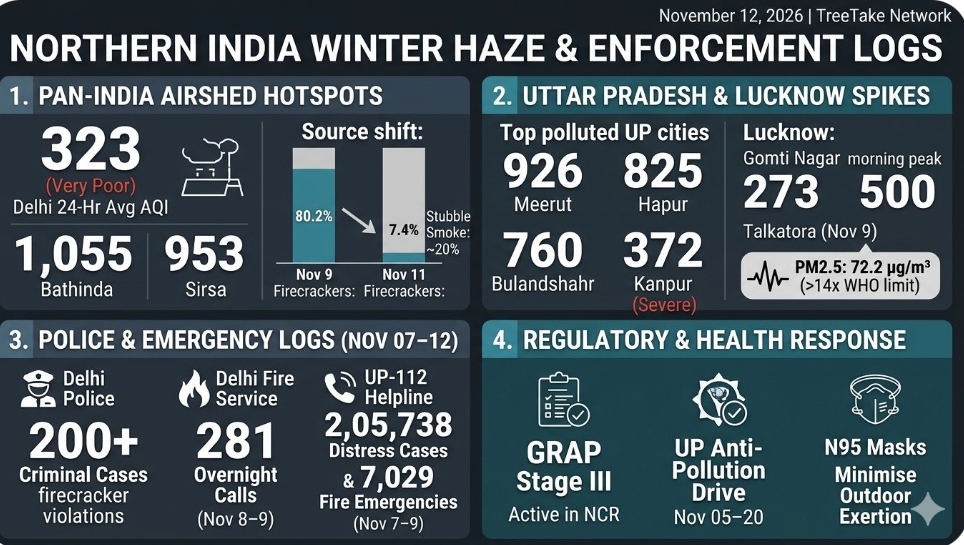
Across the broader northern airshed on November 12, 2026, real-time air quality trackers placed dozens of Indian urban centres among the world's most polluted cities, with Bathinda in Punjab recording an extreme AQI reading of 1,055 and Sirsa in Haryana logging 953, followed by Faridkot (708), Sonipat (704), and Panipat (687). Source apportionment assessments from the Ministry of Earth Sciences' AIRWISE-Delhi portal indicated that while firecracker emissions accounted for 80.2 per cent of Delhi's PM2.5 pollution between 01:00 hours IST and 09:00 hours IST on November 09, 2026, their share subsided to 7.4 per cent by the morning of November 11, 2026, as smoke from farm fires across Punjab and Haryana rose toward 20 per cent of the regional particulate burden.
"Stagnant nocturnal winds, declining surface temperatures, and shallow boundary-layer mixing prevent vertical dispersion of fine particulate matter accumulated from local combustion and regional agricultural residue smoke," explained Dr Gufran Beig, founder project director of the System of Air Quality and Weather Forecasting and Research (SAFAR). "Until stronger northwesterly winds sweep across the Indo-Gangetic Plain, pollution episodes in Delhi-NCR and neighbouring states tend to recirculate rather than disperse."
In contrast to the severe accumulation across the northern plains, coastal and southern metropolitan centres recorded markedly lower readings on November 12, 2026, with Mumbai logging moderate air quality around 147 and Bengaluru maintaining satisfactory to moderate conditions, underscoring the geographic vulnerability of the landlocked Indo-Gangetic basin during early winter.
Police and Pollution Control Board Complaints Across the Festive Period
Official enforcement logs compiled between November 07, 2026, and November 12, 2026, reveal intense public distress and regulatory pressure across northern India regarding illegal firecracker sales, timing violations, fire emergencies, and air pollution complaints. In Delhi, where the Supreme Court had permitted certified green firecrackers strictly between 06:00 hours IST and 07:00 hours IST and between 20:00 hours IST and 22:00 hours IST on November 07 and November 08, 2026, before a complete ban took effect from November 09, 2026, Delhi Police registered more than 200 criminal cases for timing violations—led by 62 cases in the West district, over 50 cases in Outer North Delhi, and more than 35 cases in the North district—while issuing renewed enforcement warnings on November 10 and November 11, 2026, urging citizens to report ongoing violations on the 112 helpline.
Simultaneously, the Delhi Fire Service (DFS) logged 257 emergency calls on Deepavali day (November 08, 2026) and 281 distress calls between 18:00 hours IST on November 08 and 06:00 hours IST on November 09, 2026, including 214 fire-related incidents and 24 calls directly linked to firecrackers. Across Uttar Pradesh, emergency helpline UP-112 recorded 2,05,738 distress cases between November 07 and November 09, 2026—compared to a normal daily average of 38,000 calls—comprising 53,264 incidents on November 07, 74,816 cases on November 08, and 77,753 incidents on November 09, alongside 7,029 fire-related emergencies triggered by extensive fireworks use. Prior to Deepavali on November 07, 2026, Uttar Pradesh Police also arrested 48 individuals and registered 35 First Information Reports (FIRs) in the Varanasi zone alone, seizing 130 quintals of illegal firecrackers valued at over 1.25 crore rupees.
"Cases have been registered against those found violating the prescribed timings, and police teams were deployed in different areas to ensure compliance with the court's directions," stated a senior Delhi Police officer following the initial enforcement sweep.
Regarding pollution control board grievances, while the Central Pollution Control Board's SAMEER portal and the Uttar Pradesh Pollution Control Board (UPPCB) grievance cells continuously register citizen complaints on open waste burning, construction dust, and industrial smoke through November 12, 2026, neither agency has published a consolidated, separate daily tally isolating firecracker-specific pollution complaints for the November 07 to November 12, 2026 window. Furthermore, the CPCB clarified on November 11, 2026, that automated particulate analysers calibrated between zero and 1,000 micrograms per cubic metre automatically flag extreme firecracker spikes exceeding that threshold as outside range during validation.
"During extreme episodes, which are occasional like Diwali firecracker bursting, this may appear as a data gap at the particular station concerned, and those hours do not contribute to the 24-hour average of relevant pollutants for the concerned station," stated the Central Pollution Control Board in its technical clarification.
Uttar Pradesh Confronts Widespread Particulate Surge Across NCR and Central Districts
Uttar Pradesh accounted for five of India's 10 most polluted cities in real-time national rankings on November 12, 2026, led by Meerut (926), Hapur (825), Bulandshahr(760), Muzaffarnagar(700), and Greater Noida (685). In the state's National Capital Region belt, real-time particulate monitors recorded hazardous PM2.5 concentrations in Noida (314 micrograms per cubic metre) and Ghaziabad (310 micrograms per cubic metre). At the same time, central and eastern urban centres also experienced sharp deterioration, with Kanpur registering an AQI of 372 in the severe category alongside PM2.5 levels of 214 micrograms per cubic metre and PM10 at 263 micrograms per cubic metre.
"The Centre for Research on Energy and Clean Air assessment already demonstrated ahead of the festival season that smaller industrial and peri-urban towns across Uttar Pradesh—such as Baraut, Khora, and Gajraula—are emerging as chronic particulate hotspots," noted Sunil Dahiya, founder and lead analyst at Envirocatalysts. "Without continuous emission controls on small-scale industrial clusters, brick kilns, and road dust across the entire state airshed, seasonal meteorological inversions rapidly push urban centres into hazardous territory."
To curb local dust and combustion spikes, the Uttar Pradesh Pollution Control Board directed municipal corporations across non-attainment cities to intensify mechanised road sweeping, water sprinkling along arterial corridors, and night patrols against open waste burning under the special anti-pollution drive running from November 05 to November 20, 2026.
Lucknow Smog Intensifies Across Gomti Nagar, Talkatora, and Lalbagh
In Lucknow, dense morning haze lingered across residential and commercial pockets on November 12, 2026, after post-Deepavali spikes pushed station readings to 500 at Talkatora on November 09, 2026, and the city's average AQI rose from 223 on November 07 to 315 on November 08, 2026. Real-time particulate sensors at Gomti Nagar recorded a morning peak AQI of 273 at 08:01 hours IST on November 12, 2026, while citywide monitoring logged PM2.5 concentrations of 72.2 micrograms per cubic metre—more than 14 times the World Health Organisation's annual exposure guideline—with elevated readings across Central School, Lalbagh, Talkatora, Babasaheb Bhimrao Ambedkar University, and Kukrail Picnic Spot.
"Post-Deepavali particulate accumulation combined with high relative humidity exceeding 90 per cent during early morning hours traps fine aerosols close to the breathing zone across Lucknow," observed Prof Venkatesh Dutta, environmental scientist at Babasaheb Bhimrao Ambedkar University, Lucknow. "High-density traffic corridors, ongoing construction dust, and nocturnal biomass burning in peri-urban fringes sustain elevated PM2.5 levels well after festival celebrations conclude."
"Severe air pollution can cause irritation in the respiratory tract, persistent coughing, breathlessness, and asthma attacks, and people with existing respiratory ailments need to take extra precautions," warned Dr S K Pandey, former Medical Officer at Ram Manohar Lohia Institute of Medical Sciences in Lucknow.
Institutional Enforcement and Public Health Advisory
Stage III of the Graded Response Action Plan (GRAP)—invoked by the Commission for Air Quality Management (CAQM) on November 06, 2026—remained in force across Delhi-NCR on November 12, 2026, enforcing bans on non-essential construction, restrictions on older BS-III petrol and BS-IV diesel vehicles, and hybrid schooling for primary classes. Simultaneously, medical authorities across Uttar Pradesh and Delhi issued advisories urging residents to avoid outdoor exercise during morning and late-evening peak smog hours.
"Prolonged inhalation of elevated PM2.5 concentrations triggers acute airway inflammation, exacerbates bronchial asthma, and increases cardiovascular strain even among healthy adults," warned Dr Randeep Guleria, former Director of the All India Institute of Medical Sciences (AIIMS), New Delhi. "Vulnerable groups—including children, senior citizens, and patients with chronic respiratory or cardiac conditions—should strictly minimise outdoor exertion and utilise certified N95 masks when stepping outside."
Editor's Note
The pan-Indian air quality data and enforcement records compiled between November 07 and November 12, 2026, demonstrate that winter air pollution spans an interconnected airshed stretching from Bathinda and Delhi to Meerut, Kanpur, and Lucknow. While police crackdowns on illegal firecrackers and GRAP Stage III restrictions address acute violations, transparent public reporting of citizen pollution complaints and year-round industrial and agricultural residue management remain essential. Moving forward, synchronising municipal dust control, public complaint resolution on the SAMEER platform, and regional airshed governance will be decisive in protecting public health across northern India.
.jpg?resize=780%2C450&ssl=1)


.jpg?resize=120%2C90&ssl=1)



Leave a comment