

TreeTake Network
A major Indigenous-led regional alliance connecting grassroots conservation and cultural organisations across Melanesia has officially launched at the University of Melbourne's annual Oceania Institute Oration, establishing a collaborative platform for biodiversity protection, cultural heritage stewardship, and sustainable community livelihoods across five Pacific territories.
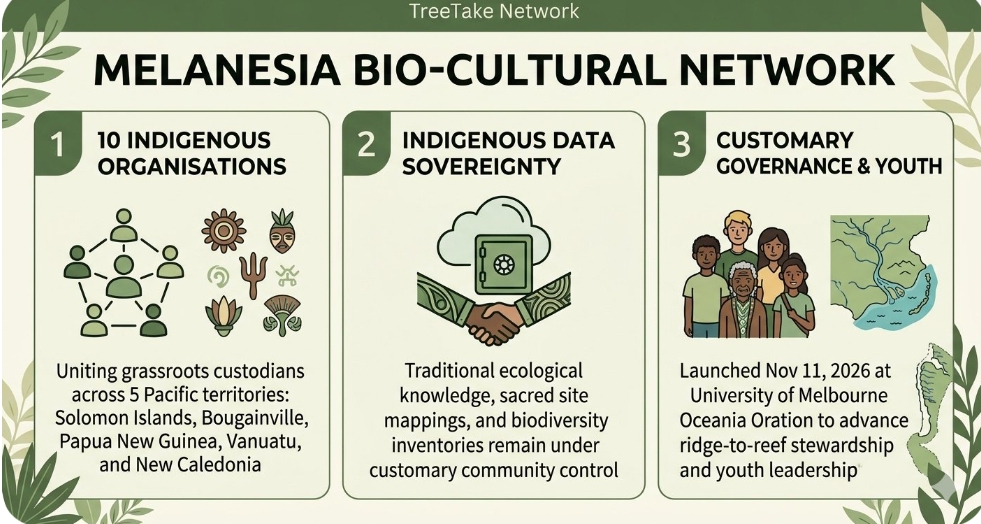
Unveiled during the evening ceremony on November 10, 2026 and announced globally today, November 11, 2026, the Melanesia Bio-Cultural Network brings together 10 community-led organisations operating across the Solomon Islands, the Autonomous Region of Bougainville, Papua New Guinea, Vanuatu, and New Caledonia. The initiative was formalised through an inaugural gathering hosted at the University of Melbourne that convened traditional landowners, customary chiefs, Indigenous researchers, and Pacific conservation practitioners to design a peer-to-peer knowledge exchange framework.
Uniting Grassroots Custodians Across Five Melanesian Territories
Melanesia encompasses one of the planet's richest centres of terrestrial and marine biodiversity alongside extraordinary linguistic and cultural diversity, with more than 1,300 distinct languages spoken across the region. Despite the proven effectiveness of customary land and sea stewardship in preventing deforestation and overfishing, community-based conservation groups have historically operated in geographic isolation with limited access to long-term institutional backing.
The newly established network directly connects 10 frontline Indigenous organisations, including the Baru Conservation Alliance in East Kwaio on Malaita in the Solomon Islands, the Kunua Conservation Network in Bougainville, the Porona Eco-Cultural Foundation in Papua New Guinea, and grassroots customary stewardship collectives in Vanuatu and New Caledonia.
Chief Esau Kekeubata, founder of the Baru Conservation Alliance in East Kwaio and a keynote speaker at the Oceania Oration, underscored that conservation in Melanesia cannot be separated from ancestral identity and customary governance. "Our forests, rivers, and reefs are not separate from who we are as Indigenous peoples; they are the living foundation of our culture, medicine, and survival," Chief Kekeubata said. "For generations, our communities have protected these ecosystems through customary law, and this network ensures our voices, knowledge, and conservation work stand together across Melanesia."
Dr David MacLaren, Senior Research Fellow and long-standing research partner with East Kwaio community leaders, emphasised the transformative value of horizontal solidarity among Pacific custodians. "Too often, conservation programmes are designed in distant capitals without listening to the customary landowners who live with and care for these landscapes every day," Dr MacLaren noted. "By linking grassroots leaders directly across borders, the Melanesia Bio-Cultural Network enables communities to share practical strategies on biodiversity monitoring, eco-cultural education, and sustainable enterprise on their own terms."
Indigenous Data Sovereignty and Youth Leadership at the Core
Supported by the University of Melbourne's Oceania Institute alongside regional philanthropic partners, the network operates strictly under Indigenous data sovereignty and governance principles, ensuring that traditional ecological knowledge, sacred site mappings, and biodiversity inventories remain under the legal and cultural control of participating communities.
Beyond habitat protection, the alliance integrates intergenerational knowledge transfer, post-conflict peacebuilding, climate resilience planning, and youth leadership training. Young community researchers from participating territories will collaborate on documenting endangered medicinal plant knowledge, endemic wildlife habitats, and traditional ridge-to-reef resource management practices.
Professor Marcia Langton, Associate Provost at the University of Melbourne and a leading advocate for Indigenous knowledge systems, highlighted the global significance of the alliance during the launch proceedings. "Indigenous peoples across the Pacific hold centuries of empirical ecological wisdom that modern conservation science is only beginning to appreciate," Professor Langton stated. "Supporting Indigenous-led networks that honour customary authority and self-determination is essential if the world is serious about halting biodiversity loss and building genuine climate resilience."
Advancing Regional Biodiversity Targets Through Customary Governance
Participating organisations will convene regular regional workshops, field exchanges, and joint conservation advocacy ahead of upcoming Pacific environmental forums, aiming to channel direct financing toward community-managed protected areas rather than costly administrative intermediaries.
Addressing the assembled delegates in Melbourne, Bougainville community representative and Kunua Conservation Network coordinator Peter Sipari reflected on the shared aspirations uniting the 10 founding groups. "Whether in Bougainville, Malaita, Papua New Guinea, Vanuatu, or New Caledonia, our elders taught us that if we look after the land, the land will look after our children," Sipari said. "Through this alliance, we are strengthening our collective endeavour to safeguard our forests and cultural heritage for generations to come."
Editor's Note
The launch of the Melanesia Bio-Cultural Network affirms that durable biodiversity conservation across the Pacific depends on placing customary landowners and Indigenous governance systems at the centre of decision-making. Ensuring that international climate and biodiversity funds flow directly to community-led initiatives under strict Indigenous data sovereignty protections will be vital to safeguarding Melanesia's irreplaceable ecosystems against extractive pressures and climate impacts.



Leave a comment