

Thinking Point
TreeTake Network
Scottish Water Horizons, the commercial subsidiary of public utility Scottish Water, has unveiled a comprehensive ecological enhancement and biodiversity restoration scheme integrated directly into its renewable solar power development at the Gailes Wastewater Pumping Station near Irvine in North Ayrshire, Scotland.
Announced today, November 11, 2026, the initiative shows how utility-scale clean energy infrastructure can decarbonise essential water treatment operations while regenerating coastal grassland habitats for threatened native pollinators, including the rare tormentil mining bee.
Nature-Positive Design Alongside Renewable Solar Generation
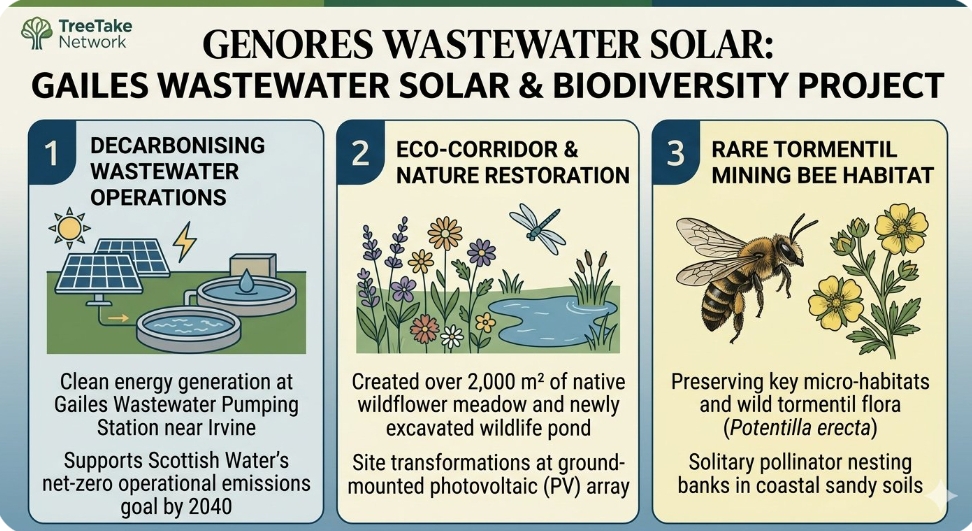
Rather than treating land surrounding ground-mounted photovoltaic arrays as sterile industrial ground, project engineers and ecologists redesigned the site layout at Gailes to accommodate a newly excavated wildlife pond, over 2,000 square metres of native wildflower meadow, and carefully contoured sandy nesting banks tailored to specialist burrowing insects.
The solar installation itself generates clean, renewable electricity on site to offset grid consumption at the energy-intensive wastewater pumping station, supporting Scottish Water's broader commitment to achieve net zero operational emissions by 2040. By pairing renewable generation with targeted habitat creation, the site has been transformed into a thriving ecological corridor along the Ayrshire coast.
Kelda Wilkie, Environmental Project Manager at Scottish Water Horizons, emphasised that embedding biodiversity gains into renewable infrastructure is central to the utility's engineering philosophy. "Our goal at Gailes was to show that delivering clean energy infrastructure and enhancing local biodiversity go hand in hand," Wilkie said. "By working closely with specialist ecologists from the earliest design stage, we created a wildlife pond, planted more than 2,000 square metres of native wildflowers, and safeguarded critical micro-habitats right alongside our solar panels."
Safeguarding the Rare Tormentil Mining Bee
Ecological baseline surveys conducted before construction identified coastal sandy soils and patches of wild tormentil plants around the Gailes site that support the tormentil mining bee (Andrena tarsata), a scarce solitary pollinator listed on conservation priority registers across the United Kingdom due to habitat fragmentation and agricultural intensification.
Unlike social honeybees, female tormentil mining bees excavate individual nest burrows in sparsely vegetated, sun-warmed sandy banks and rely almost exclusively on the bright yellow flowers of tormentil (Potentilla erecta) to provision their offspring with pollen.
To protect and expand this fragile population, ecological consultants established exclusion zones during construction, preserved existing host flora, and sculpted south-facing earth banks seeded with regional provenance tormentil and coastal wildflowers.
Dr Liam Henderson, Principal Ecologist advising on the Ayrshire coastal habitat restoration, noted the wider significance of utility land stewardship for specialist invertebrates. "Specialist pollinators like the tormentil mining bee are extraordinarily sensitive to subtle changes in soil structure and flower availability," Dr Henderson explained. "Utility sites such as Gailes offer secure, undisturbed coastal refuges where targeted habitat management can reverse local declines and connect fragmented pollinator populations across North Ayrshire."
Scaling Biodiversity Across Utility Infrastructure
The newly created wildlife pond at Gailes is already attracting dragonflies, amphibians, and wading birds. At the same time, seasonal grazing and conservation mowing regimes will ensure the wildflower meadow continues to flourish without encroaching upon solar panel efficiency.
Donald MacBrayne, Business Development Manager at Scottish Water Horizons, highlighted that the Gailes model will inform future renewable energy projects across the utility's operational estate. "Every solar and renewable scheme we deliver is an opportunity to leave the surrounding environment in a healthier condition than we found it," MacBrayne stated. "Gailes sets a practical benchmark for combining carbon reduction with measurable nature restoration."
Editor's Note
Integrating ecological restoration directly into renewable energy installations offers a replicable blueprint for utilities and infrastructure developers worldwide. As clean energy deployment accelerates, mandating early-stage ecological surveys, native species propagation, and long-term habitat stewardship ensures that decarbonisation efforts actively strengthen local biodiversity rather than competing with nature for space.



Leave a comment