

TreeTake Network
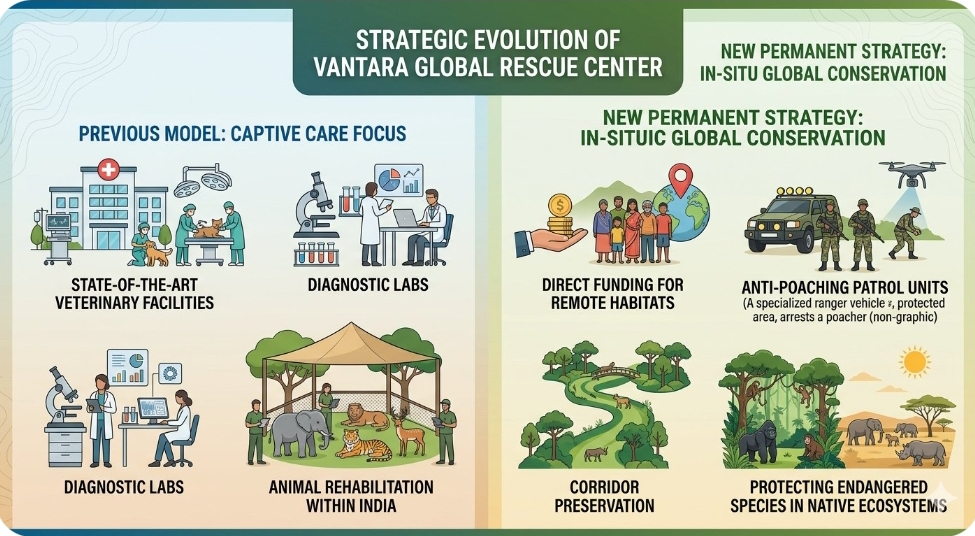
The Vantara animal rescue, rehabilitation, and care facility located in Jamnagar, Gujarat, India, has formally announced a permanent structural shift in its long-term operational strategy on November 01, 2026. Under the updated mandate, the expansive facility will completely halt all foreign wildlife imports and international animal transfers. Instead, the organisation will redirect its substantial financial resources and veterinary infrastructure to fund in-situ conservation, protecting critically endangered species directly within their native habitats across the globe.
The strategic redirection follows months of intense discourse within the international zoological community regarding the transport of exotic wildlife across continents to private facilities.
Global Allocation of Conservation Resources
The transition marks an analytical shift from captive rehabilitation to global habitat preservation. Field zoologists and habitat protection networks have largely welcomed the development, noting that localised funding can yield exponential ecological benefits compared to the high maintenance costs of housing exotic species in non-native climates.
Dr Elena Rostova, a wildlife biology consultant with the International Consortium for Habitat Integrity, evaluated the move: "Transporting large mammals like African elephants or apex predators across oceans creates severe acclimation risks, no matter how advanced the destination facility is. Vantara’s commitment to deploy capital directly into the Congolese Basin and Southeast Asian rainforests means we can protect entire wild ecosystems, securing thousands of species simultaneously rather than focusing on a few rescued individuals."
Adding an administrative viewpoint on international wildlife logistics, Vivek Menon, a senior policy advisor at the Wildlife Conservation Trust, observed: "This pivot establishes an important precedent for mega-facilities. By shifting focus toward strengthening global anti-poaching units, building corridor protections, and funding localised community-led conservation projects within the native ranges, the structural root causes of wildlife exploitation are being directly dismantled."
Operational Strengths and Facility Transition
Conversely, managers within the domestic zoological sector and facility proponents emphasise that Vantara’s existing state-of-the-art infrastructure in Gujarat will continue to serve as a critical apex care centre for injured, abused, or confiscated animals within India. They point out that the specialised hospitals and diagnostic labs built on-site remain unmatched in their capacity to handle complex veterinary emergencies.
A senior veterinary officer attached to Vantara’s core operations clarified the facility's internal roadmap: "Our specialised hospitals, operating theatres, and metabolic research labs in Jamnagar will remain fully active. Our focus is merely evolving. India has thousands of rescued circus animals, injured leopards, and confiscated reptiles that need world-class lifetime care; by halting new international intakes, we maximise our specialised space and medical staff for domestic wildlife emergencies while funding global wild populations remotely."
Defending the facility's long-term contributions, Harshvardhan Shah, an independent wildlife rehabilitator and member of the Indian Zoo Managers Association, noted: "Vantara has fundamentally raised the baseline for veterinary standards across Asia. The knowledge generated by their specialised staff over the last few years is highly valuable. Utilising that expertise to train forest rangers internationally, combined with direct funding for habitat restoration, bridges the gap between high-tech captive medicine and boots-on-the-ground field conservation."
Editor's Note
The permanent policy pivot at Vantara highlights a maturing perspective within large-scale private conservation initiatives. Moving forward, the true gauge of this framework's success will depend on the establishment of transparent, third-party-audited funding pipelines to ensure that the redirected resources effectively mitigate habitat fragmentation and poaching pressures in vulnerable global biodiversity hotspots.



Leave a comment