

TreeTake Network
The draft Prevention of Cruelty to Animals (Control and Supervision of Experiment, Breeding and Trading of Laboratory Animals) Rules, 2026, issued by the Indian Ministry of Fisheries, Animal Husbandry and Dairying, has divided the biomedical ecosystem. Replacing the 1998 guidelines, the 2026 draft introduces a severity-based categorisation (non-recovery, mild, moderate, or severe). It transfers authority over mild and moderate procedures from the central Committee for Control and Supervision of Experiments on Animals (CCSEA) to local Institutional Animal Ethics Committees (IAEC). The public comment window is set to close on November 05, 2026.
Welfare Concerns and Sourcing Exceptions
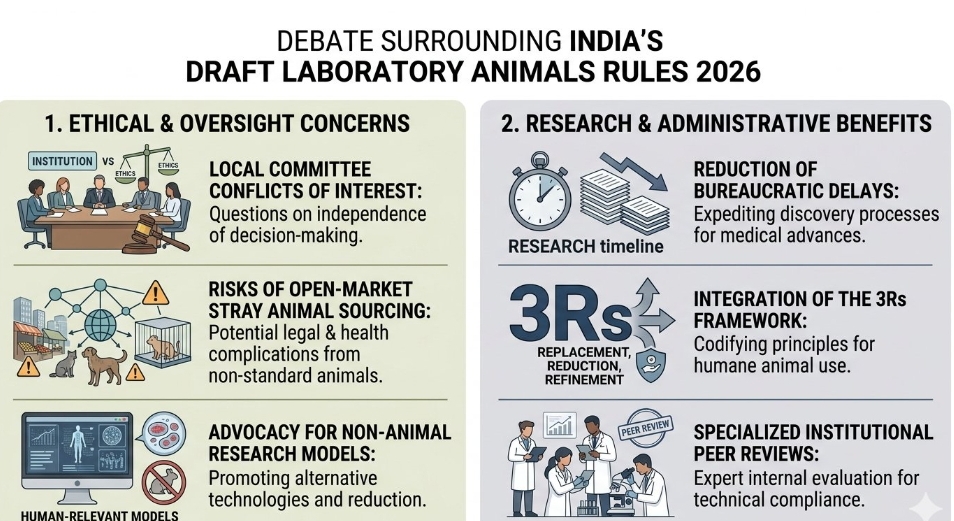
Animal welfare advocates warn that Rule 5(3) contains ambiguous language that may permit laboratories to source subjects from open markets and free-ranging environments, potentially exposing community street dogs and stray animals to experimental testing. Critics also highlight potential conflicts of interest in local self-approvals, as internal committees feature a majority of members from the applying establishment.
Dr Noopur Jain, a senior veterinary consultant at PETA India, stated: "Confining non-laboratory animals causes extreme psychological distress and completely compromises scientific accuracy due to their unknown genetic and health background. India must move entirely toward modern, human-relevant non-animal science rather than carving out regulatory shortcuts that endanger community stray animals."
Dr Surat Parvatam, an independent bioethics researcher representing the Humane World Coalition, added: "Shifting the approval authority for mild and moderate protocols entirely to local institutional committees removes an essential layer of independent central oversight. Without strict, centralised CCSEA validation, regional facilities face immense internal corporate pressure to self-approve shortcuts at the expense of basic animal welfare standards."
Research and Official Defense
Conversely, officials and industry proponents defend the framework as an essential mechanism to streamline bureaucratic delays for pharmaceutical and academic research. Supporters note the rules formally integrate the 3Rs framework (Reduction, Refinement, Replacement), and emphasise that the CCSEA retains authority over "severe" procedures and large non-rodent mammals.
An official spokesperson from the Ministry of Fisheries, Animal Husbandry and Dairying clarified the regulatory intent: "The primary purpose of decentralising mild protocol oversight is to eliminate months of administrative delays that stall critical national research, including vaccine trials. The CCSEA maintains absolute, strict veto power over high-severity testing, and structural safety guardrails remain intact to prevent arbitrary exploitation."
Dr Alok Srivastava, Director of Biomedical Innovation at the National Pharma Research Consortium, defended the updated rules: "Modern drug discovery requires an agile regulatory environment to keep pace with global healthcare emergencies. The integration of explicit severity definitions ensures that researchers are legally bound to minimise pain, and institutional peer reviews offer a highly competent, specialised layer of day-to-day ethical compliance."
Editor's Note
The escalating friction over the 2026 draft rules underscores the complex structural tension between accelerating national biomedical research and maintaining rigorous bioethical standards. Moving forward, the ministry should eliminate ambiguity around open-market sourcing by codifying a blanket prohibition on using unbred stray and wild animals, while also implementing random, digitised central audits of local committee approvals to restore public transparency.



Leave a comment