

TreeTake Network
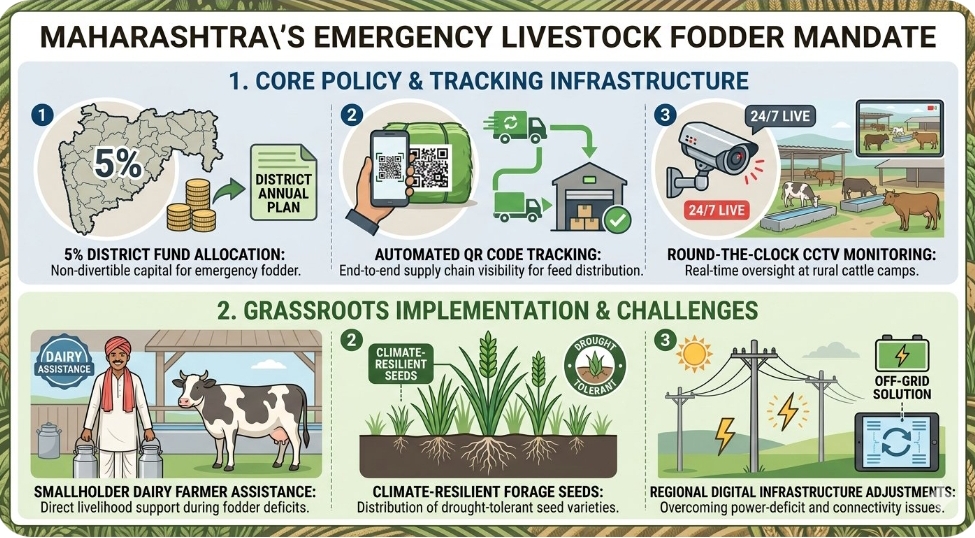
The Maharashtra state administration has formally implemented a state-wide agricultural mandate on November 01, 2026, compelling all district authorities to systematically buffer the rural livestock economy against climate-induced strain. Under the new statutory decree, a minimum of 5% of all District Annual Plan funds must be strictly ring-fenced and deployed for emergency animal fodder cultivation, water conservation infrastructure, and cattle camp management. To prevent historical systemic leakage, the government has integrated automated QR code tracking for fodder distribution and mandated round-the-clock closed-circuit television (CCTV) monitoring inside all newly established rural cattle shelters.
The policy framework comes as prolonged regional dry spells across the Marathwada and Vidarbha belts trigger severe localized hydrological deficits, threatening the security of millions of livestock.
Administrative Rigour and Tracking Protocols
State policymakers and rural development administrators defend the aggressive automation and funding mandates as necessary measures to eliminate financial mismanagement and ensure resources directly reach vulnerable farming households. They argue that traditional ad-hoc relief packages during ecological crises are often delayed by bureaucratic bottlenecks.
An official spokesperson from the Maharashtra Department of Agriculture and Animal Husbandry outlined the deployment guidelines: "By legally enforcing a 5% district fund reservation, local administrations have immediate, non-divertible capital to plant drought-resilient fodder varieties before deficits peak. The implementation of automated QR codes on every single fodder shipment, matched with mandatory live CCTV streams from cattle camps to a centralized digital dashboard in Mumbai, ensures absolute accountability and prevents illegal diversion to commercial markets."
Eknath Shinde, a senior regional administrative coordinator supervising relief operations, added: "During past droughts, the lack of real-time supply chain visibility led to massive disparities in fodder availability across neighboring talukas. This structural overhaul ensures data-driven distribution, providing smallholder dairy farmers with an guaranteed safety net directly at the village level."
Grassroots Challenges and Agricultural Adjustments
Conversely, local agrarian unions, while acknowledging the financial support, point out significant operational challenges regarding infrastructure readiness and internet connectivity required to maintain automated monitoring systems in remote areas. Agronomists also caution that immediate land allocation for fodder could inadvertently squeeze fields meant for winter food crops.
Dr Milind Deshmukh, an agricultural economist at the Maharashtra Institute of Rural Development, analyzed the operational friction: "Reserving financial capital is a highly progressive step, but setting up stable, round-the-clock CCTV streaming and automated QR scanning in power-deficit regions requires extensive rural digital infrastructure. Additionally, district officers must carefully coordinate land use so that emergency fodder cultivation does not cause local food-crop inflation by replacing traditional winter cereal fields."
Ajit Patil, a representative for the Maharashtra Shetkari Sanghatana farmers' union, expressed the view from the ground: "The emergency allocation of district funds is a life-saving measure for our livestock, as fodder prices have risen rapidly over the past month. However, the government must ensure that local village councils are not penalized if technical glitches disrupt the automated tracking networks. The focus must remain on the timely physical delivery of water and feed to the cattle camps, rather than purely digital compliance."
Editor's Note
The implementation of the emergency fodder allocation framework in Maharashtra marks a shift from reactive disaster response to predictive asset protection. Moving forward, the success of this strategy will depend on stabilizing the rural digital infrastructure to keep tracking networks online, while scaling up partnerships with local agricultural universities to distribute climate-resilient forage seeds that require minimal groundwater resources.



Leave a comment