

TreeTake Network
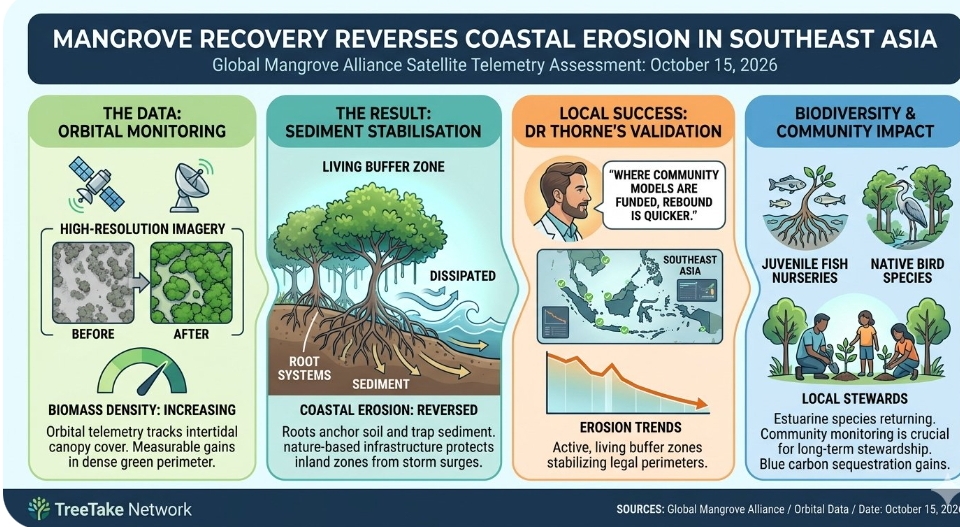
The Global Mangrove Alliance on October 15, 2026, released its latest comprehensive satellite telemetry assessment, revealing that targeted community-led replanting initiatives have successfully reversed decade-long coastal erosion trends across key Southeast Asian wetlands. The long-term tracking project indicates a measurable return of dense intertidal canopy cover, which plays a vital role in protecting vulnerable inland infrastructure from escalating tropical storm surges.
Using high-resolution orbital monitoring networks, researchers calculated changes in biomass density and sediment stabilisation across hundreds of coastal zones. "The data clearly indicates that where community restoration models are securely funded, nature-based infrastructure can rebound far quicker than previously estimated," stated Dr Marcus Thorne, a coastal ecological modeller who contributed to the global dataset. "We are seeing entire legal perimeters stabilising, which effectively creates an active, living buffer zone against rising sea levels."
The localised recovery has triggered an immediate return of critical estuarine biodiversity, particularly among native bird species and commercial fish nurseries. "The return of these ecosystems is directly linked to the health of our local fisheries," noted biological analyst Sarah Jenkins, who monitored the field validation sites. "The satellite imagery matches what we see on the ground—juvenile fish populations are rebounding because the root systems are intact again." However, the report cautions that despite these successes, adjacent aquaculture expansions continue to threaten peripheral mangrove ecosystems that lack formal statutory protection.
International climate finance organisations stress that maintaining this positive ecological trajectory requires scaling up direct capital investments into local coastal communities. Empowering coastal populations to legally monitor and maintain their adjacent marine forests remains the single most effective strategy to ensure long-term carbon sequestration and robust regional climate resilience.
Editor's Note: The documented success of the Global Mangrove Alliance restoration highlights the undeniable efficacy of localised, nature-based infrastructure solutions. To secure these fragile ecological gains against intensifying commercial developments, global environmental frameworks must pivot from short-term planting campaigns to long-term legal protection and sustainable community-led stewardship.



Leave a comment