

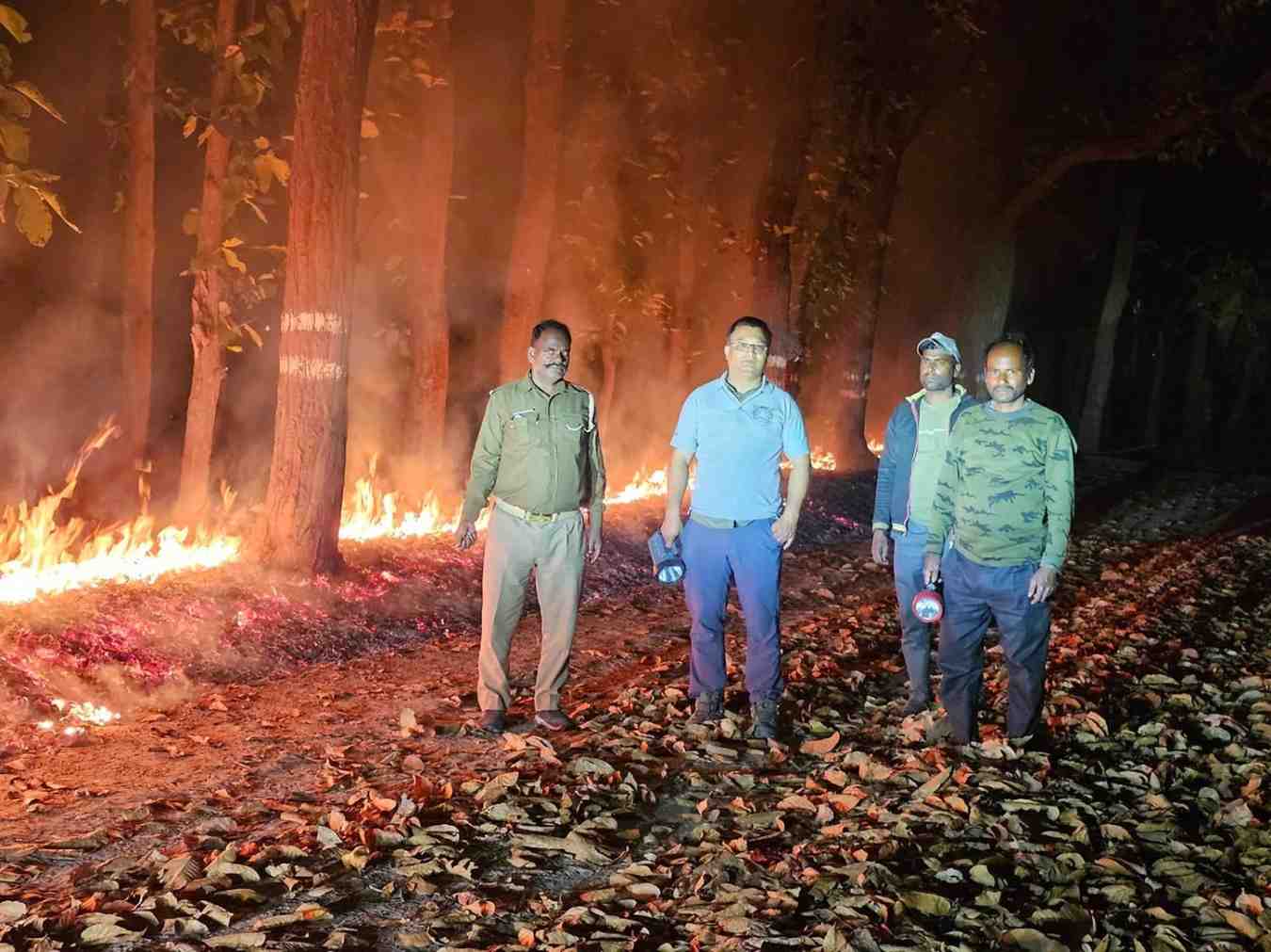
Selfless Souls
Manish Singh is an Indian Forest Service 2013-batch officer who is presently the District Forest Officer (DFO) of Pilibhit Tiger Reserve (Since March 2024). His other postings have been as follows: DFO Ghaziabad Social Forestry Division (November 2022–March 2024), DFO Sohagibarwa Wildlife Division, Maharajganj (January 2017–July 2019), DFO Bahraich Forest Division (July 2019–November 2022), DFO Bhadohi (April 2016–December 2016)…
Q: It’s been almost a year since you took charge of DFO, Pilibhit Tiger Reserve (PTR). What major challenges have you faced since then, and the solutions that you found?
Human-Wildlife conflict in the Mahof range was the immediate challenge faced by me soon after joining the Tiger reserve. A female tiger with four sub-adult cubs was operating along the boundary of Mahof village. To address conflicts, 24-hour monitoring of tigers was ensured with the help of technology, including thermal drones and camera traps, along with early morning pugmark tracing by field staff. Baagh Mitras were motivated to develop a positive communication about the steps being taken by the forest department to ensure the safety of villagers and livestock. A sub-adult male cub was rescued from close vicinity of the village to safeguard any possible human/livestock loss.
To address the human-wildlife conflict in and around PTR following measures have been taken:
1. 50 50-kilometre length of the tiger reserve has been fenced with chain-link fencing.
2. 1075 street lights have been installed in 47 human-wildlife conflict-sensitive villages through Corporate Social Responsibility.
3. Awareness is a major tool to address any problem. A dedicated programme named ‘Baagh Express’ has been implemented in human-wildlife conflict-sensitive villages where sensitisation is done through Nukkad Natak and audio-visual methods.
4. Scholarships have been given to students who lost either of their parents in human-wildlife conflict.
The Pilibhit Tiger Reserve holds great potential with respect to eco-tourism. Its geographical conditions, good vegetation, and prey base provide an ideal habitat for tigers and other wildlife, thus making PTR a potential eco-tourism hotspot. To harness this potential, it was important to channelise different activities related to eco-tourism.
The following actions were taken:
1. The whole eco-tourism area was divided into two safari zones, and it was ensured that zone-specific safari vehicle operates in the designated zone only.
2. Complete ban on private vehicles inside forest/safari routes.
3. Opening of new gates to distribute tourists and avoid congestion at one gate.
4. The new tourist campus at Sapt Sarovar was opened for tourists.
Q: Rapidly increasing man-animal conflict is no doubt one of the major issues before you. What is your strategy to ensure the animal is not always proven guilty and condemned?
Pilibhit Tiger Reserve has effectively addressed human-wildlife conflict, and cases in recent years have shown a downward trend. However, due to open boundaries and overlapping boundaries, there is always a risk of negative interaction with wildlife. In order to avoid such interaction, we are working on reaching towards co-existence rather than conflict. The Baagh Express Programme addresses potential causes which may result in negative interaction, explaining in-depth the ecology of tiger/leopard and how small steps taken by humans can avoid conflict. The Baagh Express programme has been running for the past one year and has addressed more than 1.5lakh people. However, during this period few cases of Human-Wildlife conflict resulting in human death were reported. There is a standard protocol that is followed to address animals involved in conflict; at the departmental level, we take the following measures:
1. Identification of the animal involved in conflict with the help of camera traps / thermal drones.
2. Continuous monitoring by foot-patrolling / elephant patrolling
3. Regular meetings / interactive sessions with villagers on the dos and don’ts
4. Monitoring of animal behaviour and other critical information by a veterinary doctor/biologist
With the help of the above methods, we can find out the reasons behind the conflict and accordingly plan further actions.
Q: You have good knowledge of environmental policies. What flaws would you address in the present policy if asked to?
All Tiger reserves operate under the Wildlife (Protection) Act, 1972, which provides legal protection to the wildlife defined under Section 2 of WLPA, 1972. The provisions are stringent and provide effective legal protection to wildlife in India.
Q: Tell us about some interesting cases/incidents related to wildlife you have experienced and/or resolved.
Foresters work with full dedication to protect wildlife and nature, be it the condition. One such incident took place in my career during my posting as DFO, Sohagibarwa Wildlife Division, Maharajganj. One afternoon, I got information that a female leopard was lying injured near a water channel and the range officer informed that if he waited for four-wheeler, then the animal may lose its life and told that he would carry the leopardess on bike; my initial reaction was to avoid such risky operation which may injure him as well as the staff that was accompanying him. However, considering the emergency of the situation, the range officer took the leopardess on a bike and carried it to the district veterinary hospital for treatment. This is one such incident that shows the selfless service offered by foresters in the protection of Mother Nature. The most satisfying fact is that the leopardess survived, and post-treatment, she was shifted to the Lucknow zoo.
Q: What would you like to say to those wanting to protect the remaining flora and fauna around them?
We are a part of Nature and not an independent entity; our well-being very much depends upon the health of nature, which includes all flora and fauna. We all know that we are a part of a larger ecosystem that is highly interdependent on different elements. Any disturbance in this interdependent system may result in long-term irreparable damage, leading to our own survival being put into question. Whatever fruits of development we are enjoying are coming from nature only; thus, it is our duty to protect different elements of nature.
Q: What message would you like to give on the 11th anniversary of TreeTake?
TreeTake is instrumental in bringing the smallest details of environmental issues to the common man in the simplest manner. For the past 10 years, its team has been working day and night for the protection of Mother Earth. On its 11th anniversary, I give my best wishes to the TreeTake team for a bright and successful future.



Leave a comment