

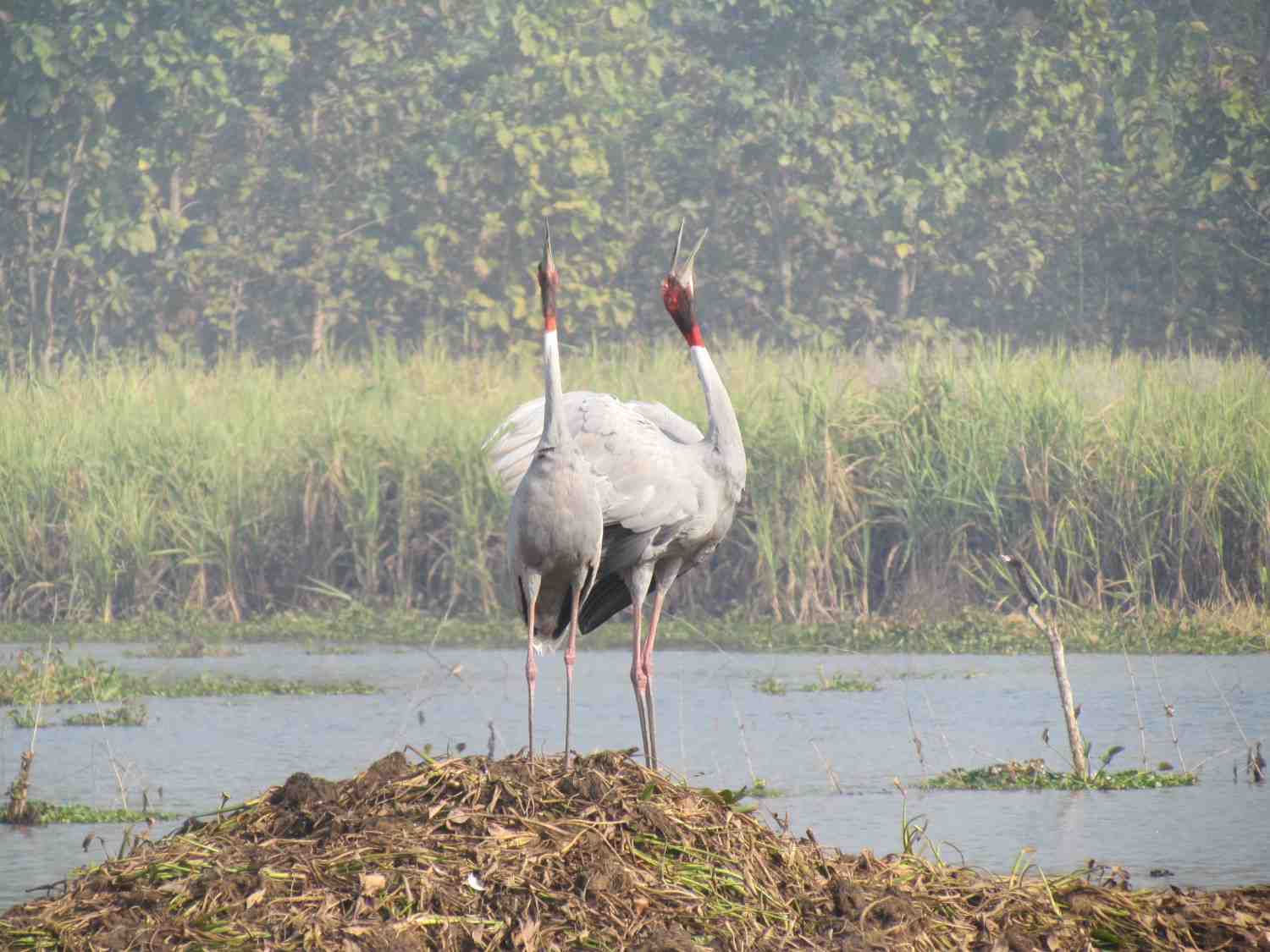
Pic by Samir Kumar Sinha of WTI
The population is going upwards in Uttar Pradesh as well as several other Indian states, thanks to community involvement in conservation. TreeTake takes a look at this heartening change in which the bird is seen as precious rather than a pest …
In an invigorating bit of news, Sarus cranes are no longer shooed away from fields. Rather, their nests and eggs are protected by farmers who chance upon them in their paddy fields, an ample illustration that community involvement can work wonders in protecting a species. Small wonder the number of Sarus in Uttar Pradesh, particularly eastern UP, is increasing. The bird, which was once driven away from fields and seen as a threat to crops and a troublemaker, is today conserved by farmers themselves who protect its nest and eggs. However, this change has not come about in a day. It is the result of years of relentless work, mainly by the Wildlife Trust of India (WTI), which worked closely with the forest department to make the farmers aware of the ecological importance of the bird and motivated them for its conservation. This is the reason that, though global populations remain categorised as "vulnerable" by the IUCN Red List, regional efforts have led to significant growth.
As the state bird of UP, the Sarus has seen a consistent surge. The 2024 summer census recorded 19,918 birds, an increase of 396 from 2023. Recent data from December 2025 in specific districts like Bareilly shows continued growth, with numbers rising to 380 from 348 the previous year.
What has pushed numbers up?
Community involvement: Programmes like the Wildlife Trust of India’s "Sarus Mitra" (Friends of the Sarus) involve local farmers in protecting nests found in paddy fields.
Agricultural synergy: They often nest in rice paddies. Farmers have shifted from viewing them as pests to beneficial "friends" that eat harmful insects.
Legal protection: This bird was upgraded to Schedule I of the Wildlife (Protection) Act in 2022, providing it with the highest level of legal protection in India.
Adaptive behaviour: In some degraded habitats, cranes have begun forming trios (three birds raising a chick) to improve survival rates, a novel behaviour that helps them adapt to environmental changes.
Jose Louies, who heads WTI as CEO and is a prominent conservation leader, said: “Basically, the Sarus is not a forest bird. It is found in wetlands. That means paddy fields in UP, particularly in the rain. So, what we initiated with the community was the Sarus Mitra Programme, in which the villagers protect the Sarus during the nesting season and after the season as well. So, when they nest, they create a bit of crop damage in and around their nest. But what we successfully managed to do is we ensured that the people understood the ecological role the bird plays. And also, it's a bird that has got a lot of cultural connections and everything. So, when we looked at the project, we were not just looking at it as a conservation project, but also at what you call the involvement of the community and the involvement of the government. Even though it is protected under the Act, it is not inside the forest, but still forest department has a role to protect the bird. So, all these factors were taken into consideration.”
Chief ecologist, WIT Samir Kumar Sinha, who is the co-principal investigator of the project, said: “The Wildlife Trust of India (WTI) has been working across 10 districts of eastern Uttar Pradesh—Bahraich, Balrampur, Barabanki, Ayodhya, Kushinagar, Maharajganj, Shrawasti, Sant Kabir Nagar, Shahjahanpur, and Siddharth Nagar—to conserve the state bird, and its habitat. This landscape comprises a mosaic of agricultural land interspersed with wetlands, which together support populations. They nest both in wetlands and in agricultural fields, primarily rice paddies. However, nesting in agricultural landscapes faces several challenges, including egg predation by stray dogs, egg theft or damage by children and disturbance or displacement of breeding pairs by farmers due to perceived crop loss during nest construction. Recognising the importance of agricultural lands and associated wetlands for conservation, the WTI initiated work with farmers through local grassroots non-governmental organisations in 2013–14, with the support of Tata Trust and later with World Land Trust. A volunteer network for Sarus conservation was established. At present, approximately 130 volunteers are actively monitoring the threats they face across the region. These volunteers conduct annual Sarus congregation site surveys and juvenile surveys, which help track population trends at the local level. As a result of sustained conservation efforts, the population in eastern Uttar Pradesh has increased from approximately 700 individuals in 2013 to 2,878 in 2025. To date, the project has facilitated the protection of 1,801 nests, with strong community participation. These efforts have established eastern Uttar Pradesh as a key landscape for conservation. WTI works closely with the forest department, Sarus Sanrakshan Samiti, Uttar Pradesh State Wetland Authority, local Krishi Vigyan Kendras and partner NGOs to conserve not only the but also the wetland habitats critical to its survival.”
He said: “Earlier, the eastern UP region was not supposed to be a good Sarus habitat in the entire UP because most of the population was recorded in the western part, mainly Etawah, Mainpuri, Etah and adjoining districts. So, we started working in this region in 2013. And at that time, our idea was to work with farmers because they live in a human-dominated landscape. They are hardly distributed inside any protected area. In 2013, we first counted the population, and around 700 sarus were there. Then we worked with, uh, several local NGOs who were working with farmers on agriculture development, and we came to know about egg stealing and the fact that farmers mainly drove away the which came to their fields for nesting. Since Sarus is culturally associated with that region, people were not killing the bird but driving it away from their fields as they thought it would destroy their crop. To some extent, when it makes its nest, it does cause damage to the rice crop. So, from 2013 onward, we started working with them, and our main focus was on engaging locals, particularly farmers. Now the Sarus has a nesting site fidelity, meaning that if the pair becomes successful in raising chicks in one area, it will return to that place the next season also. So, we sensitised the farmers, constituted volunteer groups and motivated the farmers. Initially, there were some problems: After all, why should people listen to us? But we were working with several organisations, almost 26, for agricultural development in that area. We were implementing agriculture improvement activities in the region. So, due to that, our entry became mandatory. In all their meetings or discussions, we worked with specifics and we tried to convey to them that Sarus Mitra was an indicator of good health of the system and how farming activities, such as deterioration in the Sarus ecosystem, like the use of pesticides, overuse of pesticides and also how Sarus helped them, by controlling grasshopper and other insect populations. So, all these things were done regularly. Then we started sensitising them to protect the nest. So, from 2014, 2015 onwards, each farmer started protecting the nest, and our volunteers and project staff monitored it. On World Wetland Day, we felicitated the farmers who protected the Sarus nests, and we used to organise an event in which the forest department’s senior officer or local officers would felicitate the farmers for their good work. This recognition brought a new dimension to the project. Even the media supported a lot, and this made a real impact on the ground. Now the number of Sarus cranes in eastern UP has become almost 3000. At the same time, till now we have protected almost 800 nests. Nesting success and hatching success mean that, suppose there were 10 eggs laid this season and all 10 hatched successfully. This hatching percentage is 100% hatching success. Right now, the hatching success is above 96, 97%, which is helping in bringing back the population. We have constituted a network of volunteers. They are called Saras Mitra, Wetland Mitra and then the farmers, individual farmers. And at the same time, every year we organise two population counts. And these counts are done by local volunteers. It is not done by outsiders. It is done by them only, and it is a synchronised population estimation across the landscape, across the ten districts. And the idea is not just to count but to involve the locals. They should also at least see that the number is going up or decreasing.”
DFO Ghazipur, who was earlier DFO Bahraich, was all praise for the people of the Bahraich region, saying they were fully aware and committed to protecting the bird, its nests and eggs. He said the bird laid eggs not only in fields but also on elevated bits of land amid any water-filled landscape and in the reeds along banks. The farmers who found them not only protected them but also informed the foresters who monitored them. He said nobody disturbed the eggs, and they were not stolen for eating, as it was not considered good.
Farmer and a resident of Bahraich Deepak Kumar Singh said: “We make people aware of the importance of the as a state bird and the need to protect it. The people have become very aware and immediately inform us and the forest department in case of any mishap with the bird. There has never been any killing of the bird, and its eggs are not eaten. So, the number is increasing.”
According to Pradeep Sharma, RO, Bijnor, the population of the Sarus crane had also gone up in the Nagina range of West Uttar Pradesh. Not only were the foresters going all out to conserve the bird and provide it with suitable habitats, but the farmers were also working very hard in this direction, he said.
Why protect
Protecting the Sarus crane is essential because the bird is an important ecological indicator, beneficial to agriculture, and deeply rooted in cultural heritage. Despite their significance, they are currently listed as vulnerable on the IUCN Red List due to a declining global population. Ecologically, the presence of the bird is a primary indicator of a healthy and balanced wetland ecosystem. Efforts to protect directly result in the preservation of wetlands, which provide critical services like carbon sequestration, groundwater recharge, and flood prevention. By protecting Sarus habitats, numerous other species of flora and fauna that share these ecosystems are also safeguarded. There are benefits to agriculture, too, as they feed on harmful insects, grasshoppers, and other pests that can damage crops, acting as a natural alternative to chemical pesticides. While foraging, they help loosen and aerate the soil, which can improve agricultural productivity.
In regions like Uttar Pradesh, many farmers now view the birds as "friends" rather than pests, leading to more sustainable, organic farming practices. Known for mating for life, they are revered in Indian culture as symbols of lifelong love and marital virtue. They are associated with Lord Brahma in Hindu mythology and have a legendary connection to the poet Valmiki and the origins of the epic Ramayan. This bird is the official state bird of Uttar Pradesh, making its protection a matter of regional pride and legislative priority.
Birder and biodiversity expert DR Mukul Pandya said: “It is heartening to hear and read the news that the number of s (Grus antigone ) is increasing in several districts of Uttar Pradesh. Awareness programmes for the farmers and the locals must have contributed a great deal to the increase in the number of Sarus cranes in some districts. The tallest (1.75 m) flying crane stands as vulnerable on the IUCN Red List. The main cause of the decline in the number of is its rapidly shrinking habitat: open grass-lands close to the wetlands, marshes and cultivated fields. Its name "Antigone" symbolises "worthy of one's parents" and "loyalty" as it is believed to pair for life and is hence revered by the locals. In December 2025, during my field visits in Jodhpur-jhaal in Mathura district, I noticed six pairs of s out of which two were with chicks.”
Challenges that the Sarus has been facing:
Rapid conversion of wetlands for infrastructure and housing, changing crop patterns (e.g., switching from paddy to sugarcane), are the biggest long-term threats. Collision with high-tension power lines in agricultural areas is a significant cause of mortality. Ingestion of pesticides in farmland can lead to secondary poisoning. Since they primarily live outside protected areas on private farmlands, their survival depends entirely on the cooperation and awareness of local communities. Fortunately, farmers across India, particularly in Uttar Pradesh and Madhya Pradesh, have shifted from viewing them as pests to actively serving as their primary protectors. Since these birds often nest in agricultural fields, community-driven efforts have become essential for their survival.
Protection strategies
Farmers and local volunteers, known as Friends of Sarus, identify and guard nests to prevent eggs or chicks from being stolen by poachers or eaten by predators like feral dogs. Many farmers have reduced or eliminated the use of chemical pesticides and fertilisers. This prevents the poisoning of cranes and ensures a healthy supply of insects and small aquatic life for them to eat. Farmers work with groups like the WTI to identify and protect over 100 small wetlands and village ponds used for congregation and nesting. When cranes nest in paddy fields, farmers often maintain a respectful distance and avoid disturbing the area until the chicks have successfully fledged. Trained community members provide initial first aid to injured birds and report accidents, such as electrocution from power lines, to the forest department. Village-level committees have been formed to track populations and use equipment like binoculars and cameras for documentation. There are about 12 Sarus Protection Committees in Uttar Pradesh, which track nests, record sightings and guard wetlands.
Thanks to all such efforts, the population of this graceful bird, whose motto is ‘love or die’, which is an eternal symbol of fidelity and whose friendship with a farmer Arif hit the headlines for long, has increased in many places in Uttar Pradesh, including Barabanki, Mau and Etawah. It is indeed heartening that the bird once chased away is now welcomed in paddy fields, cherished and seen as an indicator of a healthy ecosystem and healthy land. One hopes this conservation symphony grows louder with each passing day.



Leave a comment