

TreeTake Network
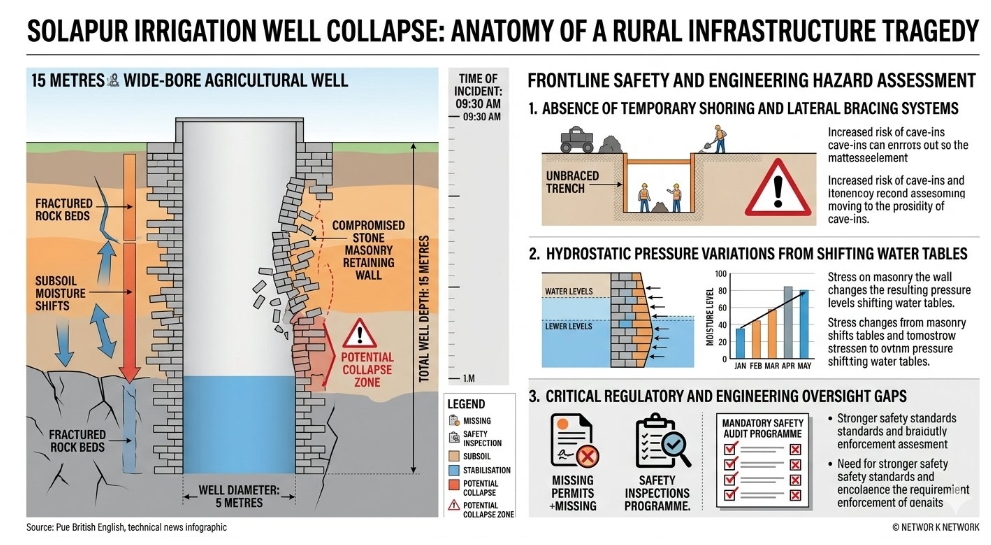
A catastrophic structural failure at an agricultural site in the Solapur district of Maharashtra has resulted in the tragic deaths of four manual labourers today, November 15, 2026. The incident occurred at approximately 09:30 AM inside the rural perimeter of Ambe village, located within the Pandharpur taluka, when the heavy stone retaining wall of a massive 50-foot-deep irrigation well suddenly collapsed. The workers had descended into the completed wide-bore structure on a farm owned by local cultivator Niwas Shinde to execute final baseline verification dimensions. A sudden shift in unstable subsoil moisture layers caused the vertical masonry structure flanking the deep excavation pit to lose structural integrity, shedding tons of concrete blocks, loose earth, and heavy clay directly onto the active workforce below, leaving them completely buried under immense physical mass.
Local rescue units, rural police, and district administrative bodies scrambled heavy earthmovers to the scene to manage the highly delicate extraction operation, following a formal dispatch request for a specialised team from the National Disaster Response Force. Despite the rapid deployment of emergency mechanical earthmovers and advanced life-detection equipment, the immense volume and weight of the collapsed masonry meant that the operation ultimately transitioned into a recovery mission. The bodies of the four deceased workers were systematically recovered from the well basin and transferred to a regional state facility for formal processing, plunging the surrounding rural communities into profound mourning.
The perilous reality of manual groundwater excavation
The physical environment surrounding deep-well digging presents an extreme, life-threatening logistical challenge for manual labourers across rural India. As changing monsoon cycles and prolonged droughts deplete shallow aquifers, communities are forced to dig progressively deeper into the earth, creating vertical pits that are highly vulnerable to catastrophic cave-ins if left unreinforced by professional engineering frameworks.
"The workers were taking final structural dimensions of the completed well when a massive mound of earth and the adjacent wall lining gave way simultaneously," stated an eyewitness from Ambe village who rushed to the edge of the pit immediately following the collapse. "We tried to clear the loose topsoil manually with shovels and ropes, but the sheer volume of the fallen stonework made it completely impossible to reach them without mechanical help. The entire village is in complete shock as these men were the sole breadwinners for their households, working under dangerous conditions simply to secure water for our agricultural survival."
Expert analysis on structural hazards and engineering deficits
Geotechnical experts and occupational safety analysts state that the absence of standardised shoring metrics during public and private agricultural digging projects creates an unacceptably high-risk environment for manual workforces. Without temporary lateral bracing systems to counteract the immense lateral earth pressure, deep shafts remain ticking environmental time bombs.
"This tragedy highlights a severe, chronic lack of safety enforcement and engineering oversight governing rural groundwater infrastructure projects," explained Dr Ramesh Kumar, a senior geotechnical engineering consultant and specialist in rural infrastructure hazards. "When digging to depths of 15 or 20 metres, the subsoil moisture profile can shift rapidly, altering hydrostatic pressure behind the masonry wall. Without structural shoring kits or formal engineering clearances, manual labourers are exposed to fatal hazards. We cannot continue to treat these catastrophic structural collapses as unavoidable rural accidents; they are systemic engineering failures that demand immediate regulatory intervention."
A solemn tribute to the frontline vanguard
The four deceased labourers have been formally identified as Mangesh More and Siddheshwar Ghadge from Ranjani village, alongside Tanaji Ghodke and Aba Ghodke from Anvali village. These men represented the true, silent vanguard of rural climate resilience, putting their lives at risk daily to construct the vital water security infrastructure that keeps regional agriculture alive.
"Our immediate, absolute priority was establishing lateral stability along the remaining segments of the well's perimeter wall to ensure the safety of the recovery teams," stated Solapur Rural Superintendent of Police Atul Kulkarni during a live operational brief at the site. "The loss of these four lives is a profound tragedy for their families and the entire district. We have registered an official case at the Pandharpur Taluka Police Station, and a thorough administrative audit will be executed to investigate the precise structural engineering deficiencies that led to this catastrophic failure, ensuring accountability for those left behind."
Editor's Note
The heartbreaking loss of Mangesh More, Siddheshwar Ghadge, Tanaji Ghodke, and Aba Ghodke must serve as a permanent turning point for rural labour safety regulations. To truly honour their memory, provincial irrigation departments must move past reactive disaster interventions by mandating formal engineering clearances for all deep-well excavations, providing standardised shoring equipment to gram panchayats, and legally enforcing strict occupational safety guidelines at rural worksites. True environmental justice and sustainable rural development can only be achieved when we integrate rigorous civil engineering oversight into agricultural infrastructure development, ensuring that the manual labourers building our collective climate resilience are never again left completely unprotected.



Leave a comment