

TreeTake Network
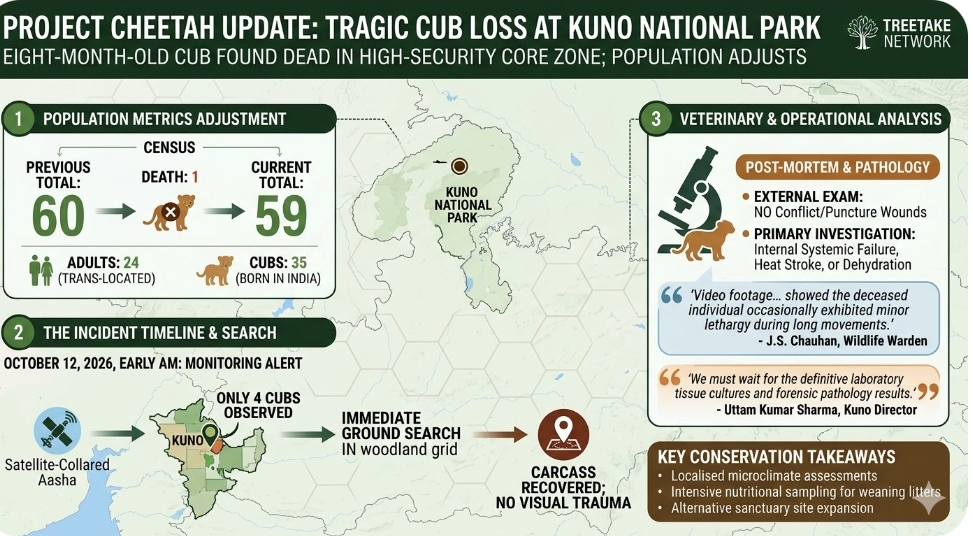
The ongoing international translocation initiative, Project Cheetah, has faced a severe structural challenge following the official retrieval of a lifeless eight-month-old cub within the high-security core zone of Kuno National Park in Madhya Pradesh. Field tracking personnel initially raised the alarm during a routine early morning monitoring operation on October 12, 2026, when satellite-collared data and visual observation confirmed that the translocated Namibian female cheetah, Aasha, was moving through the dense undergrowth with only four of her five cubs. A massive ground-search operation was deployed across the immediate woodland grid, leading monitoring teams to the hidden carcass of the missing adolescent cub.
This unexpected loss marks a painful disruption to what conservationists had previously celebrated as a major success milestone. The cub belonged to a historic litter of five born on Indian soil in February, representing the resilience of the second-generation wild population. Preliminary external examinations conducted by a specialised team of wildlife veterinarians revealed no immediate signs of physical trauma, puncture wounds, or territorial conflict with competing apex predators like leopards. The carcass has been moved to the central forensic facility for an exhaustive post-mortem, focusing heavily on internal systemic failure, potential heat stroke, or acute dehydration brought on by the unseasonal spikes in regional temperatures.
With this latest casualty, the total count of cheetahs in India under the ambitious reintroduction project shifts to 24 adults and 35 cubs born on Indian soil, bringing the living census to 59 individuals across monitored reserves. Discussing the tracking sequence and the initial state of the litter, Wildlife Warden J.S. Chauhan stated:
"The field tracking apparatus operates with round-the-clock visual checks. Video footage retrieved from the monitoring grid earlier in the cycle showed that while the healthy cubs walked aggressively with the mother, the deceased individual had occasionally exhibited minor lethargy during long movements. Our veterinary response teams are reviewing all digital tracking indicators to pinpoint any creeping physiological vulnerabilities."
Complementing this overview, Kuno National Park Director Uttam Kumar Sharma focused on the forensic path forward:
"The loss of an adolescent cub at this critical eight-month growth phase is an incredibly sensitive blow to our field teams who monitor these animals around the clock. While our immediate surveillance protocol successfully alerted us to the numerical mismatch within hours, we must wait for the definitive laboratory tissue cultures and forensic pathology results before confirming the exact underlying cause of death. Managing a wild population requires immense patience, and we remain fully committed to strengthening our field protocols."
Editor's Note
The mortality of an adolescent cheetah cub highlights the volatile biological hurdles inherent in transitioning captive-born or semi-wild lineages into an active, competitive Indian ecosystem. Moving forward, authorities must move past basic satellite tracking and invest heavily in localised microclimate assessments, intensive nutritional sampling for weaning litters, and the rapid expansion of alternative, low-density sanctuary sites to prevent lethal territorial clustering within Kuno.



Leave a comment