

The architectural limits of managing large, translocated apex carnivores within fragmented subcontinental ecosystems faced a severe operational strain today. Moving past the initial phases of enclosed micro-management, an adult male African cheetah (Acinonyx jubatus) has expanded its spatial footprint significantly, travelling deep into heavily populated agrarian buffer zones situated far outside the unfenced boundaries of the Kuno National Park in Madhya Pradesh. TreeTake presents a critical operational update on this field crisis, examining the satellite telemetry data tracking the carnivore’s movement, the immediate deployment of state tracking cells to defuse public panic, and the intense expert debates surrounding long-term habitat carrying capacities.
Satellite Telemetry and Spatial Dispersal Vectors
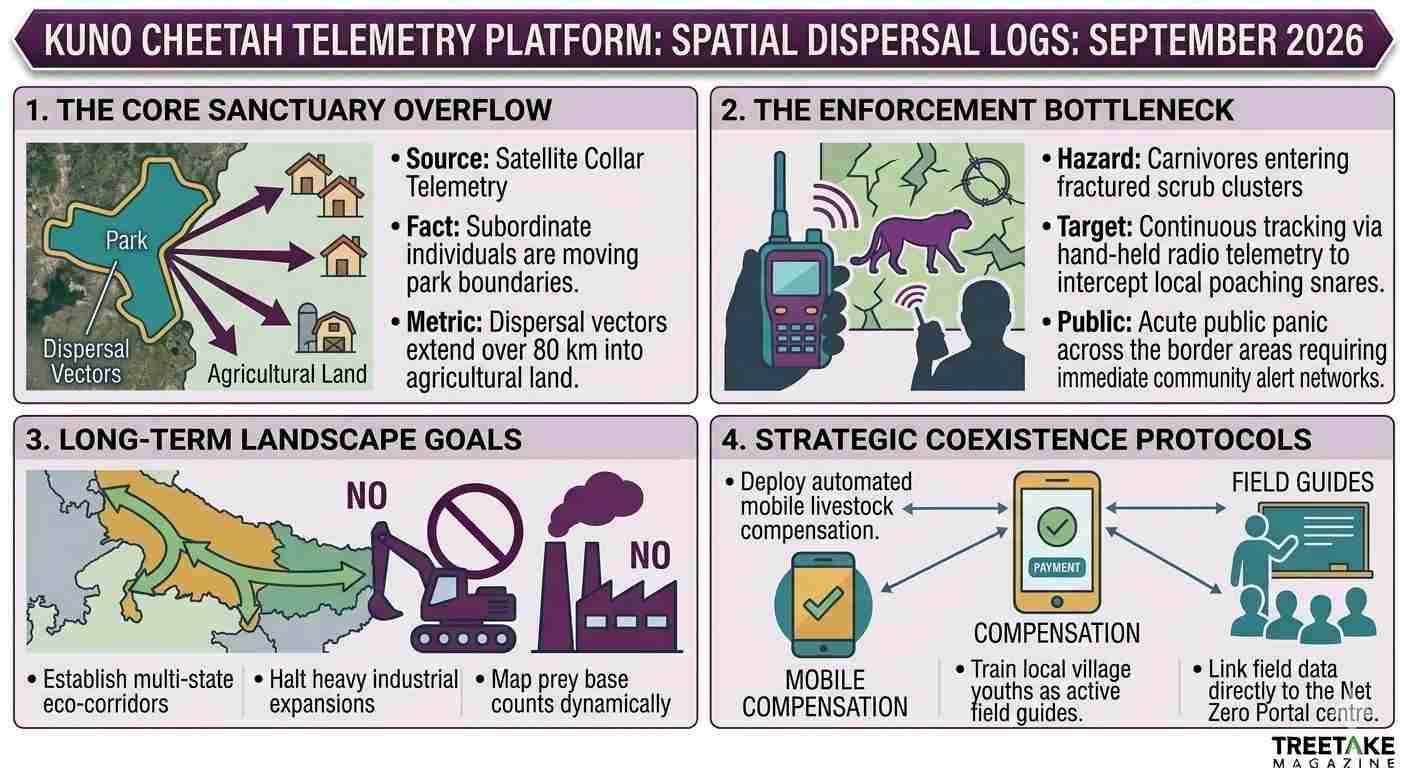
The technological monitoring grid tracking the translocated cheetah population registered a significant behavioural shift as high-resolution satellite collar logs confirmed that a subordinate male had completely exited the protective forest buffer of the sanctuary. Navigating fractured deciduous patches and crossing regional transport corridors, the large cat has charted a steady outward trajectory, establishing a temporary home range within semi-arid scrub clusters and open agricultural fields. This wide-ranging movement pattern introduces severe operational challenges for tracking teams, who must execute continuous physical monitoring to safeguard the animal from lethal infrastructure bottlenecks.
The satellite telemetry filters indicate that territorial pressure from dominant coalitions within the core park layout is forcing individual carnivores to disperse outward to locate unoccupied hunting ranges. The field data shows that the animal has moved over eighty kilometres away from its release site, adapting its stalking routines to target localised prey populations outside the reserve. To prevent the predator from stumbling into agricultural snares or domestic livestock pens, the park administration has deployed three specialised tracking cells equipped with hand-held radio telemetry receivers and tranquilising gear, working to keep a continuous visual lock on the animal’s position across the agricultural plains.
Official Monitoring Mandates and Administrative Responses
The central environment ministry has issued explicit directives to regional forest circles to prioritise community safety through real-time alerts rather than executing immediate chemical immobilisation operations. Senior conservation architects maintain that wide-ranging dispersal is a natural, expected characteristic of large feline species adjusting to a new wild landscape. "We must recognise that large coursers naturally explore vast landscape corridors, and our focus is to ensure their safe passage across human-dominated margins rather than containing them in artificial enclosures," announced a senior wildlife scientist attached to the Wildlife Institute of India during an institutional coordination brief at the project monitoring centre. He clarified that field tracking teams are collaborating with local community units to minimise friction. "Our primary focus is ensuring safe passage across these pathways by tracking telemetry data lines, educating local communities, and ensuring that any livestock loss is addressed through immediate fiscal support lines."
This flexible administrative posture has faced intense resistance from frontline forest officers and regional administrative bodies, who bear the immediate, day-to-day burden of managing public panic and livestock protection along the village edges. Local managers warn that while free-ranging dispersal looks successful on national tracking dashboards, tracking a large apex predator across open crop fields triggers severe public anxiety. "The telemetry logs showing cheetah movement across village pasture lands have triggered intense anxiety among the local agrarian communities across the border sectors," noted a senior regional forest officer responsible for field monitoring operations. He stressed that the forest department's staff is severely overstretched, trying to maintain crowd control while executing continuous physical tracking loops. "If an animal settles permanently inside community crop fields, the pressure from local panchayats to tranquilise and return the predator to an enclosed fencing setup becomes nearly impossible to resist."
The Landscape Critique and Carrying Capacity Constraints
The territorial expansion has revived a high-stakes academic debate among international large carnivore specialists and subcontinental biologists regarding the structural constraints of central India's deciduous habitats. Independent critics point out that the Kuno National Park possesses a highly restricted core area of less than seven hundred and fifty square kilometres, which is structurally insufficient to support a self-sustaining, genetically viable population without triggering inevitable, continuous outward migration.
"The current outward movement displayed by the Kuno cheetahs exposes the fundamental ecological limitation of our isolated protected area layouts," argued Dr Alok Ranjan, a senior conservation biologist specialising in subcontinental predator-prey dynamics, during an institutional evaluation session. He emphasised that traditional isolated sanctuary models cannot be sustained when surrounded by rapid infrastructure networks. "When you successfully multiply a major carnivore population within a closed, compressed sanctuary, spatial saturation occurs rapidly. The animals are not moving because they are lost; they are migrating because the territory is naturally full. Unless the government immediately transitions its strategy toward establishing large, multi-state landscape corridors that link these isolated parks to secure desert scrub networks, we will see a continuous rise in human-wildlife friction that could derail the entire conservation programme."
Strategic Pathways to Coexistence
Securing the long-term future of the translocated cheetah population requires moving beyond defensive field tracking toward proactive landscape-level integration. The Ministry of Environment must establish a permanent, automated Cheetah Conservation Corridor spanning across regional forest blocks, legally banning heavy mining expansions and high-speed infrastructure layouts within verified migration bottlenecks. Second, regional forest circles must deploy community-led stewardship models, recruiting and training local village youths as specialised conservation guides to defuse public panic and secure immediate field reporting of predator movements. Finally, the central government must establish an immutable, digital ledger for livestock compensation payments, utilising automated mobile banking to disburse market-rate financial restitution to farmers within forty-eight hours of a verified predatory strike, thereby neutralising local hostility and fostering an environment of tolerant coexistence across the expanding territorial frontiers.


.jpg?resize=120%2C90&ssl=1)



Leave a comment