

Travelogue
The Good Earth Saarang Eco-Village in Kannur, Kerala, acts as a pioneering model for reversing industrial environmental damage and protecting a global biodiversity hotspot, writes Shabil Krishnan (PERF Centre of Ecology and Biodiversity, Kozhikode)
The backbone of India was its ordinary artisans, those who transformed clay into beautiful pots and sculptures, crafted furniture from wood, built homes from mud, stone, and timber, cultivated the fields that fed the nation and grew cotton that they spun, wove and stitched into clothing with their own hands. These ordinary working people were the true custodians of India's heritage, preserving its traditional knowledge, craftsmanship and way of life. They understood the true soul of India. In the course of history, they lost their prominence in society. “We must revive and reclaim their traditional knowledge and give these forgotten souls the recognition they deserve. By restoring them to their rightful place in society, India can regain its prosperity", says Stanley George. Growing up in a home where rivers flowed freely, clouds lingered over the hills, and the landscape flourished with rich flora and fauna, Stanley was deeply shaped by the beauty of the natural world. These early experiences fostered a lasting bond with nature and laid the foundation for his vision of the Good Earth Eco Village.
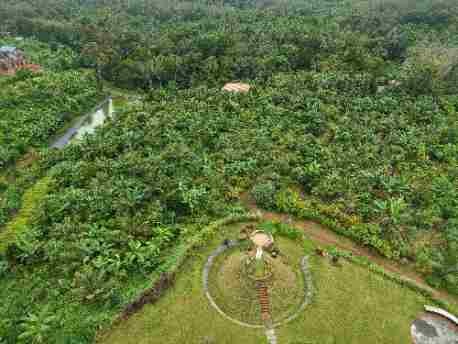
"To bring back the delicate dragonflies, lively grasshoppers, vibrant butterflies, the birds that have vanished and to restore the lost rhythms of the natural world, wouldn’t planting the native species that sustain them help revive this fragile ecosystem?” Stanley asks. My visit to the Good Earth Village in Kannur (Kerala) was with renowned geologists (seismologists) Dr Kusala Rajendran and Dr CP Rajendran. As you wander through the Good Earth Eco Village, the timeless beauty and ecological richness of the village landscape gradually unfold before you. Vibrant green meadows stretch beneath a blanket of misty clouds. Butterflies dance through the raindrops among the blooming flowers, while the fragrance of the blossoms lingers across the landscape. Chameleons peek from behind the branches, as if playing hide and seek. The landscape is alive with frogs in shades of green, black and orange, a vivid reminder of the rich biodiversity that flourishes here. There was a time when grandmothers used old folk sayings to teach children to respect the smallest creatures. A playful warning that throwing a stone at a frog would bring misfortune was not merely a superstition, but a gentle lesson in compassion towards all forms of life. For four-year-old Stanley, it was perhaps his first lesson in coexistence. With time, he came to understand that these stories carried a deeper wisdom: that the delicate bond between humans, snakes, frogs and countless other living beings was what kept the natural world in harmony.
Designed in accordance with the fundamental principles of ecology, the farm integrates traditional soil wisdom inherited through generations with modern scientific knowledge. It serves as a living learning space for generations to come. Vegetable gardens, cattle and poultry are all integrated into a single, self-sustaining farming system that thrives in abundance. The canopy of fruit trees, along with the rich greenery of native and medicinal plants, blankets the vast landscape, making it a model for biodiversity conservation. As the world faces the challenges of severe drought, natural disasters and food insecurity driven by climate change, the work of the Good Earth team stands out as an inspiring model for sustainable agricultural development in Kerala. Through its village initiatives, Good Earth creates opportunities for farmers and labourers affected by climate change to achieve sustainable livelihoods and socio-economic development. The farm has provided permanent employment to around 60 local workers, contributing to long-term stability and resilience in the region. A team comprising scientists, technologists and students is transforming wastelands across India into biodiversity-rich ecosystems under the leadership of Jeeth Lipe, co-founder and architect of Good Earth Village.
The essence of Good Earth Village is to follow the models of Laurie Baker (a British-born Indian architect who focused on cost-effective, energy-efficient architecture) and Masanobu Fukuoka (a Japanese farmer and philosopher who created ‘natural farming’), thereby making communities more self-reliant and creating greater employment opportunities. It is a practical roadmap for restoring India's greenery and water resources while addressing the challenges of water scarcity and overdependence on bore-wells. Good Earth was founded in the 1980s by a group of young entrepreneurs from the fields of architecture, agriculture and traditional crafts who were inspired by a shared vision of sustainable development. The philosophies and practices of Mahatma Gandhi, Laurie Baker, and Masanobu Fukuoka deeply influenced their work and helped shape the vision of Good Earth. Starting with sustainable housing, the initiative gradually expanded to create eco-friendly living spaces in major cities such as Bengaluru, Kozhikode and Kochi.
One of its landmark developments, the Malhar Project in Kengeri, transformed 60 acres into a community of around 600 eco-friendly houses. Committed to the well-being and healthy development of the younger generation, the project has also created recreational spaces for children in nearby villages. The revival of the drought-ridden Acheliya Lake and the restoration of the watershed in Karnataka's drought-prone Tumakuru district are among Good Earth's major achievements. Good Earth points out that the decades of excessive use of chemical fertilisers and agrochemicals, along with unsustainable farming practices, have degraded soil health. As a result, the loss of soil microorganisms, declining soil carbon levels and groundwater depletion have become major challenges for farmers. They encourage biodiversity-based farming over monoculture practices, which increase evaporation and contribute to rising atmospheric temperatures, even in regions with heavy rainfall. Through their commitment to preserving rich biodiversity, the Good Earth team has transformed degraded lands in Hunigare and Maddur into thriving organic farms. In Gundlupet and surrounding areas, they have successfully cultivated a diverse range of millets, legumes, tubers and fruit crops, promoting sustainable and biodiversity-friendly agriculture.
Guided by the ‘Return to Nature’ approach, the Good Earth team is making conscious efforts to restore the biodiversity and ecological balance of the land. This nature-centred approach has also been extended to sustainable tourism initiatives in regions such as Leh, Ladakh, Uttarakhand, and Bhutan. The Puralimala model stands as a powerful example of how development can be achieved without damaging the unique topography of the Western Ghats. On land where groundwater levels had once declined due to monoculture rubber plantations, the Good Earth team has developed a 10-acre food forest and eco-friendly homes across 15 acres, surrounded by rich flora and designed to coexist harmoniously with nature.
Through its commitment to biodiversity conservation, Good Earth has created a system that makes organic produce from its farms accessible to people at affordable prices, while spreading the message that protecting biodiversity is a collective responsibility shared by every citizen. As part of its conservation efforts, the Good Earth team supports Theyyam, a traditional temple art form and a unique cultural heritage of North Malabar.
Under its guidance, around 500 girls from local communities receive free training in Kalaripayattu. The preservation of 16 indigenous rice varieties in Muthanga, Wayanad, is another notable aspect of its work. At a time when biodiversity loss is causing significant economic and ecological damage to the country, the work of the Good Earth team serves as a powerful reminder of the need to respect and give importance to the topography, soil, climate and agricultural heritage of each region before undertaking tourism development. Their model also emphasises the importance of providing scientific knowledge about soil and crops to communities, thereby protecting the land and creating a sustainable and ecologically rich environment.
Plans are underway to build eco-friendly developments for senior citizens where they can spend their later years in serene comfort, and for environmentalists to stay, study, and conduct research. Grounded in biodiversity, the work in Good Earth Village ultimately stands as a powerful and enduring blueprint for the nation's socio-economic and agricultural future.


.jpg?resize=120%2C90&ssl=1)



Leave a comment