

Tell-All
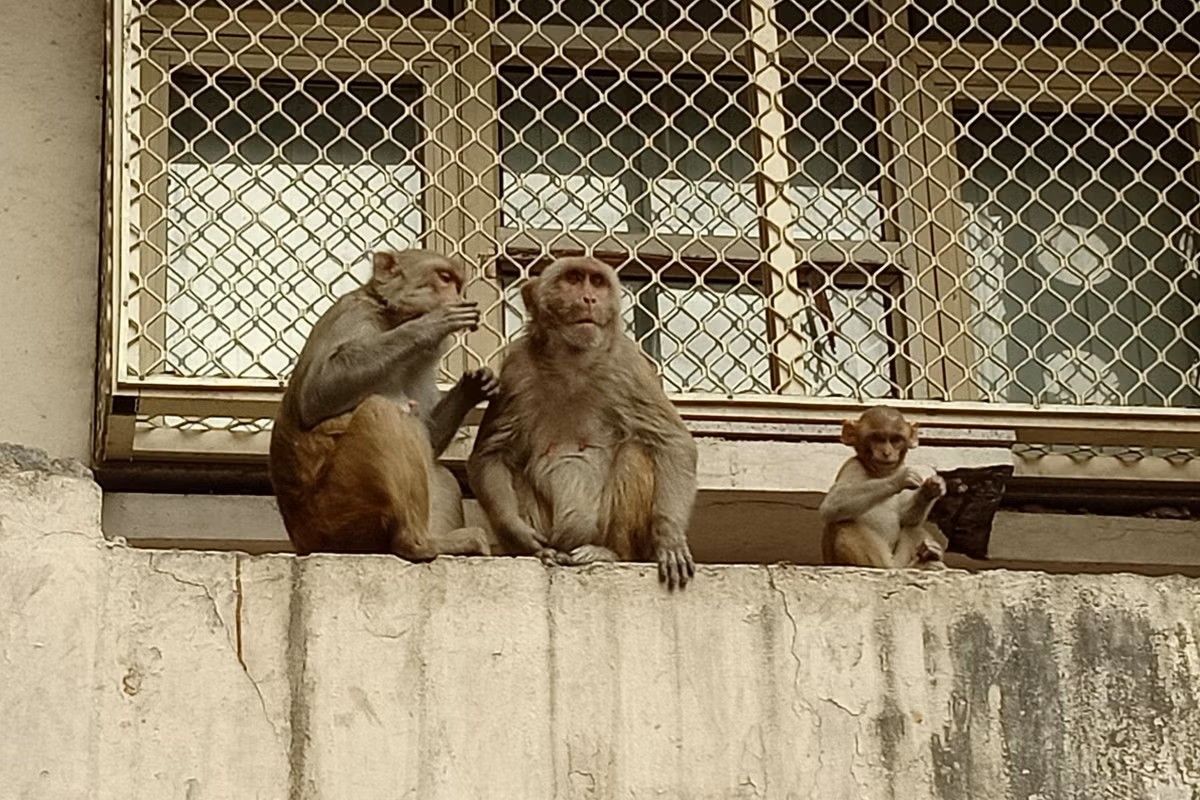
We asked: Monkey menace plagues many cities, with a lot of people getting injured and even dying in accidents. Yet no one thinks about their rehabilitation, and government departments shelve responsibility. What do you think should be done so that both simians and humans live in their spaces peacefully?
The ever-expanding city limits of urban sprawl have encroached on the natural habitat of so many wild animals that many of them have become domesticated animals. Amongst these, monkeys have remained a creature that has neither become domesticated nor remained wild. Although in terms of Darwin’s Theory of Evolution, monkeys are called the ancestors of the human being. Lately, the co-existence of monkeys and humans has become critical, where monkeys have been categorised as a menace to human beings, as the various actions of monkeys have affected humans to a catastrophic level. We critically evaluate this issue in the light of the co-existence of Homo sapiens sapiens and simians, where lately it has been observed that various acts of habitation of monkeys have become troublesome for the life and plants that are grown in city area limits. In a country like India, which is mostly religious in nature, Hindus treat them like a god (Lord Hanuman Ji) and provide shelter in the temples of the city. They are fed by people in general, considering them as deities on account of the mythological texts of Ramcharitmanas and Ramayana, where they helped Lord Rama in defeating the demon king Ravana. Having said so, let us discuss the current situation in urban and rural areas of the country, in which monkeys have become an animal with a lot of their violent tendencies, where they have attacked human beings to the extent that people have died. Their bites lead to rabies, a very torturous disease that or cause bleeding wounds; it takes months to heal. Apart from that, they are a nuisance because they tear out the cloths, pluck the plants, break the pots, throw away articles, and when moving in herds, they ruin the entire area, such as totally destroying the fields where food grains are being grown. During the season of the ripening of the fruit, they destroy the crops to a great extent. We can say the monkeys have now become a menace to the normal habitat of human beings. Under the law, the Wildlife Protection Act 1972, they are considered as wildlife animals where the two taxa, the Rhesus Macaques and Grey Langur, are the common species found in India, which need proper attention. So, under the law of India, monkeys have total protection. Therefore, killing or hunting them will be an act of violence against the monkeys. However, states like Himachal Pradesh have considered monkeys as vermin and have taken actions against the menace of monkeys by way of culling them in order to reduce the population density of these disturbing animals. The point that we wish to emphasise is that what are the possible ways by which we could avoid the menace of monkeys in the city areas. Various departments of the government, such as the Forest Department, the Wildlife Institute in India, various zoological nature parks and wildlife sanctuaries, can take effective measures to provide habitation to monkeys. We should also realise that in the discovery of new drugs, the final stage tests are made on monkeys because they are the closest species to human beings. Removing them completely may bring them to the brink of extinction. We suggest here that there should be a government-funded organisation which should be entrusted to catch them, sterilise them and then release them into jungles or wildlife sanctuaries or zoological parks or monkey habitat centres. So that they are able to survive in a natural habitat without being multiplied into thousands. It is also brought to the notice of the readers here that nowadays, the monkeys are a very big menace to agricultural areas, and farmers are the worst sufferers because these monkeys destroy their crops while moving in herds to the extent that no crops survive. They have been asking the government officials to take action, but hardly any action has been taken by the forest department. Often, people tried to call the professional monkey catchers, these catchers caught many of the monkeys and pushed them into trucks, but left them after 10–12 km only. Later, it was found that monkeys returned to the same place. It seems that the government play an active role in restricting the growth of these animals and providing alternative forested areas for their rehabilitation, and in that direction policy framework should be developed in consultation with experts so that at the national level, the monkey menace can be taken care of. The role of the general public in this direction can be restricted to stopping the offerings of food, whether in the temples or in their houses, so that their numbers are put to a controllable limit. Farmers can further reduce losses by using non-lethal deterrents, including motion-activated sound devices, reflective surfaces, and periodically repositioning dummy predators that prevent monkeys from becoming habituated. Strategically, planting buffer crops such as chillis, marigolds, mint or aloe vera around fields can naturally repel monkeys while reducing the appeal of high-risk crops like maize or bananas. Villagers can form coordinated watch groups that alert farmers when monkey troops are nearby, while improving local waste management ensures that monkeys do not become dependent on human food sources. Long-term solutions also include habitat restoration, such as planting fruit-bearing trees and ensuring the availability of water within forested areas, which can draw monkeys away from residential zones. -Namrata Singh, Department of Chemistry, and Dr Vibhuti Rai, Department of Geology, University of Lucknow
The monkey menace in our cities is real; people get injured, accidents happen, and infrastructure gets damaged. But even as we respond to these incidents and debate what should be done, we often forget something fundamental: monkeys aren’t guilty of being monkeys. They are wild animals doing what their instincts have taught them to do for thousands of years, searching for food, water, and shelter. So instead of asking how to remove them, I believe we must start by asking a more important question: what have we changed in our landscapes that makes monkeys choose to live among us? When you look closely, it becomes clear that monkeys don’t enter cities out of mischief or curiosity; they enter because we’ve made urban life surprisingly convenient for them. As forests around our cities have degraded and fragmented, monkeys have discovered that survival is easier in urban areas. Waste piles offer abundant food, leaking tanks provide uninterrupted water, and terraces and rooftops serve as safe resting places. In many ways, our cities have become accidental habitats built on convenience, convenience not for us, but for the animals we unintentionally attract. This isn’t very different from the mosquito analogy. We don’t solve the mosquito problem by eliminating every mosquito; we address the stagnant water that allows them to breed. Similarly, the presence of monkeys in cities isn’t the core issue; the conditions that attract them are. Once those conditions change, their behaviour will shift naturally, without force or conflict. But to truly understand how we reached this point, we need to examine how our cities have expanded over the last few decades. Indian cities rarely grow with long-term ecological planning. Instead, they sprawl organically, filling every available gap in a way that responds more to immediate demand than to sustainable logic. As a result, continuous forests become scattered into disconnected fragments, which I call “pocket forests.” Highways slice through wildlife corridors, railway lines separate habitat patches, and real estate developments creep into forest edges without leaving any ecological buffer. For wildlife, especially monkeys that depend on territorial continuity, these fragmented patches are not viable homes. A troop that once roamed across kilometres of forest suddenly finds itself confined to small islands of green surrounded by roads, houses, and human activity. Their instinct is simple: when their natural paths are blocked and their food sources shrink, they must explore outward. And the nearest accessible space is usually a human settlement. This breakdown of natural movement patterns also shapes evolution in ways we seldom acknowledge. The monkeys that survive near city edges, those bold enough to raid bins, climb balconies, and navigate electric wires, end up passing these adaptive behaviours to the next generation. Over time, we unintentionally create a new behavioural class of monkeys, one shaped entirely by human environments rather than forests. It is not the monkey that has changed by choice; it is the environment that has pushed them into new behaviours for survival. So, what can we do to restore balance in a way that works with nature instead of against it? I believe the answer lies in a combination of design, planning, cultural wisdom, and responsible governance. The simplest and most immediate solution is proper waste management. Open garbage is the biggest attraction for monkeys. Covered bins, timely collection, closed dumping points, and disposal sites located away from forest edges remove the primary incentive for monkeys to enter cities. If food isn’t easily accessible, they won’t invest energy in entering human zones. Good waste design is not just a matter of cleanliness; it is a behavioural gatekeeper that guides animals away from human spaces. Another uniquely Indian insight lies in our cultural relationship with monkeys. Through Hanuman worship and long-standing traditions, feeding monkeys is seen as a gesture of devotion. This sentiment cannot be ignored, and in fact, it can be transformed into part of the solution. By creating designated feeding zones within temple premises and firmly discouraging feeding elsewhere, we set predictable boundaries for both humans and animals. Monkeys are highly intelligent; they learn quickly where food is consistently available. This cultural strategy respects faith while reducing human-animal conflict. Yet cultural and behavioural interventions will fall short unless we also rethink how we build and plan our cities. Fragmentation of forests cannot be reversed entirely, but its effects can be softened. Planning departments should map existing forest patches, identify critical connection points, and create ecological buffers and green linkages that allow wildlife to move without entering dense human zones. In some places, preserving or restoring vegetated strips is enough to provide continuity. In other areas, simple animal-friendly underpasses or alignment buffers along infrastructure can help maintain movement corridors. These are not extravagant or overly technical interventions; they are pragmatic corrections to prevent long-term ecological imbalance. Quality of infrastructure matters more than we realise. Weak fixtures, exposed joints, loosely fitted components, and fragile materials make it easy for monkeys to access and damage public or private property. This is not about blaming the animals; it is about acknowledging the real-life demands placed on our built environment. Ensuring that contractors deliver as per specification, enforcing regular checks, verifying BOQs, and demanding adherence to standards can significantly reduce such vulnerabilities. There is also room here for Indian product designers and manufacturers to innovate responsibly. Infrastructure does not exist in a vacuum; it must respond to its ecological context. Components designed for environments with wildlife presence, smoother fittings, tamper-resistant materials, or modular units that can be easily serviced would not only reduce animal interference but also improve overall durability. Better infrastructure is not just animal-resistant; it benefits citizens, reduces maintenance costs, and raises the baseline quality of our public spaces. Ultimately, peaceful coexistence requires coordinated responsibility. Forest departments, municipal bodies, planning authorities, and local communities must work together. Rehabilitation cannot be limited to capturing and relocating monkeys; that approach only provides temporary relief. Real rehabilitation involves restoring habitat continuity, enforcing waste regulations, restructuring feeding practices, and educating communities about their role in reducing conflict. Monkeys live in our cities because we created the conditions that draw them in. If we change those conditions with intention, through better planning, responsible design, and respect for ecology, their need to enter our spaces will naturally diminish. This issue is bigger than wildlife management; it is a mirror reflecting how we build, how we grow, and how easily we forget the natural systems that quietly support all life. Coexistence isn’t achieved by pushing animals away. It is achieved by designing places where neither species must struggle for space. When we build with awareness instead of afterthought, when we honour both culture and ecology, we do more than solve a “monkey problem”; we create cities that are kinder, wiser, and more in harmony with the living world around us. And perhaps that is the real measure of progress: not how well we dominate nature, but how gracefully we learn to share it. Ar. Anand PJ, Architect | Sustainable Design Enthusiast
The monkey menace has become a growing concern in many cities across India. Every year, countless people are injured in encounters, road accidents caused by sudden troop movements, or aggressive behaviour triggered by feeding or habitat loss. At the same time, these incidents are often treated as isolated nuisances rather than symptoms of a deeper environmental imbalance. The truth is simple: if humans do not encroach upon the monkeys’ natural habitats, monkeys will not be forced to enter human settlements. The problem, therefore, is as much ecological as it is social. Over the years, rapid urbanisation has swallowed forest patches, hillocks, orchards, and riverbanks, spaces that once served as safe and abundant habitats for various monkey species. When food sources diminish and trees disappear, monkeys naturally search for alternatives. Cities, with their overflowing garbage, open markets, accessible rooftops, and generous human feeding habits, become easy replacements. Unfortunately, this shift brings them into stressful proximity with humans, leading to frequent conflicts. Yet, when it comes to responsibility, different government departments often pass the issue from one desk to another, while little is done on the ground. What we need is a holistic approach that respects ecological boundaries while ensuring public safety. The first step is habitat restoration. City authorities must identify and protect remaining green spaces that serve as wildlife buffers. Planting fruit-bearing trees along forest edges, preserving old groves, and preventing illegal construction in ecologically sensitive zones will help monkeys find food and shelter within their own territory. Urban planning should incorporate wildlife corridors, continuous stretches of greenery that allow animals to move without entering densely populated areas. When their own homes remain intact, monkeys feel no need to venture into ours. Secondly, public behaviour must change. Feeding monkeys, though often done out of religious sentiments or kindness, creates dependency and aggressive expectations. When monkeys associate humans with food, they lose their natural fear and begin to snatch or attack. Strict enforcement of anti-feeding laws in public spaces, along with awareness campaigns, can drastically reduce such interactions. Schools, temples, residential societies, and market areas should be educated about the long-term harm caused by intentional feeding. Third, waste management needs serious attention. Open garbage dumps act as free buffets for monkeys. Ensuring secure garbage bins, regular waste collection, and clean surroundings not only improves public hygiene but also eliminates an easy food source that attracts monkeys deeper into urban areas. Municipal bodies must prioritise this as a central strategy in reducing the conflict. Fourth, humane and scientific management is essential. Often, the response to monkey issues is reactive, capturing, relocating, or, in some tragic cases, harming them. Relocation without ecological assessment only shifts the problem from one area to another. Instead, wildlife departments should employ trained primatologists and animal welfare experts to develop long-term plans. Sterilisation programs, when conducted ethically and consistently, can help regulate growing monkey populations. Rehabilitation centres can provide temporary support for injured or displaced monkeys, but the ultimate goal should be to keep them in their natural ecosystem. Fifth, the government must clearly define responsibility. At present, monkey management falls between forest departments, municipal corporations, and wildlife authorities. A dedicated urban wildlife cell, well-funded and trained, could coordinate efforts, handle emergencies, and create policies that anticipate growth rather than merely respond to crises. Accountability is crucial; without it, the problem will continue to bounce between agencies. Finally, coexistence must be seen as a shared duty. Monkeys have lived on the subcontinent far longer than our modern cities. They are a part of our cultural heritage, religious narratives, and ecological balance. The goal is not to “remove” them but to restore harmony. That harmony begins by acknowledging that humans have a responsibility not to destroy the habitats of other species. When we respect ecological boundaries, by not encroaching on forests, by building sustainably, and by maintaining clean environments, we create a situation where both humans and monkeys can live peacefully in their respective spaces. In conclusion, the monkey-human conflict is not a problem without solutions. It is a reminder that our urban development must be compassionate, scientific, and environmentally conscious. If we protect their homes, they will not invade ours. A peaceful coexistence is not only possible, but it is also necessary for the health of our cities and the well-being of the natural world that surrounds them. -H N SINGH, Lions International Faculty, SPHEEHA Member, naturalist, HAM Radio Licensee, trekker & mountaineer
This is a critical and complex issue that requires a multi-faceted approach. A lasting solution must prioritise coexistence by addressing both the human-related factors (like food availability and habitat encroachment) and the simian-related factors (like population control and natural habitat provision). Here are key measures that should be implemented for peaceful human-simian coexistence: 1. Non-Lethal Simian Population Management: The only long-term, humane solution to reduce the monkey menace is to control their birth rate, as their high numbers drive them into cities for food. 2. Habitat Enrichment and Forest Enclosures: Translocating monkeys to new forests often fails because they lack familiarity with the new area or return due to insufficient resources. A better approach is habitat creation and rehabilitation centres 3. Modifying Human Behaviour and Infrastructure: Monkeys primarily enter cities because of the easily accessible, high-calorie food. Curbing this attraction is crucial. 4. Government Policy and Coordination: The core issue of "shelving responsibility" requires clear departmental mandates. Clear Allocation of Responsibility: Following models like Uttarakhand, the Urban Development Department should be made clearly responsible for conflict mitigation within city limits (e.g., waste management, public awareness), while the Forest Department takes the lead on scientific population control (sterilisation) and habitat creation/enclosures. Funding and Compensation: Allocate a dedicated, non-lapsable fund for monkey-related conflict management. Ensure timely and increased ex gratia payments to victims of monkey-related accidents or crop damage, which helps build public tolerance. Scientific Research: Fund long-term studies to better understand macaque troop movements, population dynamics, and the effectiveness of different mitigation strategies (e.g., different contraceptive drugs). By combining long-term population control (sterilisation) with immediate mitigation strategies (no-feeding, monkey-proofing, habitat enrichment), the conflict can be systematically reduced, leading to peaceful coexistence. -Manoj Kumar Chaturvedi, bank employee and animal activist, Lucknow, UP
मानव-वन्यजीव संघर्ष तब उत्पन्न होता है जब बंदर भोजन की कमी या आवास हानि के कारण शहरी क्षेत्रों में आते हैं। इसे कम करने के लिए, हम कई रणनीतियों का अन्वेषण कर सकते हैं। बंदरों के लिए संरक्षित क्षेत्र बनाना उनके प्राकृतिक आवासों को संरक्षित करने और मानव-बंदर संघर्ष को कम करने में मदद कर सकता है। उदाहरण के लिए, लोपबुरी, थाईलैंड में सिमियन सैंक्चुअरी बंदरों के लिए एक सुरक्षित आश्रय प्रदान करती है। प्रभावी कचरा प्रबंधन भी महत्वपूर्ण है, क्योंकि इससे बंदरों को मानव बस्तियों में आने से रोका जा सकता है। सुरक्षित कचरा निपटान प्रणालियों को लागू करना और सार्वजनिक जागरूकता बढ़ाना मदद कर सकता है। वन्यजीव गलियारे बनाना टुकड़े हुए आवासों को जोड़ सकते हैं, जिससे बंदर स्वतंत्र रूप से घूम सकें और मानव क्षेत्रों पर उनकी निर्भरता कम हो सकती है। भारत में, वाइल्डलाइफ इंस्टीट्यूट ऑफ इंडिया लैंगूर के लिए गलियारे स्थापित करने पर काम कर रहा है। बंदरों के साथ सहजीवन के बारे में सार्वजनिक शिक्षा आवश्यक है। सुरक्षित बातचीत के लिए दिशा-निर्देश, जैसे कि बंदरों को भोजन न देना और उनके पास न जाना, संघर्ष को कम कर सकते हैं। सिंगापुर में, नेशनल पार्क्स बोर्ड सामंजस्यपूर्ण सहजीवन को बढ़ावा देने के लिए शैक्षिक सामग्री और आउटरीच कार्यक्रम प्रदान करता है। स्थानीय अधिकारियों, समुदायों और वन्यजीव विशेषज्ञों के बीच सहयोग आवश्यक है। साथ मिलकर काम करके, हम मानव-बंदर संघर्ष को प्रबंधित करने के लिए प्रभावी रणनीतियाँ विकसित और लागू कर सकते हैं। डॉ. मोनिका रघुवंशी, सचिव (एन.वाई.पी.आई.), अधिकारी (एन.आर.जे.के.एस.एस.)
Topic of the month: Topic of the month: Forests, fertile fields, villages, lakes and ponds are all falling prey to urban expansion due to the uncontrolled rise in population. Amidst hue and cry over curbing the population of stray and even certain wild animals, do you think the Indian government needs to seriously shift focus on controlling the human population now, even to the degree of implementing a one-child policy and dealing strictly with IVF centres with a focus on child adoption instead? You may send your views (either in Hindi or English) in not more than 800 words along with your latest pic to [email protected].



Leave a comment